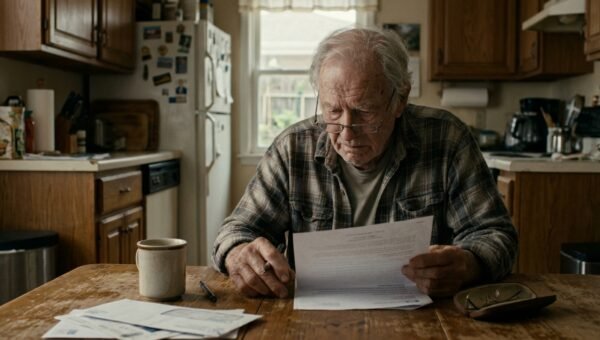
At 10:06, five minutes after Richard Cole fired me, he told me to fix the machine before I left.
My cardboard box was still beside my desk. The termination notice in my hand had 10:02 AM printed under Richard’s signature. Behind him, the assembly line alarm was flashing, and three people from maintenance had stopped what they were doing to watch.
Richard pointed at the console. “Get it running, Cal.”
I looked at the notice. “That service was free five minutes ago. Now it costs $600 an hour.”
I’m not usually quick with a line like that. I’m a calibration technician. I fix things, write down what I changed, and go home. But Richard had just ended my employment to cut overhead, and apparently expected me to keep working because he said so.
He blinked at the paper in my hand. Then he looked toward the stopped line, like the machine might take his side.
I’d worked at that plant for seventeen years. The primary assembly system made parts for a major client order due that afternoon. It was old enough to have its own habits, and complicated enough that the factory’s new contractors couldn’t reset it by poking around. I held the active license for its calibration software. I also knew the sequence that kept its pressure controls from locking up.
Richard knew I was good at the job. He didn’t know what the job involved.
At 10:00, he’d called me into his office and said the company was “restructuring.” He had a spreadsheet open with labor costs highlighted in yellow. My position, he said, was a “redundancy.”
I asked whether the maintenance contract was changing. He said he planned to bring in lower-cost contractors for routine work. Then he handed me the termination notice.
“Your last day is today,” he said.
It was a strange little meeting. Richard kept using words like efficiency and overlap. I kept looking at the clock because I had a pressure calibration due before lunch. I had told him that was important the week before. He’d said, “We’ll get to it.”
When I took the notice, I asked whether my access would stay active through the end of the shift. He said IT would handle it. I should’ve asked what that meant. Instead, I put the paper in my folder and went to collect my things.
I had a coffee mug from the union picnic and a little jar of mints I kept for the crew. The box was from a shipment of printer paper. One of the corners had split, so I was carrying it from underneath.
The machine alarm started as I reached the aisle.
Richard had cut my access before the daily pressure calibration was complete. The system saw my account go inactive while the bypass safety routine was still open, and it went into emergency halt mode. It wasn’t a random breakdown. It was the result of shutting down the wrong thing at the wrong point in the sequence.
I didn’t know that yet. I only saw the red diagnostic code blinking on the console. I knew what it meant, but I needed the full log to confirm the cause.
Richard stepped into my path before I could head for the door.
“Cal, don’t make this difficult.”
“I’m not. I’m leaving.”
“You’re still here. This is company equipment.”
“Not my equipment. And I’m not your employee.”
He tapped the termination notice with one finger. “That takes effect at the end of the day.”
I turned it around and showed him the timestamp. The line under his signature said the separation was effective at 10:02 AM.
“That’s the time you signed it,” he said.
“That’s the time your authority over my work ended.”
I said it calmly. That surprised me more than it surprised him.
The alarm kept pulsing. There was a burnt-dust smell near the console, the kind you get when a fan has been pulling lint through a warm motor housing. Behind us, one of the operators said the client’s truck was already scheduled for pickup.
Richard lowered his voice. “You’re going to help us out. We can sort out the rest later.”
I’d heard that before. “Help us out” usually meant a missed meal break, an unrecorded hour, or a fix that became my responsibility without becoming part of my paycheck.
I set the box down.
“Emergency dispatch is $600 an hour,” I said. “Four-hour minimum. I need a signed purchase order and the minimum paid before I touch the machine.”
“You can’t bill us.”
“I can, as an independent contractor.”
“You’re not a contractor.”
“Not yet. That’s why I’m asking for the paperwork.”
He glanced at the men watching us. Richard was used to having people answer him before he finished asking. The crew had learned to keep their heads down when he got that clipped sound in his voice.
He pointed at the machine again. “It’s a reset. Don’t pretend this is some big specialty job.”
“It’s a certified calibration lockout.”
“Then reset it.”
“No.”
Richard stepped closer. “You want to lose your severance over this?”
“I don’t want to lose anything. My employment ended at 10:02. You can’t call this insubordination after the fact.”
He opened his mouth, then shut it. His face wasn’t angry exactly. More like he was trying to find the old lever that had always worked.
“People here have been good to you,” he said.
That one landed, because I did care about the people there. I’d trained half the maintenance crew. I knew whose kid had just started college and who needed to leave early on Thursdays to take his mother to dialysis. I also knew how often I’d let Richard turn my loyalty into a blank check.
“I’m not asking them to pay me,” I said. “I’m asking the company.”
The line sat still. A supervisor called out that production had been down for six minutes. Someone else said the downtime estimate was climbing by the minute. Richard told him to stop saying numbers out loud.
Then Marcus Vance came onto the floor.
Marcus was the plant general manager. He wasn’t a warm man, but he listened before deciding who to blame. He came straight to the console and asked what had happened.
Richard answered first. “Cal’s refusing a simple reset.”
Marcus looked at me. “Is it simple?”
“No. The system needs the active calibration license and a controlled recovery sequence. I can do it. I won’t do it without a signed emergency dispatch.”
“Why did it stop?”
“I need the access log.”
Richard said, “It stalled on its own.”
That was the first point where I knew the paperwork mattered as much as the machine.
Marcus asked the controls operator to pull the plant log. The operator looked at Richard, who gave a short nod. A few minutes later, the log showed the account revocation at 10:05. The halt followed seconds later. It also showed the pressure calibration had not been completed.
Nobody said anything for a moment. A compressor thumped behind us.
Marcus read the lines twice. “Who ordered the access shutdown?”
Richard rubbed his thumb along the edge of his badge. “IT did it as part of the separation.”
“Who told IT to run it before the calibration cycle?”
Richard looked at me. “We didn’t know it would trip the system.”
I could’ve made him beg. I thought about it, honestly. I also thought about the operators waiting on an order they had nothing to do with, and the maintenance crew who’d be blamed if someone tried to force the restart.
So I kept it to the work.
“The recovery needs the licensed account, a pressure check, and the full reset sequence,” I said. “If someone guesses through it, we could damage the control unit or lose the calibration record.”
Marcus nodded. “Then we do it by the book.”
Richard shook his head. “We don’t have time for vendor paperwork.”
“We don’t have time not to,” Marcus said.
He asked me for my emergency dispatch terms. I had a form ready. I’d been doing small consulting jobs on weekends, mostly for local shops that couldn’t afford a full-time calibration specialist. I hadn’t planned to use it that day, but I kept the paperwork in my truck because I’d learned not to trust a handshake when money was involved.
Richard looked at the form. The top line listed my emergency rate: $600 per hour, four-hour minimum. Below it were the terms for the paid retainer and the scope of work. The plant’s downtime liability estimate was also printed there, $600,000 per hour. That wasn’t my fee. It was the documented exposure if the order missed its production window.
The invoice that went with the dispatch form showed the exact time I’d been terminated beside the emergency call. It also showed “$600,000/hr.” in the downtime exposure section. When Richard saw that figure, his eyes stayed on it.
“This says six hundred thousand an hour,” he said.
“That’s the plant’s downtime exposure, not my hourly rate. My rate is six hundred.”
He looked at Marcus. “This is ridiculous.”
Marcus read the terms himself. “The company needs a purchase order before he works. And we need a record of what happened.”
Richard’s jaw tightened. “You’re making me sign this?”
“I’m authorizing the dispatch,” Marcus said. “You’re signing as the department head approving the charge.”
Richard looked around. The crew was still there. No one was smirking. That almost made it worse for him.
He tried one last time. “Cal, we can talk about bringing you back after this.”
I said, “I’m not taking a rehire promise instead of a purchase order.”
Marcus set a pen on the form. “Sign it, Richard.”
The paper shifted under Richard’s hand. He signed. Marcus countersigned. Then the finance manager on speakerphone approved the four-hour minimum retainer, charged to Richard’s department budget. I got confirmation of the payment before I went near the console.
Richard had to stand there while the whole maintenance crew watched him approve the emergency work he’d just said wasn’t worth keeping me to do.
That part felt good. I won’t pretend it didn’t.
Then I put my box behind the console and got to work.
The system was locked hard enough that the quick reset would’ve done nothing. I checked the log, verified the pressure readings, and made sure the safety bypass had returned to its proper state. I could hear the operators talking softly behind me, then going quiet whenever I asked for a reading.
The main sensor was fine. The problem was the unfinished calibration cycle and the account shutdown. I restored the sequence under the temporary vendor credentials, ran the pressure check, and waited for the readings to hold steady.
Richard kept asking how much longer.
“Forty-five minutes,” I said.
“You said that twenty minutes ago.”
“I said it would take about forty-five minutes.”
He looked at his watch. I kept working.
The system needed a full controlled restart, not a shortcut. I followed the steps in order and checked each result before moving on. A tiny pressure drift showed up on the second pass, so I corrected it and ran the test again. It held.
The line came back up forty-five minutes after I started. The alarm stopped. The operators began calling out numbers, and the machine settled into its usual clanking rhythm.
It wasn’t magic. It was the process Richard had cut off.
Marcus asked the operator to print the downtime log. The record showed the lockout at 10:05, immediately after my credentials were revoked. He asked that it be attached to the incident report. Richard didn’t argue.
There was an internal review, I heard later. Richard’s abrupt termination process and the resulting downtime were both documented. I don’t know what happened after that, and I didn’t ask. I’d spent enough years trying to keep his problems from landing on the crew.
I closed out the work, signed the service record, and got a stamped company emergency check for the retainer. The full four-hour minimum was paid, even though the repair took less than an hour. The invoice listed my $600 hourly rate and the minimum hours. The $600,000 figure remained where it belonged, under plant downtime exposure.
Richard asked me to come back the next morning so they could “discuss options.”
“I’m available for consulting,” I said. “Under the same terms.”
He looked at my box. “You’re really leaving?”
“I was already leaving.”
I picked up the box. One of the maintenance guys held the door for me. He didn’t say anything, but he gave me a small nod. I was grateful. I’d trained him, and I’d worried he might think I’d left him with the mess.
Outside, the air smelled like wet grass and diesel. I put the box on the passenger seat, then slid the stamped corporate emergency check beside it. In the rearview mirror, the plant’s security gates opened smoothly as I drove out.
Richard had fired me to save the department money. By the time I left, he’d signed the authorization in front of the people he’d expected me to work for free.