My daughter was on the evening news, cutting a ribbon outside a safe house for runaway girls.
I hadn’t heard her voice in eighteen years. I sat down hard enough to make the old chair creak, and the local anchor kept talking while I stared at the name under the woman holding the scissors.
Elena Ruiz. Founder, The Threshold House.
The news showed her smiling for a picture. She looked older, of course.
Thirty-six now. But I knew the small crease between her eyebrows, the one she got when she was trying to listen and decide what she thought at the same time.
I called the station. I did not ask them to give me her number. That distinction might sound small. It wasn’t small to me.
The receptionist transferred me to the public affairs desk, where I asked for the shelter’s public mailing address and the name of its donation office. I wrote it down on the back of an old grocery receipt. My hand was shaking, which annoyed me. I was only asking for an address.
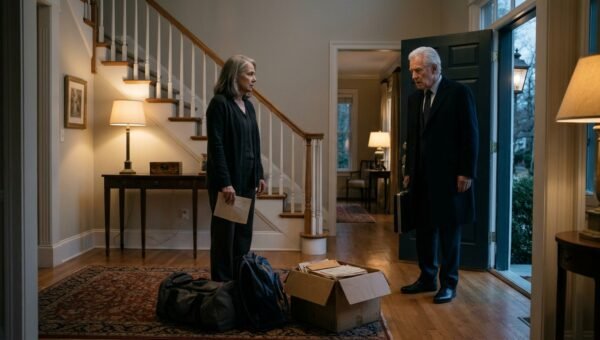
I’m sixty now. I live in the same Nebraska railroad town where Elena grew up, though the trains don’t stop as often as they used to. There’s a dining chair I keep bringing out at Christmas. I can’t claim I expect her to appear. I just haven’t been able to put the chair away.
The last time Elena spoke to me face-to-face before she left, she was eighteen. She stood in the kitchen with her duffel bag by her leg and said, “You didn’t protect me. You humiliated me.”
I had a lot to say back then. I just didn’t know how to say the part that mattered.
When Elena was sixteen, I found out she was planning to run off with a man of twenty-eight. I found it in her journal. I read it because I was snooping. There isn’t a nicer word for it. The journal was under a stack of school papers in her room, and I had no business opening it.
I’m not proud of that. I also don’t think I could have read what was inside and done nothing.
The man worked at a local business. Elena had written that they were going to leave together. She had worked out where they’d meet and what she’d take.
I don’t remember all the details now. I remember the age gap, the way she wrote about him as if he was the only person who understood her, and the date she’d circled twice.
I remember standing in her room with that journal in my hand and hearing her bedroom door shut downstairs. I put it back where I found it. Then I went to the kitchen and waited until I could hear her moving around again.
I called his boss first. My voice sounded steady. I told the boss what I’d found and what I thought the man was doing. Then I called the county sheriff. I told myself I was choosing the safest way to stop it. I did not ask Elena what she wanted, or tell her what I’d found, or give her any chance to talk to me before I brought other adults into it.
The sheriff took it seriously. The man left town within the week.
That part still matters. He was twenty-eight. Elena was sixteen. I don’t make myself feel better by pretending he was misunderstood or that I misread the danger. He was a grown man pursuing a child, and I was right to get help.
But I did it in a way that took every bit of control from her.
The calls became gossip. People in town knew something had happened, though I can’t tell you who knew what. I know Elena heard things at school. I know she stopped sitting with a couple of girls she’d been close to. She never told me the details, and I didn’t ask. I was so busy defending my actions that I didn’t notice how alone she felt.
When she found out I’d read the journal and called the sheriff, she didn’t yell. That might have been easier. She stood at the end of the hall in her socks and said, “You didn’t protect me. You humiliated me.”
I said, “I was trying to keep you safe.”
She answered, “You could’ve talked to me.”
I said she was sixteen. I said I was her mother. I said I knew what I was doing. Those words came out one after another, like fence posts I could lean on. She went quiet. I mistook that for the end of the argument.
In 2007, she turned eighteen and left with $300 and a duffel bag. I can still picture the bag because one strap was coming loose and she kept tucking it back over her shoulder. I tried to stop her at the front door. I didn’t grab her. I said her name, and she said, “I’m going.”
I let her go. I didn’t know what else I could do by then.
For years I told myself that if she needed me, she knew where I was. That was convenient for me. It made staying quiet sound like respect instead of fear. I wrote letters I didn’t mail. I sent two birthday cards to old addresses and had both come back. After that, I was afraid a real attempt would feel like another way of pushing into her life.
The first years were the worst for filling in the blanks. I knew she’d left with very little money, and my mind went over every bad thing that could happen to a young woman on her own. I’d hear a train at night and start counting miles. That’s how my head worked. It still does, sometimes.
I didn’t know she’d spent time without a steady place to sleep. I didn’t know how quickly a person can run out of cash when she’s trying to eat and keep herself safe. I didn’t know she’d found a community mentor who helped her get her feet under her, finish school, and find work.
I found that out later, from Elena herself. Not all of it on the first day. She gave it to me in pieces.
After the news broadcast, I went to the library because my old computer takes forever to load anything. I searched the shelter’s name and found its website. The mission statement talked about safety, privacy, and giving young women room to make choices. I read it twice. Then I read it again, slower.
It didn’t say anything about parents being right. It didn’t say girls had to be grateful for rescue. It didn’t say a person had to tell her whole story to get help.
I sat at that library computer longer than I needed to. I had the urge to call somebody and ask what Elena was like now, but there wasn’t anyone I could ask without turning her life into town news again. So I closed the page and wrote down the donation address.
The Threshold House had a public wish list. It asked for sturdy cookware, sheets, towels, and warm blankets. I chose blankets and cookware. Not flowers. Not a family photograph. Not anything that said, “Remember me.” Just things the house could use.
I shipped the boxes without my name. I told myself it was to keep the pressure off her. That was partly true. It was also easier than putting my name on something and finding out she didn’t want it.
About a week later, the shelter posted about its community open house. The post said visitors could tour the newly renovated building and learn about volunteer work. I stared at the screen. Then I printed the notice, folded it, and set it beside my keys.
I almost didn’t go. I changed my mind twice while driving across the county line. I thought about turning around at the gas station. I didn’t. I’d already spent too many years doing nothing because I was scared of making the wrong move.
The building was plain and clean, with a sign for The Threshold House beside the entrance. People had brought cookies and coffee. A volunteer handed me a paper name tag. I wrote my first name and left the rest blank.
Elena was speaking near the front room. She didn’t have notes in her hand. She talked about the staff and the rules they’d built around privacy. She said young women weren’t required to explain every choice they’d made before they could ask for a safe place to sleep.
I stood near the back and listened.
She had the same crease between her eyebrows. She wore a simple blue sweater, and she kept one hand resting on the edge of a table while people asked questions. Her answers were clear, not sharp. I was proud of her. I was also aware that pride can be another way of making somebody else’s work about me.
When the tour ended, I waited by the entry. I didn’t follow her from room to room. I didn’t call her name across the crowd. I let people talk to her and let the building empty out.
I held the strap of my purse and counted the minutes by the sound of cups going into the kitchen sink. I was close to leaving when Elena came down the hall. She saw me. I could tell she recognized me before she stopped walking.
She looked at my name tag. “Mom.”
“Hi, Elena.”
“I saw the boxes.”
I nodded. “I wasn’t sure if I should put my name on them.”
“I figured they were from somebody who knew the wish list.”
“I did.”
She looked at me for a second. Then she said, “Do you want to talk in my office?”
I followed her down a short hall. She kept the door open. I was grateful she did. The office was small, with a desk, a filing cabinet, and a coffee mug near the edge of the table. There were no family pictures on the wall.
I stayed standing until she pointed to a chair. Then I sat down. My hands were clasped so tightly that I had to make myself loosen them.
I’d rehearsed a lot of things in the car. None of them sounded right in that room. I could have told her I missed her, but she knew that. I could have told her I was proud, but that wasn’t why I was there.
“I’m sorry I read your journal,” I said.
She didn’t answer right away.
“I’m sorry I called your boss and the sheriff before I talked to you. I was scared, but I made the choice for you.”
“You were scared,” she said.
“I was. And I thought that made everything I did okay.”
She lowered her eyes to the desk. I watched her thumb rub the side of the coffee mug. She used to do that with a spoon when she was nervous. I almost said so. I didn’t.
“I still think he was dangerous,” I said. “I’m not going to tell you I should’ve let you go with him. I can’t say that honestly.”
“I know he was dangerous.”
I didn’t expect her to say it so plainly. My fingers were still tight around each other.
“I’m not blaming you for stopping him,” she said. “I needed you to see what happened after. You called the sheriff, and people talked. I couldn’t walk into school without wondering who knew what. Then every time I was upset, you told me it was because I was young.”
I swallowed. “I did.”
She let out a breath through her nose. “I left because staying felt like being watched all the time. I didn’t leave because I thought he was some wonderful man.”
That was the truth I hadn’t understood. I’d spent years fearing she’d gone because she wanted him, or because she believed I had no right to stop her. I’d been wrong about the shape of her anger. Her silence wasn’t loyalty to that man. It was a boundary between her and me.
“I will never apologize for stopping him,” I said. “But I am sorry for how I made you feel worthless while doing it.”
She looked at me. Her face didn’t soften right away. She didn’t rush to make the moment easier for me.
Then she breathed out and looked down at the mug again.
“Thank you for saying it that way,” she said.
I nodded. I was afraid that anything more would turn into an excuse, so I kept my mouth shut.
She told me a little about the years after she left. She’d stayed with people who didn’t always have room for her. She’d met a woman named Alma through a community program, and Alma helped her find steady work and finish school. Elena had learned what it felt like to need help and still want to be treated like a person who could make her own choices.
“I didn’t start the house because of you,” she said. “Not exactly.”
“I understand.”
“I started it because I knew that gap. Between being told to go home and being told to fend for yourself. There wasn’t much help in between.”
I wanted to ask her about every year I’d missed. I wanted to know where she’d slept, what she’d eaten, who she called when she was scared. I also knew I had no right to demand the whole account because I had finally shown up and apologized.
So I asked whether the shelter needed volunteers.
“Not right away,” she said. “We have to do background checks and training.”
“Of course.”
“I can put you on the donor list. We can exchange numbers. I’m not promising we’ll talk every week.”
“I wouldn’t ask that.”
That was true. It was also hard to say without trying to sound like a good mother. I don’t know if I managed.
She took her phone from the desk and gave me her number. I gave her mine. We didn’t hug. I didn’t try to make her. Before I left, she set a coffee mug on the table and asked whether I wanted a cup for the drive.
I said yes.
The next week, I went back with a case of winter blankets. I signed the donor sheet with my full name. Elena met me at the intake office and checked the boxes against the delivery list. We talked for six minutes, maybe seven. She told me the volunteer training dates. I told her I could come Tuesday.
There wasn’t a big reunion. No one clapped. We didn’t pretend eighteen years could be fixed by one careful conversation. But she put my number in her phone, and I put hers in mine. I left without asking her to promise anything beyond the next call.
At Christmas, I still set out the chair. This year, I won’t tell myself it means she’s coming. It’s just a chair. I can let it be that.
A week after the open house, Elena mailed me a handwritten receipt for the blankets. I pinned it to the refrigerator beside her school photograph from when she was sixteen.
The receipt says, “Thank you, Mom.”