PART 1
The little wooden skiff sat on the shelf above my workbench for four long years, covered in a thin skin of gray sawdust and cobwebs. It was fourteen inches long, carved from an offcut of white pine my late husband Harold had squared up before he passed.
Back when my daughter Laura separated from her first husband, my grandson Toby was ten years old. He was a quiet, thin boy who took the divorce hard, keeping his head down and his hands jammed into his coat pockets.
Every Saturday morning at nine sharp, Laura would drop him off at my small house in Cedar Falls. We would head straight down the basement stairs, click on the twin fluorescent shop lights, and go to work. Toby loved the smell of pine shavings. He spent hours smoothing the hull with medium-grit sandpaper, checking the curve with his small thumbs, and asking if we could stain it dark cherry so it would look like an old fishing dory.
We made a plan to finish the rudder, fit a pine mast, and drive out to Big Woods Lake on his eleventh birthday to watch it float.
Then Laura met Craig.
Craig was an area supervisor for an industrial supply company. He wore starched golf shirts, drove a spotless four-door truck, and liked to take command of every room he entered. Within eight months, Laura and Craig were married. They bought a two-story brick home in an upscale subdivision twenty miles north in Waverly.
Craig immediately announced that the family needed structure, clean schedules, and modern routines.
Almost overnight, the Saturday visits stopped.
First, Laura texted that Toby had weekend travel soccer tournaments that took up all of Saturday. Then she claimed he was enrolled in private weekend tutoring. Whenever I tried calling the home landline, Craig picked up on the second ring, his tone brisk and cold. He would inform me that Laura was busy with household errands, or that Toby was resting after training drills. When I drove up to their subdivision on Toby’s eleventh birthday with a wrapped model plane kit, Craig met me on the front porch with the storm door held open just two inches.
He told me flat out that Toby needed to bond with his new household, and that constant visits with extended family were confusing the boy’s sense of discipline. He took the box from my hands, gave me a tight, unsmiling nod, and shut the heavy oak door in my face.
A week later, Laura sent me a short text message asking me to give them space to adjust. After that, her phone number was disconnected, and the holiday cards I mailed were returned marked undeliverable.
I was sixty-four years old, living alone on a modest pension and Social Security. In Iowa, grandparents have almost no legal standing to force visitation unless parental rights are revoked or there is documented severe neglect. I did not want to push Laura into a corner or cause a bitter courtroom fight that might make life harder on Toby. So I swallowed my grief. I kept my porch light on, prayed for that boy every single night, and left the half-built pine skiff sitting untouched on my shop shelf.
Four years went by without a single phone call, school photo, or Christmas card.
Then, last Thursday afternoon, the mail carrier left a small, padded mailer in my metal box beside the driveway.
There was no return address on the corner. But the moment my fingers touched the envelope, my knees went weak.
The address was written in crooked, hurried blue ink, slanted heavily to the left. It was Toby’s handwriting, unmistakable from all the Saturday afternoons he spent labeling tool drawers in my shop.
I carried the package into the kitchen, my hands trembling so badly I could barely cut the tape with a paring knife.
Inside was a triangular piece of green polyester mesh fabric, roughly six inches tall, cut with uneven scissor edges. Across the front of the green cloth, printed in peeling white vinyl, was the number 8 and the first three letters of our local youth soccer team name. It had been cut directly out of the chest of the green uniform jersey he wore the last summer we spent together in the basement.
Folded tightly inside the cloth was a yellow sticky note.
Written across it in that same rushed, frantic ink was a single line:
He took my phone, but I hid this old prepaid flip under my floorboard.
Beneath the sentence was a ten-digit number with a local area code.
I did not stop to think. I reached for the kitchen landline, punched in the numbers, and pressed the receiver hard against my ear.
The line rang once. It clicked open before the second ring finished.
I drew in a breath to say Toby’s name, but before I could make a sound, a deep, harsh voice barked into my ear.
“I told you I was going to check the call logs on this piece of junk, Toby. Who is this?”
PART 2
The sound of Craig’s voice made my stomach drop through the floor.
“Craig,” I said, gripping the plastic receiver until my knuckles went white. “This is Evelyn.”
The line went completely dead for four long seconds. I could hear Craig’s heavy, measured breathing on the other end, followed by the dull squeak of an office chair.
“I don’t know what kind of game you think you’re playing, Evelyn,” Craig said, his voice dropping into a low, controlled threat. “I made the rules of this family crystal clear four years ago. You do not contact my home, and you do not contact Toby.”
“Toby mailed me a package, Craig,” I told him, keeping my voice as firm and steady as my shaking legs would allow. “He reached out to his grandmother. Put my grandson on the phone.”
“Toby doesn’t make decisions in this house,” Craig snapped, his temper cutting through the calm front. “He is fifteen years old, he lives under my roof, and he follows my orders. He broke house rules by concealing unauthorized electronics, and he is facing disciplinary consequences for it right now. If you ever dial this number again, or if you show up near my property, I will have the county sheriff cite you for criminal harassment. Do not test me.”
The line clicked dead.
I stood in my quiet kitchen with the dial tone buzzing in my ear, staring at that scrap of green jersey on the table. My heart was pounding like a drum. Four years ago, I had convinced myself that stepping back was the polite, peaceful thing to do. I had told myself that Craig was just strict, that Laura was just trying to build a stable marriage, and that Toby would reach out when he was grown.
Looking at that green cloth, I saw the truth. Toby had not just sent a nostalgic keepsake. He had cut up the only piece of his old life he had left, crept to a public mailbox or slipped it to a friend, and risked Craig’s wrath just to send me that one sentence. A fifteen-year-old boy does not hide a phone under a floorboard unless he is living in fear.
I knew that driving up to their house in Waverly would solve nothing. Craig would lock the gate, stand on the porch with his phone out, and have the local police turn me around before I could even see Toby’s face.
I sat down at the table and thought carefully. Laura used to work as an administrative assistant at a dental surgery clinic in downtown Cedar Falls before she remarried. She had kept her personal vehicle, an older gray sedan, registered under her own maiden name.
Early Friday morning, I drove to the high school in Waverly. I parked across the street from the bus loop at seven-thirty, watching the students file through the double glass doors with their backpacks.
At seven-forty-five, Craig’s black truck pulled into the drop-off lane.
Craig didn’t get out. The passenger door opened, and Toby stepped onto the sidewalk.
My breath caught in my throat. He had grown nearly a foot taller, his shoulders broader, but his head hung low between his collarbones. He wore an oversized dark coat, and as he walked, he kept his left arm tucked tightly against his ribs, moving stiffly toward the building without looking back at the truck.
I waited until Craig’s truck cleared the corner and turned down the avenue toward the highway. Then, I crossed the street, walked through the visitor doors, and stepped directly up to the front desk.
PART 3
The attendance secretary, a woman named Mrs. Keller, looked up from her computer screen.
“May I help you, ma’am?” she asked politely.
“My name is Evelyn Miller,” I said, setting my driver’s license squarely on the counter. “I am Toby Reynolds’s maternal grandmother. I need to speak with the principal and the school guidance counselor immediately.”
Mrs. Keller gave me a cautious look. “Family conferences require an appointment, Mrs. Miller, and our records list Mr. and Mrs. Miller-Vance as the primary guardians.”
“I am not asking for a routine conference,” I said, keeping my voice dead level, leaning over the counter so only she could hear. “My grandson mailed me a distress note two days ago. He was dropped off fifteen minutes ago favoring his left ribs and barely able to lift his school pack. You can call the principal out here right now, or you can watch me dial the Black Hawk County Department of Human Services and the child welfare intake line from this lobby.”
The secretary’s face tightened. She looked at my license, picked up her desk phone, and dialed an extension.
Five minutes later, I was sitting in a windowless conference room with the vice principal, Mr. Harris, and the school social worker, a woman named Sarah Jenkins.
I laid the padded mailer, the yellow sticky note, and the scrap of green jersey on the laminate table between them. I gave them a calm, precise timeline: the sudden cutoff four years ago, the phone call to Craig yesterday afternoon, Craig’s threats, and the way Toby had moved across the sidewalk that morning.
“Mr. Harris, I am not a hysterical woman,” I told him. “I raised two children in this county. Toby would not hide a telephone under a bedroom floorboard if he felt safe in that house. I want his physical wellbeing verified by a school nurse before he leaves this building today.”
Sarah Jenkins took the sticky note and examined the handwriting. “Toby has had six unexcused absences this semester, Mrs. Miller. His grades dropped significantly in November, and he was pulled from the junior varsity track team by his stepfather last month for what was described as a disciplinary infraction.”
She looked at Mr. Harris. The vice principal nodded once, stood up, and left the room.
Twenty minutes crawled by in complete silence. My hands were folded tightly in my lap, my chest aching with every second that passed on the wall clock.
When the door finally opened, Toby walked in behind Sarah Jenkins.
He stopped the second he saw me. His eyes went wide, his mouth parted, and all the color washed out of his face. He looked down at the table, saw the green cloth from his jersey, and his chin began to tremble.
“Grandma?” he whispered, his voice cracking like dry wood.
I stood up from the metal chair. “Come here, Toby.”
He didn’t hesitate. He took three fast strides across the linoleum, wrapped his long arms around my shoulders, and buried his face into my neck. He was fifteen years old, taller than me now, but he shook with the same desperate, silent sobs he had cried on my basement stairs when he was ten.
I held him tight, feeling the rigid tension in his back. When my hand brushed lightly against the left side of his ribs, he gasped sharply and flinched backward.
“Toby,” Sarah Jenkins said gently from the doorway, her voice quiet and professional. “You told the nurse you bruised your side falling off a ladder in the garage. Is that what really happened?”
Toby looked at me, tears streaming down his face, then looked down at his sneakers.
“Craig took the door off my room on Tuesday,” Toby whispered, his voice shaking. “He said I didn’t deserve privacy because I was lazy. When I tried to pull my dresser back to block the doorway so I could change my clothes, he shoved the dresser into me. It slammed me into the doorframe. He told me if I told anyone at school, he would send me to an out-of-state military academy and Mom wouldn’t be allowed to visit.”
ENDING
The school district did not wait for Craig to pick up his truck that afternoon.
Under Iowa mandatory reporting laws, Sarah Jenkins placed an immediate call to the county Department of Human Services and the local police department. Within forty-five minutes, a child welfare investigator and a uniformed patrol officer were sitting in the principal’s office taking Toby’s recorded statement.
A medical examination at the local clinic confirmed two cracked ribs and extensive bruising along his left torso.
When the investigator called Laura at her home, she arrived at the station an hour later, looking terrified and fragile, dressed in an old coat with her car keys clutched in white-knuckled fingers.
When the investigator laid the medical report and Toby’s sworn statement on the desk, Laura broke down completely. She confessed that Craig had taken complete financial control of their home, monitoring her bank access and using Toby as leverage whenever she threatened to leave. She had stayed out of terror that Craig’s high-priced lawyers would strip her of custody.
Seeing her son’s cracked ribs and hearing what had happened behind the removed bedroom door snapped whatever hold Craig had over her.
With the assistance of a legal aid attorney provided through the county crisis center, Laura filed an emergency petition for relief from domestic abuse and an ex parte protective order. By four o’clock that afternoon, a district judge signed the order, granting Laura temporary exclusive possession of their personal belongings and barring Craig from contacting Toby or Laura in any manner.
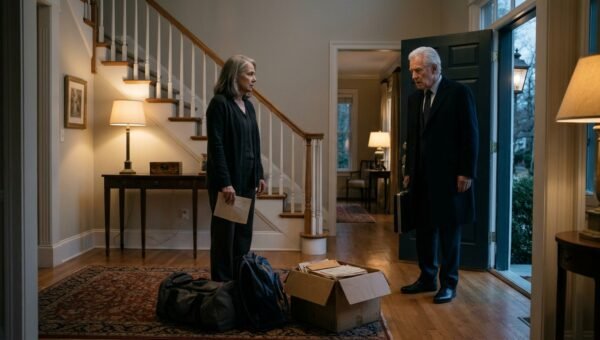
Two sheriff’s deputies escorted Laura to the house in Waverly to pack their clothes, their personal documents, and Toby’s school supplies, while Craig was served at his distribution office and ordered to surrender his keys.
By seven o’clock that evening, my small house in Cedar Falls