PART 1
The little wooden skiff sat on the high shelf above my workbench in the basement, gathering gray cobwebs and sawdust. It was eighteen inches long, carved out of clean white pine, with two brass screw-eyes for the rigging and a copper nail holding the rudder in place.
Six years ago, when my daughter Laura separated from her first husband, my grandson Toby was nine years old. He was a quiet, sensitive boy who took the divorce hard.
Every Saturday morning at nine o’clock, Laura would drop him off at my house in Cedar Rapids. We would go downstairs to my shop, put on our safety glasses, and sand that hull smooth with fine sandpaper. Toby loved working with wood. He talked about how we were going to seal the pine with marine varnish, take it down to Prairie Park Fishery, and float it across the calm water near the boat ramp.
We worked on that boat for nearly ten months. We had just finished shaping the mast when Laura met a regional sales manager named Craig.
Craig drove a big black pickup, wore expensive suits, and took charge of everything immediately. Within six months, Laura and Craig were married. They bought a large brick house in a gated development twenty miles north. Craig decided that Toby needed structure and high-level travel sports.
Almost overnight, the Saturday visits dried up.
First, Laura said Toby had weekend soccer tournaments in Des Moines. Then she claimed he had private math tutoring on Saturday mornings.
Whenever I called the house, Craig would answer and tell me Laura was busy with the new baby on the way, or that Toby was out at practice. When I drove up to their subdivision on Toby’s eleventh birthday with a wrapped present, Craig met me on the front porch with the storm door cracked just enough to talk through. He told me firmly that they were trying to establish a unified family unit with the new baby, and that frequent visits with old relatives were confusing Toby’s loyalty.
He took the wrapped box from my hands, thanked me politely, and shut the heavy front door.
Two weeks later, Laura texted me asking me to respect Craig’s boundaries. After that, her phone number was changed.
I was heartbroken. I did not want to cause a massive scene that would tear Laura apart from her new marriage, and under Iowa law, grandparents have very little legal standing unless parental rights are terminated.
So I did what many grandmothers do when they are shut out. I prayed, kept my grief to myself, and left that unfinished wooden boat sitting on the shelf as a monument to what Craig had stolen from us.
Four years crawled by. Four years without a phone call, a birthday card, or a single school photograph.
Then, on a rainy Tuesday afternoon last week, the mail carrier dropped a small, padded manila envelope into my metal mailbox.
There was no return address on the label. But as soon as I picked it up, my heart skipped a beat. The recipient line was addressed to “Grandma Evelyn” in slanted, hurried blue ink. It was the same left-handed handwriting Toby had when he practiced his spelling lists at my kitchen table.
I took the envelope into the kitchen, my hands shaking so hard I could barely hold the scissors. I sliced the top tape and reached inside.
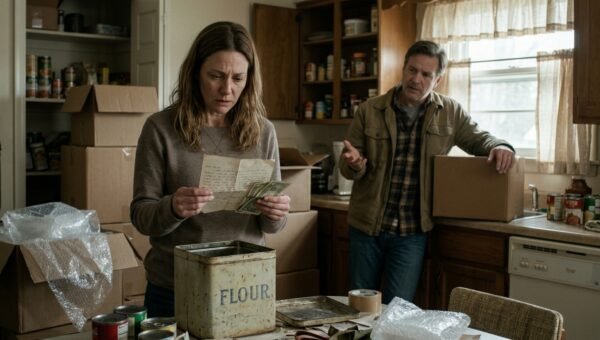
I pulled out a small piece of dark green mesh fabric, cut with dull scissors into the exact triangular shape of a boat sail. The edges were slightly frayed, but across the fabric, printed in white rubberized lettering, was the number 7 and the letters “RO-“. It was cut directly from the front chest of his old youth soccer jersey, the one he had worn the last summer we spent together.
Tucked into the fold of the green cloth was a pale yellow sticky note.
Written across it in that same rushed ink was one single sentence:
*He took my phone, but I hid the spare sim card in my dresser under the drawer.*
Underneath the sentence was a ten-digit cell phone number.
I stared at that little scrap of jersey for five minutes, tears blurring my vision. My nine-year-old boatbuilder was now fifteen, and he was reaching out through the dark.
I picked up my kitchen cordless phone and dialed the number right away. It rang once. It rang twice. On the third ring, the line clicked open.
Before I could even breathe Toby’s name, a man’s cold, irritated voice boomed through the receiver.
“I told you to quit messing with old electronics, Toby. Who is this?”
PART 2
The sound of Craig’s harsh voice on the other end of that line turned my blood to ice.
“Craig,” I said, forcing my voice to sound as steady as granite. “This is Evelyn.”
A heavy, suffocating silence fell over the line. For five seconds, the only sound was Craig’s breathing, sharp and annoyed.
“How did you get this number, Evelyn?” Craig asked, dropping his voice into a low, controlled growl. “Laura and I made our position perfectly clear four years ago. You do not contact this house directly.”
“Toby sent me a package, Craig,” I replied, refusing to back down. “I want to speak to my grandson. Put him on the phone right now.”
“Toby is a minor, and I am his legal guardian,” Craig snapped, his voice rising in irritation. “He doesn’t need old people dredging up the past and disrupting this household. He has a real family now, and he needs discipline, not coddling. Do not call this number again, or I will file harassment charges with the county sheriff.”
The line went dead with a sharp click.
I stood in my kitchen, clutching the receiver until my knuckles turned white. Craig thought that a threat of legal action would scare an old woman into silence. He thought that because I had stepped aside four years ago to avoid a scene, I was weak.
He was dead wrong.
I looked down at the scrap of green jersey and the yellow sticky note. Toby had deliberately cut up his jersey, risked getting caught, walked to a public mailbox or had a friend drop it in, and mailed it to me because he had nowhere else to turn. He had hidden a SIM card because his phone had been confiscated. A fifteen-year-old boy does not hide electronics and send secret messages unless he is living in an environment of total control and fear.
I called the library where my daughter used to work part-time, but they told me she had resigned two years ago. I called her old church, but the pastor told me the family had stopped attending when Craig took a new position at an industrial distribution center.
I knew I had to be smart. If I simply drove up to their house and pounded on the front door, Craig would call the police, claim I was trespassing, and lock Toby down even tighter. I needed to see Laura without Craig standing over her shoulder like a prison warden.
I drove across town to the dental clinic where my daughter had kept her family accounts for over a decade. The receptionist, Marsha, had been a family friend since Laura was in high school.
“Marsha, I am not asking you to break any privacy rules,” I said, leaning over the reception counter, keeping my voice low. “I only need to know if Laura still has an active appointment on your schedule.”
Marsha looked at my face, saw the red around my eyes, and tapped a few keys on her monitor. She turned the screen slightly toward me.
“She has a cleaning scheduled for tomorrow morning at nine-fifteen, Evelyn,” Marsha whispered. “She always comes alone while the kids are in school.”
PART 3
The next morning at nine o’clock, I sat in my sedan in the parking lot outside the dental clinic.
At nine-ten, a silver minivan pulled into the space two rows ahead of me. Laura stepped out.
My heart broke the moment I saw her. Four years ago, Laura had been vibrant and full of energy. Now, she moved stiffly, her shoulders hunched inward, wearing an oversized beige cardigan and keeping her eyes glued to the pavement. She looked ten years older, worn down and exhausted.
I got out of my car, walked across the asphalt, and stepped in front of the clinic walkway.
“Laura,” I said softly.
She stopped in her tracks, gasping as her head snapped up. When her eyes met mine, a look of pure terror flashed across her face, followed immediately by tears.
“Mom?” she whispered, glancing frantically around the empty parking lot as if Craig were hiding in the bushes. “What are you doing here? You can’t be here. If Craig finds out—”
“I don’t give a damn about Craig, Laura,” I said, stepping closer and taking both of her shaking hands in mine. “Look at me. Look at your mother.”
She looked up, tears spilling over her cheeks.
“Toby mailed me a package three days ago,” I told her, pulling the green triangle of jersey and the sticky note from my purse and placing them in her hands. “He cut this from his old soccer shirt. He wrote this note. And when I called that number yesterday, Craig answered and threatened me. What is happening in your house, Laura?”
Laura looked down at her son’s handwriting. A ragged sob tore out of her throat, and she collapsed against my shoulder right there on the clinic sidewalk.
I guided her into the passenger seat of my car, shut the doors, and turned on the heater.
Between choked breaths, the truth came pouring out.
Craig had systematically isolated them from everyone. After their baby was born three years ago, Craig convinced Laura to quit her job, took full control of the bank accounts, and put tracking software on all their devices. Toby had become the primary target of Craig’s temper. Craig resented Toby because he was a constant reminder of Laura’s first marriage. He demanded that Toby make the varsity soccer squad, took his phone away whenever his grades dipped below an A, and forced him to spend hours doing manual yard work while Craig inspected every chore like a drill sergeant.
“Last week, Toby told Craig he wanted to quit soccer and take shop class instead,” Laura wept, gripping my arm. “Craig lost his mind. He smashed Toby’s phone against the garage floor, took the door off Toby’s bedroom hinges, and told him he was an ungrateful freeloader. Mom, I have tried to leave. But every penny is in Craig’s name. The house is titled solely to his trust. He told me that if I ever file for divorce, he will hire top lawyers to take the baby away from me and leave Toby and me on the street.”
I sat there in the driver’s seat, listening to my only daughter describe a life of psychological captivity.
“Listen to me, Laura,” I said, my voice completely cold and resolute. “You are not trapped, and you are not penniless. Your father and I set up a family trust twenty years ago that Craig knows nothing about. I have my home, and I have