I thought keeping Karen calm would keep Maya safe, and I was wrong.
Maya came to my house with one backpack and no coat. She said she’d had a fight with her mother, said she’d hurt her arm at volleyball, and asked if she could stay “a few days.” It was cold enough that I asked twice where her coat was. She said she’d left it in the car.
I accepted that answer because it was easier than asking what she was afraid to tell me.
My sister Karen and I have always been good at making things sound smaller than they are.
We grew up in a house where you didn’t air trouble outside the family. If the sink leaked, you put a pot under it. If someone was angry, you waited until morning. That habit made me a useful sister and, in this case, not nearly a good enough aunt.
Maya was eighteen, a high school senior, and usually the sort of kid who left her shoes in the middle of a walkway and texted me a picture of every stray cat she saw. That first night she sat at my kitchen table with both hands wrapped around a mug of tea. She kept rubbing the bruise on her forearm through her sleeve.
“Volleyball?” I asked.
“Yeah. It’s nothing.”
She didn’t look up when she said it. I noticed, but I let it go.
For the next couple of days, I treated the visit like a family cooldown. I made up the guest bed.
I asked if she needed anything from home. She said no. Karen sent a text saying Maya was being dramatic, and I replied that I’d give her a day to settle down. I thought I was staying out of the middle.
That was my mistake. I was already in the middle. I just didn’t want to admit it.
On the third night, I heard a scrape from the guest room. Then another. The wooden chair legs made a dry sound against the floorboards. I went down the hall and found Maya pushing the chair under the doorknob.
“What are you doing, honey?”
She stopped with both hands on the chair back.
“Nothing. I’m just tired.”
“You’re blocking the door.”
“I know.”
I didn’t push her. I should have asked what she thought might come through it. Instead, I called Karen from the kitchen.
“She needs to come home,” Karen said.
“She says she needs a few days.”
“Make her come home.”
I remember the little pause after that. Karen sounded exhausted, but not surprised.
I told myself she was scared her daughter would run off or fall behind in school. I let the ordinary explanation win because it was familiar.
The next morning, the landline rang while I was buttering toast. I still have one because my phone drops calls in the back bedroom, and because I’m apparently the last person in town who thinks a corded phone is sensible.
A man asked for Maya by her full name.
“Who’s calling?”
“My name is Harris. I’m with loss prevention at Richard’s company. I need to speak with Maya about an access badge.”
I covered the receiver and looked toward the hall. Maya had come out of the guest room. She was barefoot. When she heard “Richard,” she grabbed the edge of the counter.
I didn’t hand her the phone. I asked Harris to call back in ten minutes, then hung up.
Maya was shaking. Not loudly or dramatically. Her fingers were just moving against the countertop like she couldn’t make them stop.
“What card?” I asked.
She went to her backpack and laid it flat on the table. She pulled a small pair of scissors from the junk drawer and started cutting at the inside seam.
“What are you doing?”
“Showing you.”
She worked the scissors under a few stitches and tugged the lining apart. A key card slid out. Richard’s company photo was printed on the front.
I knew Richard as the polished man who remembered birthdays and talked about “the numbers” at family dinners. He was a senior executive at a shipping firm. He wore pressed shirts even to cookouts. He’d helped Karen buy a newer car and redo the kitchen, and Karen liked to say she’d finally found someone who knew how to plan ahead.
The card didn’t look like much. It had Richard’s picture, his company ID, and a dark strip along the back. Maya said that strip held a digital token. The badge was needed along with his password to approve certain transfers.
“Why is it in your bag?” I asked.
She pressed her lips together. I could see her trying to decide how much I could take.
“I found him in his office,” she said.
She showed me pictures on her phone. I had to pinch the screen bigger. There were account names, routing records, and figures on a computer display. Some accounts were offshore. Others were listed as regional operating funds at Richard’s firm. Maya said she’d taken the pictures because she didn’t know what else to do.
“Did he know you saw?”
“Yeah.”
She looked at her arm.
It wasn’t a volleyball bruise. I knew that before she said it. Still, I asked.
“Did Richard do that?”
“He grabbed me.”
Her voice got smaller, not louder.
“He said I had no idea what I was looking at. I told him I was going to tell Mom. He reached for the badge, and I pulled away.”
The dark marks on her forearm were shaped like fingers. I had seen them from across the room and let her explain them away. I’d been protecting my own comfort, though I called it giving her space.
“Why didn’t you tell me?”
“I thought you’d make me go back.”
That one hurt because it was fair.
Harris called again from the company’s main office number. I gave him my name and asked him to verify his job. He did. He said Richard had reported the badge stolen that morning and named Maya as the person who had it.
The timing made me sit down.
“Did Richard say she took it?”
“He said an unauthorized person had it,” Harris replied. “He gave us her name.”
I asked if he had a record of the badge being used. Harris said he couldn’t discuss the audit by phone, but he could meet us at the company’s legal office if we brought the card and the photos. He also said Maya shouldn’t go near Richard.
I looked at the card on my table. Then I looked at Maya.
I called Karen. She didn’t answer.
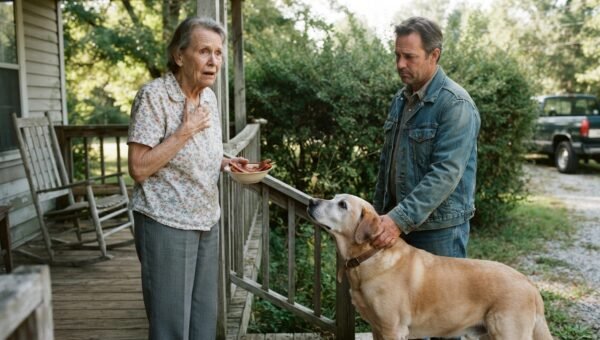
By noon, she was at my front door. I opened it but stayed in the doorway. Karen looked like she’d driven over without brushing her hair. Her eyes went past me, searching the hall.
“Where is she?”
“She’s inside.”
“I need the badge.”
“You need to ask if she’s all right.”
“She’s fine. Richard said she stole it.”
Maya came to the hall behind me. She didn’t step outside. Karen looked at her arm, but only for a second.
“Give me the card,” Karen said.
“No,” I told her.
“Do you know what this could do to him?”
I almost laughed, but I didn’t. Karen had spent years living inside the life Richard built for her. The house, the car, the kitchen she was proud of. She had a reason to fear losing it. That didn’t make her right.
“He grabbed her,” I said.
“He was trying to get company property back.”
“He grabbed your daughter.”
Karen looked down the hall, not at Maya. “Richard says those pictures are being taken out of context.”
Maya’s face didn’t change. Mine probably did.
“Did you see them?” I asked.
“He said he’d explain.”
“Then let him explain to the company.”
Karen took a step closer. I put one hand on the doorframe and didn’t move.
“Please,” she said. “I can fix this if I get the card back.”
“You can’t fix it by sending her back to him.”
“He’ll leave me with nothing.”
That was the first honest thing she’d said all morning. I felt sorry for her. I was still angry. Both things were true.
“Richard told you he’d leave?”
Karen’s eyes dropped. She said he’d promised to divorce her and cut her off if she didn’t get the badge back within the hour. She said he’d told her the company was already asking questions. She’d come because she thought returning the card could save their marriage and their money.
Maya had been right about the danger. Karen had heard her and chosen the version that hurt less.
“You’re asking me to send your daughter back to the man who left those marks,” I said.
“He’s my husband.”
“She’s your daughter.”
Karen started crying then. I didn’t open the door wider. I didn’t give her the badge. I told her she could come in if she was willing to sit down and listen to Maya, but I would not put Maya in a car with her or send her home.
Karen wiped her cheeks with her sleeve.
“You’re making this worse.”
“No. I’m done pretending it’s smaller than it is.”
That line sounded harder than I felt. My hands were shaking, so I folded them together where neither of them could see.
I took Maya to the firm’s headquarters that afternoon. I put the badge in an envelope, though I kept it in my coat pocket the whole drive. Maya sat beside me with her phone in both hands. We didn’t talk much. At a red light, she asked if I believed her.
“Yes,” I said.
She nodded and looked back at her phone.
Harris met us at the entrance with a woman from corporate legal. They took us to a small office and asked Maya to describe what had happened. I stayed beside her. When she got to the part where Richard grabbed her, she stopped.
Harris slid a box of tissues across the table.
“You don’t have to rush,” he said.
Maya took one, then showed them the pictures. The lawyer asked when she had taken them. Harris checked the card’s access record and compared it with the company’s audit log.
The room went quiet while he read.
“Richard reported this badge stolen,” he said. “He also tried to complete a transfer using the same access.”
The company’s security system needed the physical card to approve the final routing. Without it, Richard couldn’t finish moving the money or cover the record of what he’d already done. He’d tried to blame Maya before the audit reached the transfers.
I watched the lawyer write that down. It was the first time all week I saw an adult write Maya’s words as facts instead of treating them like a family problem.
The firm made a formal record of her account and the photos. The lawyer explained that Maya was being treated as a witness, not as the person who stole the badge. Harris told us Richard’s access was being shut off while the audit continued.
Not long after, security officers escorted him out of his office. I didn’t see the first part. I saw him through the glass as we were leaving, his tie loose, one hand held out as he argued with the guard beside him.
He looked toward us.
Maya didn’t look away. She didn’t wave or say anything. She held her phone against her chest and stayed beside me.
The company referred the records to federal financial investigators. Richard was detained for questioning about the transfers and the company funds. His job was gone. Karen was placed under a forensic review of the family accounts, and she was told what she could keep from the assets she had before the marriage.
None of that fixed us.
Karen started counseling after the lawyers made clear she couldn’t explain away the money or the bruise. She called Maya. Maya didn’t answer right away. I didn’t tell her she had to. I told Karen that if she wanted a relationship with her daughter, she’d have to stop asking Maya to carry Richard’s lies.
I also told her Richard was not welcome in my home or anywhere near Maya. That part wasn’t up for discussion.
Maya moved into my guest room for the rest of the school semester. She unpacked her backpack into the closet, one shirt at a time. She still apologized for taking up space. I kept telling her she didn’t have to.
That afternoon, I bought her a winter coat. It was plain, warm, and a little too big in the sleeves. She tried it on in the entryway and checked the pockets.
The bedroom door stayed open.
Her coat hangs on the peg by the front door now, where she can reach it on her way out. There’s no chair by the guest room door.