PART 1
The solid oak sewing table belonged to my mother before it belonged to me. It had iron treadle legs, two deep drawers on each side, and a center drop-leaf that held a fifty-year-old Singer machine running as quiet as a cat. When my husband passed away and my knee surgeries made maintaining my ranch-style house in Council Bluffs impossible, my son Kevin suggested I move in with him, his wife Brenda, and their ten-year-old daughter Maya.
I sold my home, placed the bulk of the proceeds into a high-yield savings account to protect my retirement, and agreed to pay twelve hundred dollars a month toward household groceries and utilities. I did not ask for much. I only wanted to bring my clothes, a cedar chest of family quilts, and that sewing table.
Two days before the moving truck arrived, Brenda stood in the doorway of the spare bedroom upstairs, crossing her arms over her chest. She looked around the twelve-by-twelve space, shaking her head.
“Evelyn, there is simply no room for that giant wooden contraption in here,” Brenda told me, her voice flat and matter-of-fact. “You need a queen bed, a dresser, and a nightstand. If you cram that antique junk in here, you won’t even be able to open the closet door. It belongs in the garage.”
“It has lived inside a heated bedroom for seventy years, Brenda,” I replied gently, trying not to start off on the wrong foot. “The wood will warp in an uninsulated garage.
I can get a twin bed instead. That table is how I make alterations, mend Kevin’s jackets, and keep my hands busy.”
“A twin bed looks like a dormitory, and this is an executive home,” Brenda said, giving an exasperated sigh. “Kevin agrees with me. The garage has plenty of space along the back wall under a drop cloth. Don’t be difficult before you even unpack your bags.”
Kevin had stayed in the kitchen during that conversation, staring down at his phone and pretending he did not hear. Rather than causing friction right away, I swallowed my pride. I bought a heavy canvas tarp, wrapped the oak cabinet carefully, and watched the movers wheel it past the kitchen and out into the cold, concrete garage.
For the first three weeks, I tried to stay invisible. Brenda ran a strict, spotless house. Everything was white quartz, gray linen, and silent surfaces.
Whenever I offered to help with dinner, Brenda politely steered me toward the sofa. Whenever I wiped down the counters, she wiped them again behind me. Kevin worked late at his logistics firm, and Maya, usually a bubbly girl whenever I visited in past years, walked through the halls like a ghost, keeping her bedroom door shut.
The first crack in that quiet surface appeared on a Thursday afternoon. Brenda was out running errands for her boutique consulting business, and Kevin was still downtown at his office. I went up the stairs to bring a stack of freshly folded laundry down the hall. Maya’s bedroom door was open a few inches.
I heard a tiny sniffle, followed by the faint rustle of stiff fabric.
I nudged the door open and looked inside. Maya was sitting cross-legged on the floor behind her desk, hunched over her dark navy private school cardigan.
She had a silver desk lamp angled down toward the carpet. In her small hands, she held a common sewing needle with black thread knotted through the eye, shaking as she tried to force it through a heavy plastic button.
Beside her knee lay an empty plastic pencil case where she had hidden the spool of thread, a tiny pair of craft scissors, and a paper envelope of cheap hand-sewing needles. Her thumb was bleeding slightly from where she had pricked the skin.
“Maya, sweetheart,” I said, stepping into the room and crouching down beside her bad knee or not. “What are you doing on the floor?”
She jumped, gasping, and immediately tried to shove the sweater beneath her legs. When she saw it was only me, tears spilled over her eyelashes.
“Please don’t tell Mom,” Maya whispered, her shoulders trembling. “She said if I tore or ruined one more piece of my uniform, she wouldn’t let me go to art camp this summer. The button popped off at recess when someone grabbed my sleeve. I found this needle in the kitchen drawer three days ago.”
I reached out and gently took the cardigan from her lap. The fabric around the buttonhole was already frayed, and the uneven stitches she had managed to push through were pulling the wool into a messy knot.
“You aren’t using a thimble, honey, and this is heavy woven wool,” I said, wiping a tear off her cheek with the pad of my thumb. “You can’t push a fine needle through double-layer suiting without hurting your fingers.”
Maya grabbed my sleeve, looking toward the hallway as if she expected Brenda to materialize out of thin air. “Can you teach me? Can you fix it? Mom inspects our clothes on Sunday nights. If she sees I lost a button, she’ll lecture me about responsibility for an hour.”
“Of course I will,” I said. “Tonight, after your parents go to sleep. Come down to the garage. My sewing box is out there. We will do it properly on the wooden table so no one hears us.”
She nodded frantically, wiping her nose on the cuff of her sleeve.
That evening at six o’clock, the front door clicked open. Kevin came in, carrying his briefcase and loosening his patterned tie. Brenda walked into the kitchen right behind him carrying takeout containers from the Italian place down the street.
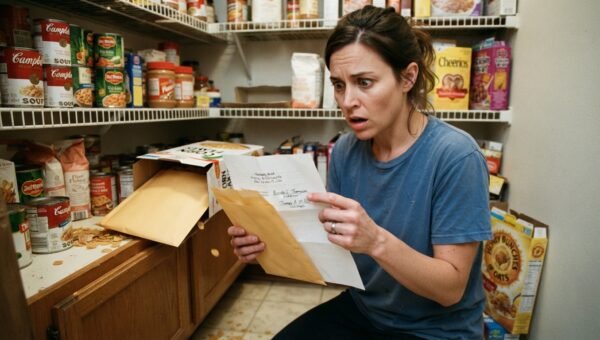
Maya had laid the cardigan on the entryway console table, intending to take it upstairs after dinner. Kevin happened to pick it up to hang it on the coat rack. He glanced down at the bottom front hem, frowning slightly. He ran his thumb along the lower edge of the navy wool.
“Brenda, look at this,” Kevin said, walking into the kitchen and holding the cardigan out beneath the bright recessed lights. “Did you take Maya’s sweater in for tailoring?”
Brenda paused with a pasta container in her hand. “No. Why would I pay for alterations on a school sweater she will outgrow in six months?”
“Look at the bottom hem,” Kevin said, his eyebrows pulling together. “There is something sewn right inside the lining. It feels like a stiff slip of paper or a card.”
PART 2
Brenda snatched the cardigan from Kevin’s hands, her polished nails digging into the dark wool. She pinched the lower hem, feeling the stiff, rectangular object sealed between the face fabric and the binding tape.
“Maya,” Brenda called out, her voice sharpening instantly. “Get in here right now.”
Maya crept into the kitchen from the hallway, her head down, her eyes wide with panic. She looked at me, terrified that her clumsy attempt to fix the front button had somehow caused this.
“What did you shove inside your sweater hem?” Brenda demanded, holding the navy cardigan up like evidence in a courtroom. “Did you hide a cheat sheet in here for a test?”
“No, Mom! I didn’t hide anything!” Maya pleaded, her voice cracking. “I didn’t even know anything was in there! I promise!”
“Don’t lie to me,” Brenda snapped. She opened the kitchen drawer, pulled out a pair of kitchen utility shears, and cut clean through the navy hem threads. She reached two fingers inside the opened seam and pulled out a crisp, folded piece of white paper, folded down to the size of a business card.
She unfolded it under the kitchen pendant lights. Kevin leaned over her shoulder, and I stepped closer from the doorway.
Written in neat, black ink were five lines of handwriting, followed by a printed logo stamp:
*St. Jude Academy Tuition Ledger – Grade 5*
*Student: Maya Reynolds*
*Term Balance Paid: $0.00*
*Notice: Second Reminder of Delinquency issued to Kevin Reynolds. Balance overdue: $4,850.00.*
Beneath the note was an administrator’s stamped warning: *Uniform inspection pass revoked until tuition clearance.*
Brenda turned slowly toward Kevin, the color draining entirely from her face. “Kevin? What is this?”
Kevin’s mouth opened, but nothing came out. His face turned a deep, blotchy red.
“The school accountant gave that to me two weeks ago when they pulled Maya out of assembly,” Maya whispered, terrified. “The lady told me to give it directly to Dad in his car, because the emails weren’t bouncing through. I forgot it was in my pocket, and when the hem came unstitched on the bench last week, I pushed it inside so I wouldn’t lose it before I saw him.”
“Overdue?” Brenda’s voice climbed an octave, trembling with sudden fury. “Kevin, we pay fourteen thousand a year for St. Jude. I transfer seven hundred dollars into our joint account every single month specifically for her tuition portion, and you cover the rest. How is there an overdue balance of nearly five thousand dollars?”
“It’s just a clerical mix-up, Brenda,” Kevin stammered, pulling at his collar. “The accounting office switched software systems last month. I told them I’d handle it at the end of the quarter.”
“A clerical mix-up does not generate a formal second delinquent notice,” Brenda said, her eyes blazing. “Where is the money, Kevin?”
“Can we not do this in front of my mother and Maya?” Kevin hissed, glaring toward me. “Evelyn, take Maya upstairs.”
I took Maya’s trembling hand and led her up to her room. We sat on the edge of her bed while the muffled shouting rose through the floorboards below. Maya clung to my arm, weeping softly, convinced the anger was all her fault.
“Listen to me, Maya,” I said softly, stroking her hair. “You did nothing wrong. The adults are having a disagreement about adult business. You are completely safe, and we are going to fix your button right now.”
I went down the back stairs to the garage, retrieved my small wicker sewing basket from the shelf above my covered oak table, and brought it back upstairs. Sitting side by side on her rug, I showed her how to thread the needle, how to position a toothpick across the button so the thread wouldn’t pull too tight, and how to wind a solid thread shank behind the plastic to keep the heavy wool from popping off again.
By nine o’clock, the cardigan was mended neatly, the front buttons firm and even. Maya was asleep beneath her comforter, exhausted from the tension.
Downstairs, the house had gone completely dead silent.
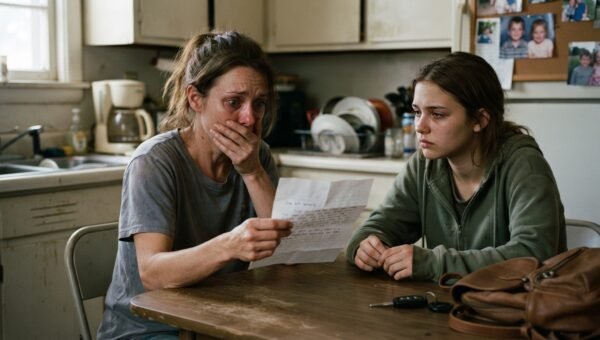
I walked down to the kitchen to get a glass of water before bed. Brenda was sitting alone at the kitchen island. The takeout food sat untouched and cold in its cardboard boxes. Her laptop was open, the bright screen reflecting off her pale face. Papers from their home filing cabinet were scattered across the quartz counter.
She did not look up when I walked in, but her shoulders were rigid.
“He took out a second line of credit against the house six months ago,” Brenda said, her voice completely dead of emotion. “Eighty thousand dollars. Gone.”
I stopped beside the island, the cold glass in my hand. “Kevin did that? What on earth for?”
Brenda turned the laptop toward me. On the screen was a brokerage transaction statement. Line after line of high-risk speculative option trades on tech startups, dated over the last seven months. Red numbers covered every single row.
“He thought he could double it, pay off our credit cards, and keep the difference without me knowing,” Brenda whispered, covering her mouth with one shaking hand. “He burned through the credit line, then stopped paying Maya’s tuition to cover the interest payments so our checks wouldn’t bounce. The school accountant told him yesterday that if the account isn’t settled by Friday morning, Maya cannot attend classes next week.”
She looked up at me, and for the first time since I arrived in her home, the sharp, defensive barrier she kept between us was gone. She was just a terrified mother looking at financial ruin.
“The bank won’t extend another dollar,” Brenda said, tears finally spilling over her eyelids. “My personal savings are tied up in inventory for my business. If I liquidate, I forfeit my contracts. I don’t know what to do.”
PART 3
I stood in that pristine, sterile kitchen for a long minute, looking at my daughter-in-law. For weeks, she had treated me like an inconvenient burden, banishing my mother’s table to the drafty garage and treating my presence like a stain on her orderly life.
It would have been easy to feel vindicated. It would have been easy to say nothing, let Kevin face the storm he had built, and quietly look for an apartment across town.
But I thought of Maya sitting on the floor, hiding a torn sweater because she was terrified of disappointing her parents. I thought of my late husband, Arthur, who always told me that family pride was the most expensive luxury in the world, and usually the most useless.
“Brenda,” I said evenly. “Close the laptop.”
She blinked at me, sniffling. “What?”
“Close the screen and sit straight. We need to talk like two grown women who care about this family.”
She shut the laptop slowly.
“I have eighty-five thousand dollars from the sale of my house sitting in a certified treasury account at First National,” I said. “It is my retirement cushion. It is not an open checkbook, and it is not a gift for Kevin to gamble with.”
Brenda’s breath hitched. “Evelyn, I couldn’t ask you—”
“You aren’t asking me,” I cut in. “I am making a business proposition. I will write a cashier’s check tomorrow morning directly to St. Jude Academy for four thousand eight hundred and fifty dollars so Maya’s schooling is protected. Then, I will pay off the delinquent balance on the secondary line of credit so the bank does not begin foreclosure proceedings on this roof over our heads.”
Brenda stared at me, her mouth slightly open. “Evelyn… that’s over thirty thousand dollars.”
“Thirty-two thousand, four hundred,” I corrected her. “And here are my terms. Kevin does not touch the household accounts again. You and I will take over the finances together. Every dollar he earns goes into a managed account with your name and my name on it until my money is fully repaid, with a legal promissory note drawn up by an attorney.”
Brenda swallowed hard and nodded. “Agreed. Whatever you want.”
“And second,” I added, looking her straight in the eye. “My sewing table comes out of the garage. Tomorrow morning. It goes into the dining room alcove where there is natural light, and Maya will spend two afternoons a week learning practical mending and sewing with me. We are done pretending this house is a magazine spread. It is going to be a home.”
Brenda lowered her forehead into her hands and let out a long, ragged sob. “I am so sorry, Evelyn. I was so stressed about keeping up appearances, about making everything look perfect while everything was slipping through our fingers. I was awful to you.”
“You were scared,” I said honestly. “Now stop crying and get some sleep. We have a bank to visit at eight-thirty.”
The next morning was not gentle. Kevin came downstairs with dark circles under his eyes, looking defensive and miserable. When Brenda set the promissory note on the table and explained what was happening, Kevin tried to argue, his face red with wounded male pride.
“Mom, you don’t need to step into my marriage,” Kevin protested, his voice tight. “I had a strategy to recover the losses next month. You’re treating me like a child.”
“Kevin,” I said, setting my coffee cup down with a firm clatter on the saucer. “You used your daughter’s school tuition to gamble on internet stocks. You stopped being the head of this household the moment you made your child hide notices in her clothes. You will sign the agreement, you will surrender your secondary bank cards to Brenda, and then you will help me wheel my oak table in from the garage.”
He looked at Brenda. Brenda’s face was set like concrete; there was no sympathy left in her eyes. Kevin looked back at me, saw the absolute lack of compromise, and dropped his shoulders.
He signed the papers.
ENDING
By noon that Friday, the cashier’s check had been hand-delivered to the front office of St. Jude Academy. The registrar handed Brenda an official receipt marked *Paid in Full*, along with an updated enrollment clearance for Maya.
Kevin spent the afternoon moving the heavy oak sewing table through the back patio doors, his shirt soaked with sweat, carefully wiping down the wood with lemon oil under my supervision. We set it right beside the large bay window in the formal living room, where the afternoon sun hit the drop-leaf surface just right.
Brenda brought down a porcelain jar of buttons that had belonged to her own mother, setting it right next to my spool rack without saying a word. That night, she didn’t wipe down the counter after I made tea; she sat down next to me and drank a cup while Kevin cleared the dishes.
On Saturday afternoon, the sun streamed through the front window, warming the dark, oiled oak. Maya sat on the matching wooden stool, running her fingertips over the cast-iron pedal underneath the frame.
“Does it really work without a battery, Grandma?” she asked, her eyes bright with wonder.
“It works on foot power and patience,” I told her, placing a scrap of sturdy cotton beneath the presser foot. “Place your foot here. When you push, the needle moves. You control the speed. If you rush, the thread snaps. If you take your time, the seam holds forever.”
She pressed down slowly, watching the silver needle rise and plunge through the clean fabric, stitching a straight, unbreakable line.
From the kitchen doorway, Brenda paused, a laundry basket resting against her hip. She watched her daughter leaning into my shoulder, listening to the steady, rhythmic click-clack of the fifty-year-old machine. Brenda didn’t say a word, but she didn’t look away either. For the first time since I moved into this house, the silence between us didn’t feel like a wall. It felt like room to breathe.