For nearly two years, I mistook my father’s quiet for a promise that I was safe. I was in my grandfather Arthur’s bicycle shop, sorting repair tags, when he saw the bruise on my shoulder. I’d kept that side turned away from him all afternoon. I thought I could get through one more visit without explaining it.
Arthur set the brass fittings on his workbench. “Who did that to you, Emily?”
“Vivian,” I said. The word came out broken.
“How?”
“She shoved me into the pantry door.”
He looked at my shoulder, then at my face. “And Richard?”
“He heard it.” I stared down at the tags. “He told me I needed to stop provoking her.”
The little clock over the sink ticked while I tried to keep my voice steady. Then Arthur pulled out the stool beside his bench.
“Sit down, sweetheart.”
I sat. I’d spent almost two years folding things away after Mom died. The bruise opened the rest. Vivian could smooth my hair in front of company and call me overwhelmed. Alone, she gripped my arm hard enough to leave marks, then said I must have bumped into something.
“She says she’s worried about me,” I told Arthur. “That I’m unstable. That I can’t be trusted with anything from Mom’s things.”
Arthur’s mouth tightened.
After Mom died, Vivian took charge of the household paperwork, including anything tied to Mom’s estate. If I asked about a box or a document, she reminded me I was living under Richard’s roof. She married my father about twenty months ago, and little by little, the house started to feel like a place where I had to ask before opening a drawer.
“Your father believes her?” Arthur asked.
I gave a short laugh. “He believes whatever makes the house quieter.”
I told him about the way Vivian called me dramatic when I flinched.
I told him Richard had looked at a bruise on my wrist and asked what I’d done to upset her. I’m not proud of this, but I’d started keeping my sleeves down even in the house. It was easier than watching my father decide what the mark meant.
Then I told Arthur about the blue inventory tag.
It had gone missing from a box of Mom’s things. Vivian accused me of taking it, even though I hadn’t seen it. When I said so, she grabbed my shoulder and spun me toward her. Richard came in after the noise.
“He said I owed her an apology,” I whispered.
Arthur folded his hands on the bench. He didn’t yell or make a speech. His anger just settled into him.
“You can stay with me,” he said. “There’s a spare room.”
“She’ll come after me.”
“Do you think she would?”
“I think she’ll say I stole from her. And Dad will believe it.”
Arthur nodded like he understood that fear wasn’t just a guess. “I won’t make promises until I check the trust.”
He crouched and unlocked a steel drawer under the workbench. The key scraped in the lock. Inside were folders, ledgers, and copied forms squared neatly beneath a tin of screws. He took out Mom’s original trust papers. She had named me her sole beneficiary, with Arthur as the secondary oversight trustee.
I read the line twice. My hands started shaking.
Beside it, Arthur placed a recent authorization form. The signature looked almost like mine.
“I didn’t sign that.”
“I know,” he said. “Vivian had no right to redirect what was yours.”
“Then where did it go?”
Arthur picked up the shop phone and called Daniel, a records clerk who had helped him check the trust filings before. I could hear Daniel ask questions over the line, then Arthur answer in short pieces.
The phone cord tapped the side of the workbench while I waited.
When Arthur hung up, he put one finger on the authorization form.
“The transfer was flagged,” he said. “Daniel’s checking where it went.”
That was the first time I understood this wasn’t only about Vivian being mean to me. Mom’s trust had been set up to protect my future. Someone had used a paper with my name on it to move the money without asking me.
Arthur could have gone to the county office alone. I wanted him to. I was tired and scared, and some part of me still thought if I stayed out of sight, Vivian might stop.
But she’d already made me doubt my own memory. I didn’t want to spend the rest of my life asking whether I was allowed to know what belonged to my mother.
“I’m coming with you,” I said.
The next morning, we drove to the county records office. The place smelled like toner and wet coats. Daniel met us near the counter and brought us into a small office with a printer that kept clicking even when nobody touched it.
He showed us the certified transaction file. The redirected trust payouts had gone into a private holding account controlled by Vivian. The amount was more than $40,000. Some of the money had covered her personal spending and old debts.
Daniel pointed to the routing details. “This account is under Vivian’s name.”
Arthur leaned closer. “And the authorization?”
“It was filed six months ago,” Daniel said. “I also pulled the notary log.”
I watched him turn a page. The notary stamp belonged to a mobile notary. The log said the form had been witnessed at our house, but I hadn’t been there. I’d been at school that day. The paperwork was supposed to make it look as if I’d signed over control because I was unstable. Vivian had been building that story before I knew there was a story.
Daniel tapped the line with the notary’s name. “This wasn’t done correctly.”
I asked him, “Can the form be stopped?”
“It can be challenged. We’ll need the original records and a full review.”
Arthur had copies of the trust. Daniel had the county file. Still, the blue tag kept coming back to me. Vivian had been so angry about a little tag. I couldn’t figure out why it mattered until Arthur said Mom’s inventory notes might help us check what had been sold.
We went back to Richard’s house while Vivian and Richard were out. Arthur had called ahead to make sure we could enter. I almost turned around at the garage door. I knew that sounds small, but my hand was on the knob and I couldn’t make it move for a few seconds.
Then I remembered Vivian’s grip on my shoulder.
“I’m not leaving without looking,” I said.
The garage attic was cramped, and the pull-down ladder made a dry creak under my foot. Arthur stayed below while I searched through the boxes. I found an old suitcase, two broken lamps, and a stack of garden chairs. Near the back, under a folded tarp, I saw the blue tag.
It was tied to a cedar chest.
The lock was old, but Arthur had brought a small tool kit from the shop. He worked the latch loose without damaging the wood. Inside were Mom’s original handwritten appraisal logs, certified serial numbers, trust correspondence, and a ledger with her neat notes in the margins.
The inventory showed which family items had been sold. Several were gone. The ledger also listed the monthly trust payments and the dates they stopped reaching the account meant for me.
I touched Mom’s handwriting. She wrote the number seven with a line through it, the way she used to label leftovers in the fridge. I hadn’t thought about that in years.
“She kept track of everything,” I said.
Arthur nodded. “She wanted you to have a clear record.”
The chest explained why Vivian wanted the tag gone. The inventory could prove what she’d sold, and the letters and trust papers could show she had no right to do it. We carried the chest inside and set it in the dining room.
We were still there when Richard and Vivian came home. Vivian looked at the papers first, then at me.
“What are you doing in my house?”
Arthur didn’t get up. He put the forged authorization beside the certified audit, then set the blue inventory tag on top of the ledger.
“This isn’t your property,” he said. “The trust belongs to Emily.”
Vivian turned to me. “She’s not well. You know how she gets.”
I wanted to answer too quickly. I’d spent so long trying to prove I wasn’t the problem that I nearly started listing every time I’d been calm, every time I’d done what she asked.
Instead, I placed my hand on the ledger.
“That’s my mother’s writing,” I said. “And that’s my name on a form I never signed.”
Vivian’s voice got sharper. “I was trying to protect the estate.”
“By putting the money in your account?” Arthur asked.
Richard stood near the doorway. He looked from the form to the records, then to my shoulder, where the bruise was still visible above my sleeve. He didn’t ask me what I’d done this time.
Arthur laid out the county audit and the notary log. He told them the authorization could be voided, and that Vivian would have to sign a restitution agreement returning the diverted funds to an escrow account supervised by him and Daniel. If she refused, Arthur said, the file could go forward for forgery and fraud. He also told her the bruise wasn’t something she could explain away on paper.
Vivian looked at Richard. “You’re going to let him threaten me?”
Richard didn’t answer at first. Then he looked at me.
“I thought you two could work it out,” he said.
“You knew she was hurting me.”
“I didn’t know it was this bad.”
“You didn’t ask.”
He rubbed his forehead. “I was trying to keep the peace.”
I had heard that line in different forms for months. It had always meant I should be quieter, less upset, easier to live with. I looked at my father and understood that his silence wasn’t a shield around me. It was a choice that left me alone with her.
Vivian signed the restitution agreement that afternoon, with Arthur and Daniel making sure the terms were clear. The county voided the forged authorization, and the money was moved back under the trust’s proper oversight. The legal process didn’t fix what had happened in the house, but at least Vivian could no longer control my money or decide what records I was allowed to see.
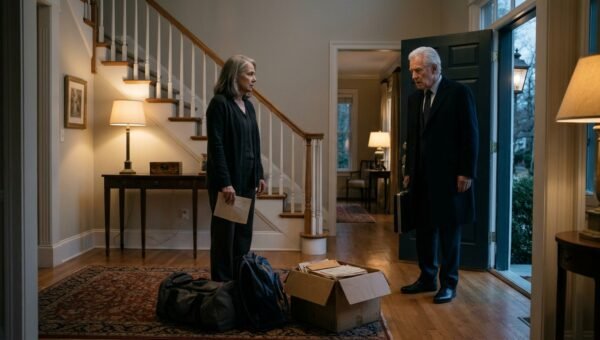
Richard caught me as I started packing.
“Please don’t leave like this,” he said. “We can handle it quietly, as a family.”
I folded one of Mom’s sweaters and put it in the box.
“You had two years to handle it,” I said.
“I’m your dad.”
“I know.”
He asked if I’d call him. I didn’t promise. I wasn’t ready to make his feelings easier just because mine had been inconvenient for him.
I moved into Arthur’s spare room that afternoon with Mom’s letters, the ledger, and the things left in the cedar chest. Arthur didn’t ask me to explain myself again. He carried the box upstairs and went back down to the shop.
I put Mom’s brass-framed photograph on the nightstand. Then I smoothed the blue inventory tag flat beside it.
Below me, the bicycle gears clicked in their steady little rhythm. The tag had marked the chest Vivian hid. Now it sat beside Mom’s photograph in a room where I could sleep with the door unlocked.