The mobile above Lily’s bassinet made a soft clicking sound whenever the wind moved the glass. I’d picked it because it was quiet, which seemed like a good thing when I was trying to get a newborn to sleep. By that evening, even the little click felt loud.
The hospital estimates were spread across the small table beside Lily’s bottles. I was in the conservatory nursery, still sore from giving birth, with my stitches pulling whenever I bent down.
I’d only had the cancer diagnosis for a few days. I knew the name of it, but I still kept thinking the doctor must have meant somebody else.
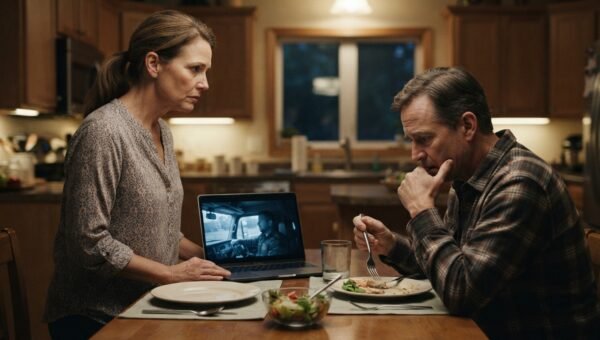
Two days earlier, Daniel had asked me to sit down. He had an envelope thick enough that it wouldn’t lie flat on the table. I looked at the hospital papers beside it and understood he wasn’t asking me to help sort the bills.
“Sign these, Claire,” he said. “Then you can make arrangements to leave.”
I had Lily against my shoulder. I was tired enough that the room kept going soft around the edges, so I took a minute before answering.
“I need time to understand what the doctors are saying.”
“I’m not paying for treatment that could drag on for years,” he said. “You’re not turning this house into a hospital.”
Victoria sat in a wicker chair, still wearing her coat. She’d come over with Daniel, and neither of them had asked if I needed anything. Not water. Not a pillow. She glanced at the estimate.
“Daniel has been more than patient,” she said. “You can’t expect this family to carry you forever.”
I looked down at Lily’s blanket. One corner had folded under her chin, so I fixed it before I said anything. I remember that more clearly than I remember what the estimate said.
Victoria offered to call someone to pick us up. She said my parents could take me and the baby. The way she said “take” made it sound like she was offering to get rid of a box.
“You want me to leave tonight?” I asked Daniel.
He gave a short laugh. “You’ve always been good at making ordinary problems sound tragic.”
Then he pointed at my phone. “Call your parents. They can come get you and your little bundle.”
I didn’t answer. I set the estimate beside the envelope and held Lily closer.
Daniel knew I’d told him my family lived simply. He’d decided that meant I had nothing, and that I had nothing without him.
I knew he was wrong. I just hadn’t planned to tell him that way.
I’d kept my family’s money out of our marriage on purpose. Before I met Daniel, my father, Jonathan, had agreed to let me live without carrying a family name around like a price tag. He bought the estate through a private holding trust and let me make a life there without making a show of it. Daniel thought the house was his, or close enough. He never asked to see the papers.
I thought I was protecting something good. I also liked being treated like an ordinary person. There’s no clean way to say both those things without admitting I was stubborn.
My father had never pushed me to explain myself to Daniel. He respected my choice.
But I’d told him about the diagnosis, and I’d told my mother how Daniel reacted. I hadn’t asked them to come fight my battles. I wasn’t sure I wanted anyone to know how scared I was.
That night, I didn’t sign. I put the envelope on the table and asked Daniel, “Have you made up your mind?”
“I have.”
I heard headlights sweep over the glass roof. The beams crossed the wall and passed over the mobile above Lily’s bassinet. Daniel turned toward the driveway.
Three dark SUVs had stopped outside.
My mother got out first, holding her scarf against the wind. My father followed without an umbrella. Two attorneys came behind him, each carrying a briefcase. When they entered, nobody spoke for a moment. My mother came straight to me and touched Lily’s blanket. She didn’t ask me to explain.
Jonathan brushed melting snow from his coat. He looked at me first, then at Daniel.
“Claire,” he said softly.
My chest loosened a little. Not because anything was fixed, but because I wasn’t alone at the table anymore.
Daniel straightened. “This is a private family matter.”
One attorney opened a briefcase. The other, a woman named Vance, looked past Daniel toward the house. My father followed her gaze.
“Begin with the house,” he said.
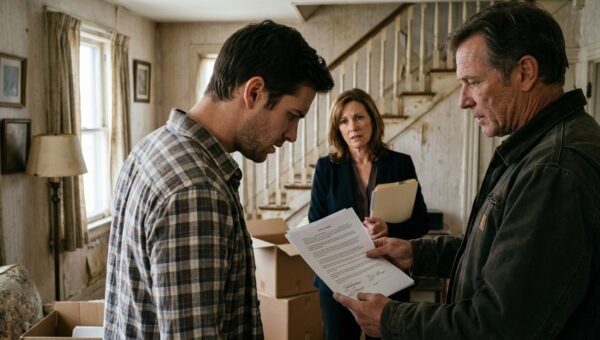
Attorney Miller took out a folder and laid a certified deed on the table, right over Daniel’s envelope. The pages were so ordinary-looking. White paper, black print, a county stamp. But Daniel’s face changed when he saw the name on the deed.
“What is this?” he said.
“The recorded title,” Miller said. “The property is held in trust.”
Daniel looked at Jonathan. “You told me this was our house.”
“I told you Claire could make a home here,” Jonathan said. “I didn’t tell you that you owned it.”
Daniel picked up the deed, then set it down like he was afraid of leaving a mark on it. He said his name was on the utility bills. He’d paid for repairs. He had every right to be there.
Miller kept his voice even. “Your occupancy came through a revocable license. It gave you permission to live here. It gave you no ownership share.”
Victoria stood up. “You can’t put my son out of his home.”
My mother stepped between her and Lily. She didn’t shove or raise her voice. She just planted herself there, one hand on the back of my chair.
“Please don’t come closer,” she said.
Victoria stopped. For once, she didn’t have an answer ready.
I was still holding Lily. Her cheek was warm against my neck. I kept looking at the deed, then at the hospital estimates, which were now half covered by Daniel’s papers. The envelope he’d brought to force me out was under the document that showed he couldn’t decide who belonged in the house.
Vance opened a second folder. She explained that Daniel’s agreement included an immediate revocation clause if he abandoned his wife and newborn daughter or used the house to force them out. The trust had been notified. A formal notice was ready.
Daniel shook his head. “This is because she’s sick?”
“No,” Vance said. “This is because of what you chose to do after she became sick.”
I don’t remember every sentence after that. I remember Daniel rubbing his thumb along the edge of the table. I remember Victoria asking if this was really necessary. I remember my mother keeping her body between her and Lily, even when Victoria tried to look around her.
Miller picked up Daniel’s envelope. He read through the pages and pointed to the parts that asked me to waive financial claims and leave the home. He said the terms were one-sided and that I shouldn’t sign anything without my own lawyer. Then he placed the papers back down.
Daniel had wanted my signature before I could get advice. That was the point. I knew it, and I hated that I’d spent years believing he’d never use my trust in him that way.
“You wanted me out before treatment started,” I said.
He looked at me. “I can’t carry all of this.”
“You wanted me and Lily gone.”
“I was trying to be realistic.”
I had heard that word from people before. Usually it meant they wanted to make a cruel choice sound sensible.
“You made vows to me,” I said. My voice sounded smaller than I wanted, but it didn’t shake. “You didn’t have to promise you’d never be scared. You did promise not to leave me and your daughter like this.”
He looked away. He didn’t say he was sorry.
Miller told Daniel and Victoria they had two hours to pack personal belongings and leave the estate. The occupancy license was revoked. They could take clothes and personal items, but the house and its contents were not theirs to claim. The legal notice gave the deadline in writing.
Daniel grabbed the divorce envelope. Vance put her hand over it.
“That paperwork stays here for review,” she said.
He pulled his hand back. For a few seconds, he looked like he might argue again. Then he saw the two attorneys, my father, and my mother standing by me. His smirk was gone.
I told Miller I wanted to pursue sole legal and physical custody of Lily. I wanted child support. I wanted the court to know Daniel had tried to make me sign away my rights while I was recovering from childbirth and dealing with cancer.
“Put that in the filing,” I said.
Daniel stared at me. “You’re doing this now?”
“Yes.”
I was glad my voice stayed plain. I didn’t want to scream. I didn’t want to give him another chance to call me dramatic.
Private security came to supervise the packing. Daniel and Victoria had two hours, and they spent most of it arguing over what counted as personal property. They left with suitcases and their coats. They were going to a hotel at their own expense.
Daniel stopped near the conservatory door with one bag in his hand.
“You’re really choosing them over me?”
I looked down at Lily. “I’m choosing the people who came when I needed them.”
He left. Victoria followed him.
My father’s attorneys took over the legal work. They made clear Daniel had no claim to the trust assets. They also began the custody filing and reviewed the papers he’d brought. I didn’t need to see the look on his face when people he knew learned he’d been living in a house he didn’t own. That part came to me later, through other people, and I won’t pretend I felt nothing.
My mother helped me out of the conservatory and into a bedroom in the main house. She took Lily while I sat down, because my back was hurting and my arms had started to shake. I’d been holding myself together so long that even resting felt strange.
My father sat beside me. He said they’d already contacted specialists and arranged a consultation at a leading oncology center for Monday morning. My parents would handle the calls and the bills. I could listen, ask questions, and decide what I wanted.
“I can do that,” I said.
“You don’t have to do it all tonight,” my mother told me.
I wanted to believe her. I was still scared. I was still sick, and none of the papers changed that. But the immediate question had an answer. Daniel and Victoria had left. Lily and I were staying.
Later, my mother brought her back to me and tucked a wool blanket around my shoulders. Snow tapped softly against the curved glass panes of the conservatory. The nursery lights stayed warm and steady. Lily slept against my chest, making a tiny sound each time she breathed.
I watched the mobile turn once over the bassinet. This time, the soft click didn’t sound like a warning.