PART 1
The steam was still rising off the black coffee in Cliff’s mug when he pulled out the wooden chair and sat down across from me. He had that small, tight smile he always wore when he thought he had figured out a way to win an argument before it even started.
“My paycheck goes into my account from now on,” Cliff said. He reached across the table, picked up the sugar dispenser, and set it down firmly on the placemat. “One account.
I manage it. You get a weekly allowance for the small stuff.”
I looked at him over the top of my reading glasses. I am fifty-four years old. For twenty-six years, I have worked as a registered dental hygienist at a busy family clinic on Maple Avenue. Cliff runs an independent heating and cooling repair van. We had been married for fifteen years, and from the day we closed on our small brick ranch house in Altoona, our finances had been strictly separate. We had a joint checking account that we each put twelve hundred dollars into on the first of every month for the mortgage, the water bill, and groceries. Whatever was left in our private accounts stayed our own.
“An allowance,” I said, keeping my voice mild and even.
“Two hundred a week,” Cliff said, nodding like he was doing me a tremendous favor. “Cash in an envelope every Friday morning.
That way you do not have to worry about the property taxes, the heating oil, or the truck insurance. Everything goes through me. It keeps things clean.”
I took a slow sip of my coffee. My heart was thumping against my ribs, but my hands did not shake.
“That’s fair,” I said.
Cliff looked startled. He had clearly spent the whole previous evening rehearsing his speech in the garage, expecting me to throw a fit, bring up our fifteen-year routine, or demand to see his invoices. When I smiled back at him, his shoulders visibly dropped. He gave the kitchen table two firm pats with his flat palm, grabbed his ring of brass keys, and walked out to his work van with a bounce in his step.
He thought he had outsmarted me.
He had no idea that I did not need to argue with him, because I already knew why he was desperate for every dollar I made.
The next morning, I arrived at Dr. Miller’s dental office forty minutes before our first patient was scheduled for a cleaning.
I walked right past the hygiene bays, turned down the carpeted hallway, and knocked on the open door of our administration office.
Brenda, our business and human resources manager, looked up from a stack of insurance pre-authorizations.
“Morning, Clara,” Brenda said. “You are in early. Need more polishing paste?”
“No,” I told her, closing the door firmly behind me. “Brenda, I need you to pull up my paper payroll file. I want to see the physical direct deposit authorization form currently attached to my checks.”
Brenda frowned, adjusting her wire-rimmed bifocals. “Did your pay get held up again?”
“Just let me see the form,” I said.
Six months ago, back in late March, my direct deposit had stopped hitting my personal credit union account. At the time, our practice was in the middle of migrating thirty years of paper billing over to a third-party payroll software company based out of Pittsburgh.
When my biweekly net pay failed to show up in my usual mobile banking app, Cliff had waved it off. He told me the practice’s new software system was probably lagging during the changeover. Then, two weeks later, the direct deposit started flowing again, but my digital stub showed an unfamiliar regional commercial bank branch two towns over in Hollidaysburg. When I asked Cliff about it, he told me that our old joint home improvement loan had automatically consolidated with a commercial escrow bucket and that the money was going toward our house repair reserve. I had been working forty-six hours a week covering for a girl out on shoulder surgery, and because the household bills were getting paid on time, I let his explanation sit.
Brenda pulled a thick manila folder from the metal filing cabinet in the corner. She thumbed through the dividers, pulled out a single cream-colored sheet, and laid it flat under the desk lamp.
“Here it is,” Brenda said. “Modified on March 14th.”
I looked down at the signature at the bottom.
The name written on the line was Clara Mae Evans. The ink was black ballpoint. To someone who only glanced at it, the letters might have passed for mine, but the slant was sharp and aggressive, leaning to the right, and the crossbar on the capital T in Mae cut completely through the letter. I have written with a rounded, left-leaning script ever since Catholic elementary school.
More to the point, on March 14th, I was over two thousand miles away in Phoenix, Arizona. I was attending the National Dental Hygiene Association convention with two of our dental assistants. I had my Southwest boarding passes saved in my phone, hotel folio receipts from the Hyatt Regency, and seminar attendance certificates stamped with that exact date.
I stared at the black ink. “Brenda, who handed this form to you?”
Brenda looked at the paper, then leaned back in her swivel chair, tapping her pen against her chin. “I remember that day because the wind was rattling the front awning something fierce. You were away at that conference. Your husband dropped that form off on his lunch break. He told Sarah at the reception desk that you had filled it out the night before your flight and that you asked him to bring it by in person so you would not miss the software cutoff.”
My stomach dropped straight into the soles of my white clinic shoes.
I looked at the starter check stapled to the corner of the form. The account number was not registered to Cliff Evans. It was not registered to Clara Evans.
The printed corporate header on the upper left corner of the check read: Ridgeview Commercial Interiors LLC.
Directly below the company name was a secondary printed line for an authorized individual: Dawn M. Vance.
“Clara?” Brenda asked, her voice dropping into a low, concerned whisper as she watched the color leave my face. “Is something wrong with that account?”
“Brenda,” I said, pulling my personal credit union debit card out of my scrub pocket and setting it on her blotter. “I need you to open the payroll system right now. Remove that routing number entirely. Every single cent of my salary goes back into my private credit union checking account, starting with the run for this coming Friday. Do not call my house. Do not leave a message on our home answering machine. And if Cliff calls this office asking about my paperwork, tell him you can only speak to the employee directly.”
Brenda looked at the forged signature on the form, looked at the Arizona conference pin still pinned to my fleece jacket, and nodded once. She did not ask another question. She just pulled her keyboard closer and went to work.
That Friday, I got home from work at four-thirty. I put a roast chicken in the oven, peeled six potatoes, and sat down at the kitchen table with a cup of peppermint tea.
At five-fifteen, the side door banged open against the wall.
Cliff marched into the kitchen with his coat half-unzipped, his face flushed dark red, and his heavy work boots tracking dried gravel across the clean floor. He was clutching his phone in his right hand like a weapon.
“What did your office do?” Cliff shouted, his voice shaking with pure rage. “The deposit didn’t hit! I checked the mobile app at four o’clock, and I checked it again at the supply counter ten minutes ago! It is Friday evening, Clara! Where is your check?”
I did not flinch. I did not raise my voice. I set my teacup down into the saucer without a rattle.
“I changed it,” I said.
The fury on Cliff’s face cracked right down the center. His mouth opened, closed, and opened again. The red in his cheeks drained away until his skin looked like wet plaster under the overhead fixture.
I looked him dead in the eye.
“So, Cliff,” I said quietly. “Who is Dawn?”
Cliff froze like a deer caught in high beams.
And I had not even brought out the checkbook yet.
PART 2
The kitchen stayed dead silent for six long seconds. The only sound in the house was the low hum of the refrigerator motor and the ticking of the round clock above the stove.
Cliff’s fingers twitched around his phone. He looked toward the doorway that led to the basement stairs, then back at me, his eyes darting like he was searching the room for an open exit.
“Dawn is a subcontractor,” Cliff said. The words came out fast, stumbling over each other as he tried to rebuild his footing. “She is a commercial interior designer. I told you three months ago that I was bidding on the HVAC retrofit for that small office plaza near the county bypass. Ridgeview Commercial Interiors is the lead contractor on the job. The company account was set up as an escrow clearing bucket so we could buy commercial ductwork and heat pumps at wholesale distributor rates.”
He took two quick steps toward the kitchen table, pulling off his leather work gloves and tossing them onto the counter. He leaned forward, resting both hands on the back of the oak chair across from me.
“I had to move your payroll temporarily because the commercial bank required a sixty-day rolling balance of eight thousand dollars to keep our contractor line of credit active,” Cliff said, his voice rising into that practiced, confident rhythm he used when quoting repair jobs to elderly homeowners. “My business receivables were delayed by forty-five days. If that escrow line collapsed, I would have lost the commercial bid. I was going to move every dollar back into your account the minute the general contractor cut our first milestone check. I was trying to protect our livelihood, Clara. I did it for us.”
I sat back in my chair and folded my hands over my knee.
“You did it for us,” I repeated.
“Yes!” Cliff said, nodding hard, thinking he had found his lifeline. “It was a business maneuver. That is all it was. You know how ruthless these commercial general contractors are. You do not understand the construction cash flow, Clara. You clean teeth for a living. You get a steady hourly rate. When you run an independent service company, you have to move capital to stay afloat. I had to show liquid reserves on paper. That is why Dawn’s name was on the account. She had the commercial contractor’s license for the interior finishings.”
He let out a long, theatrical breath, as if he were forgiving me for doubting him.
“Now please,” he said, pulling his chair out and reaching for his phone again. “Get on your computer, log into your clinic payroll portal, and put the deposit back. If that eight-thousand-dollar balance isn’t verified by midnight tonight, the bank will freeze our operating equipment loan on Monday morning. We will lose the supply accounts. You are going to ruin my business over a routine bookkeeping transfer.”
I looked at him for a long moment. I did not shout. I did not cry.
“That is a very clean story, Cliff,” I said. “You almost sound like you believe it.”
I stood up, walked over to the corner hutch where I kept my mother’s good china, and opened the small wooden drawer where we usually stored spare birthday candles and extra twist-ties.
I reached all the way to the back, behind the velvet silverware box, and pulled out a long, navy blue vinyl checkbook.
I walked back to the table and dropped it right in front of him. It hit the placemat with a heavy, flat thud.
PART 3
Cliff looked down at the navy vinyl cover. Every single muscle in his face locked solid.
“Where did you get that?” he whispered. His voice was barely a croak now.
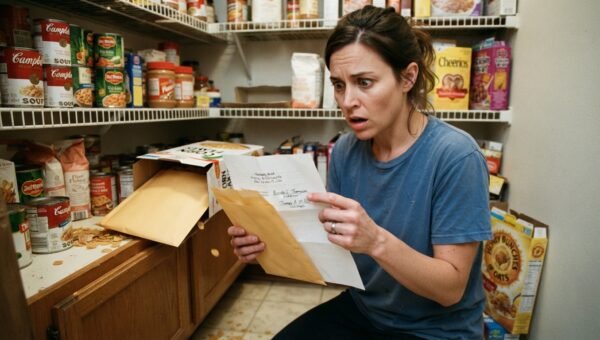
“You should really empty your pockets before you throw your canvas work jackets into the laundry basket, Cliff,” I told him. “You left your secondary ring of brass keys in the inside zipper pocket on Wednesday night. The small brass key unlocked the gray steel lockbox you keep bolted under the passenger seat of your service van. The box you told me held the vehicle title and our spare winter tire chains.”
Cliff did not move. He did not reach for the checkbook. He stood there with his arms hanging at his sides, staring at the blue vinyl as if it were a coil of barbed wire.
“I opened the checkbook, Cliff,” I said. “I looked at the carbon duplicates for the last six months. Four thousand dollars a month from my salary. Twenty-four thousand dollars of my hard-earned money, taken right out of my hands while I stood on my feet eight hours a day scraping tartar.”
I reached down and flipped the vinyl cover open with my thumb, turning straight to the carbon registers from April and May.
“On April 6th,” I said, pointing to the carbon copy, “check number 104 was written for three thousand one hundred dollars to Valley Ridge Townhomes for a security deposit and first month’s rent on Unit 14B. Authorized signature: Cliff Evans.”
Cliff swallowed hard. A drop of sweat broke out along his hairline, just above his left temple.
“On April 22nd,” I continued, turning another page, “check number 109 was written for two thousand four hundred dollars to Ashley HomeStore for a queen-size pillow-top mattress, a walnut headboard, and two matching nightstands. Delivered to Unit 14B.”
“Clara, listen to me,” Cliff began, his voice cracking down the middle. “Dawn had nowhere to go. Her ex-husband locked her out of their house in Johnstown. She was sleeping in her car behind the lumber yard. I was trying to help her get settled so she could run the staging business.”
“Shut up, Cliff,” I said.
My voice was not loud, but it had the kind of cold, iron weight that stopped him dead in his tracks.
“On June 12th,” I said, turning another slip, “check number 118 was written for eight hundred and fifty dollars to a boutique jeweler in State College for a white gold pendant with an emerald stone. My birthday was on June 14th, Cliff. Do you remember what you gave me for my birthday? You gave me a five-pack of microfiber cleaning cloths and a plastic ice scraper from the hardware store, and you told me times were tight because the supply houses had raised the price of freon.”
Cliff’s knees seemed to buckle. He dropped heavily into the kitchen chair, his elbows resting on his knees, his face buried deep in his calloused hands.
“It wasn’t supposed to go this far,” he mumbled into his palms. “She worked the desk at the commercial supply house last winter. We started getting coffee. Then she told me about her ex, and how she wanted to start her own staging company, and it just rolled out of control. She told me that if I helped her secure the townhouse and the commercial credit, she would make me a fifty-percent partner in the design firm. I thought I could build something that would make real money, Clara. I thought we could retire early. I swear to God, I was going to put every single dollar of your money back into the credit union the second her first commercial client paid.”
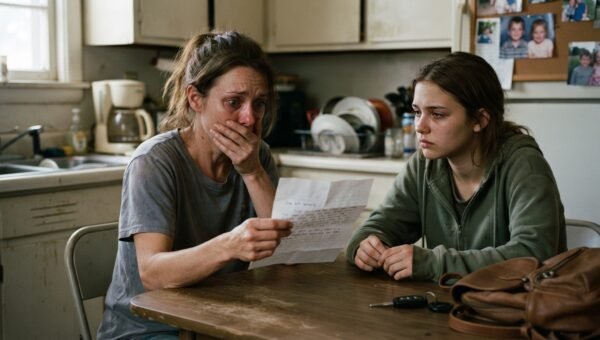
“You didn’t build anything, Cliff,” I told him. “You stole from your wife to set up a second life with a thirty-year-old clerk from the supply counter. And when you realized you could not keep up the payments on her rent, her furniture, and her jewelry with just your repair van, you sat at this table yesterday morning, looked me in the eyes, and told me you were putting me on a two-hundred-dollar weekly allowance so you could take my entire paycheck directly.”
Cliff lifted his head. His eyes were bloodshot, and tears of pure self-pity were tracking through the dust on his cheeks.
“Clara, please,” he begged, reaching out a hand across the table toward my sleeve. “The rent on Unit 14B is due on Monday. If the four thousand doesn’t hit that account tonight, the landlord is filing an emergency eviction and the bank is going to pull the overdraft line on my business checking. The supply house will cut off my parts account. I will lose the van. I will lose everything I have worked twenty years to build. Just let this one deposit go through. Just one more month, and I will fix it. I will sell the secondary tools. I will pay back every cent.”
I looked down at his outstretched hand. I felt no rage, no desire to scream, and no urge to throw the dinner plates against the wall. I only felt a deep, clean clarity that washed over me like cold water.
“No, Cliff,” I said. “You won’t.”
ENDING
I reached into the pocket of my scrub pants, pulled out an unfolded legal document, and laid it flat across the open checkbook on the table.
Across the top of the white page, printed in dark legal type, were the words: IN THE COURT OF COMMON PLEAS OF BLAIR COUNTY, PENNSYLVANIA COMPLAINT IN DIVORCE AND PETITION FOR EMERGENCY SPECIAL RELIEF.
Cliff looked at the blue court seal in the top corner. His jaw went slack.
“I didn’t just visit Brenda on Tuesday morning, Cliff,” I told him. “I spent Wednesday afternoon in Dr. Miller’s personal attorney’s office. Behind that complaint is a signed, notarized affidavit of criminal forgery from Brenda, certifying that you forged my signature on the direct deposit modification while I was two thousand miles away in Arizona. And behind that affidavit is an emergency freeze on our joint equity line and every secondary account linked to your Social Security number.”
Cliff stared at the paperwork, his breath catching in ragged, shallow gasps. “Divorce? Clara, we have fifteen years together. We built this house. We have the garden. We have our routine. You are going to destroy our entire marriage over a business mistake?”
“You destroyed this marriage on March 14th when you signed my name to a lie,” I said. “The house belongs to my family, Cliff. My father deeded this land to me three years before I ever met you, and the mortgage is solely in my name because your credit was too damaged from your first bankruptcy to qualify. You are a tenant on this deed, and nothing more.”
I walked over to the front hall, unhooked my coat from the peg, and picked up the overnight bag I had packed and hidden in the trunk of my car before I left for work that morning.
“The sheriff’s department will be here at nine o’clock tomorrow morning to serve your formal papers,” I said, resting my hand on the brass doorknob. “You have until Sunday evening at six o’clock to pack your clothes, your personal tools from the garage, and your work van. If you are still on this property when I come home from church on Sunday, the county deputies will remove you in handcuffs for criminal trespass.”
Cliff lunged up from the chair, stumbling against the table, sending his cold coffee mug crashing onto the linoleum floor. It shattered into heavy ceramic pieces, the dark liquid pooling around his boot heels.
“Clara, don’t walk out that door!” he screamed, his voice turning shrill and panicked. “I don’t have anywhere to go! The supply house already froze my credit this morning! I don’t have five hundred dollars to my name!”
I did not turn around. I pulled the front door open, stepped out onto the concrete porch, and pulled the door shut behind me. The heavy deadbolt clicked into the strike plate with a solid, final snap.
The autumn evening was cool and clear. The smell of woodsmoke from the neighbor’s chimney drifted across the yard, and the leaves on the big silver maple by the driveway were just beginning to turn orange under the streetlights. I got into my car, locked the doors, and drove two miles down the road to my sister Evelyn’s house.
The legal proceedings took nine long months of forensic accounting, subpoenaed bank records, and depositions.
When Cliff’s attorney saw the certified payroll records from Dr. Miller’s office, the time-stamped airline tickets from Phoenix, and the surveillance footage from the regional bank showing Cliff making personal counter withdrawals from the Ridgeview Commercial account, he advised Cliff to settle immediately to avoid felony wire fraud and grand larceny charges.
The court awarded me the house free and clear of any spousal claim. To satisfy the twenty-four thousand dollars in marital assets that Cliff had fraudulently diverted into the townhouse, the judge ordered the immediate seizure and court-ordered auction of Cliff’s commercial diagnostic equipment, his secondary service tools, and his share of our joint tax refund.
Dawn Vance abandoned Unit 14B three days after the accounts were frozen. She packed her clothes into the back of a rented pickup truck and moved back to her mother’s house near Pittsburgh, leaving the leased furniture behind for the landlord to sell at a public sheriff’s auction.
Cliff lost his independent business license when the supply houses placed commercial liens against his company name. He had to sell his service van to satisfy his back payroll taxes, and he ended up renting a basement room from his cousin in Tyrone, working as a night-shift maintenance mechanic at a commercial laundry plant for eighteen dollars an hour.
Last Friday was my six-month anniversary of the final divorce decree.
At noon, I took my lunch break from the clinic, walked down Maple Avenue under the warm October sun, and stepped into the lobby of my local credit union on the corner.
I handed my deposit slip through the teller window, smiled at the woman behind the counter, and watched the small green machine print out my transaction receipt. Every single penny of my paycheck was accounted for. Every hour I worked was mine, resting safely in an account that belongs to me and only me.
I folded the paper slip, tucked it into my wallet, and walked back out into the bright Pennsylvania sunshine, breathing the cleanest, lightest air I have known in fifteen years.