PART 1
The bakery sheet cake had white buttercream frosting, small spun-sugar booties in yellow and mint green, and the words “Welcome, Little One” written in script across the center. I had just pressed the serrated knife through the corner slice when the clinking started.
It was my younger sister, Lauren. She stood beside the punch bowl, tapping a plastic fork against the rim of a crystal cup.
“Before Cara opens the rest of the boxes,” Lauren said, looking around my living room with a bright, electric smile, “I have a tiny announcement of my own.
I wasn’t going to say anything today, but honestly, I just cannot keep it inside another second.”
She reached into her purse and held up a glossy black-and-white ultrasound strip.
“I am twelve weeks along,” Lauren announced. “Baby girl due in November.”
For three seconds, the room went dead silent. Then my aunt Sharon gasped, my mother dropped her napkin, and half the living room surged out of their folding chairs toward Lauren.
I stood there with my hand still gripping the white plastic handle of the cake knife.
I was thirty-four years old. My husband, David, and I had spent four years, two miscarriages, and three rounds of intrauterine insemination getting to thirty-two weeks. My ankles were swollen into my flats, my lower back throbbed, and my friends had pitched in to buy the stroller system sitting unopened by the coat rack. But within forty seconds, nobody was looking at the stroller.
My mother was weeping into Lauren’s shoulder, smoothing Lauren’s hair and declaring it a miracle.
I set the knife down on a paper plate. My stomach felt hollow. I took a slow breath, smoothed my linen dress over my belly, and walked across the rug to give my sister a hug.
“Congratulations, Lauren,” I said. I kept my voice as warm and steady as I could make it. “That is wonderful news.”
Lauren pulled back and looked at my stomach, then back at my face. She laughed, a quick, breezy sound that carried over the chatter.
“Well, Cara,” she said loudly enough for my mother and two of my cousins to hear, “looks like our babies are going to compete from day one. Let us see who walks first.”
I stiffened. I didn’t know what to say to that. But before I could even manage a weak smile, my mother chimed in from behind Lauren’s shoulder.
“Oh, you know Lauren’s girl will be running circles around everyone,” Mom said with a hearty chuckle, wiping real tears from her cheeks. “She has always had that fire.”
A couple of my work friends traded uncomfortable glances by the hallway, but my mother didn’t notice. She spent the remaining forty-five minutes of my shower asking Lauren about morning sickness, prenatal vitamins, and whether Lauren had picked out a pediatrician yet. When the last guest left at four o’clock, Mom barely said goodbye to me before helping Lauren carry leftover chicken salad out to her car.
David came home from his overtime shift an hour later, found me sitting on the living room rug surrounded by half-wrapped gift boxes, and held me while I cried until my eyes swelled shut.
“You don’t have to pretend it didn’t hurt,” he whispered into my hair.
“I don’t want to be bitter,” I told him. “I just wanted one afternoon that was ours.”
In the weeks that followed, I tried to let it go. I focused on finishing the nursery, assembling the crib, and washing rows of tiny cotton onesies.
My daughter, Maya, was born healthy on a Tuesday morning in late July. She had dark hair and David’s chin. Mom visited the hospital for twenty minutes, took two photographs holding Maya with an awkward, stiff grip, and spent the remaining fifteen minutes talking about how Lauren’s twenty-week anatomy scan showed long legs.
I didn’t argue. I didn’t push. When someone shows you where you stand, arguing only makes you feel smaller.
By late October, Maya was three months old. We had settled into the rhythm of middle-of-the-night feedings and quiet mornings. Lauren was eight months along and had stopped answering my weekly check-in texts, which wasn’t unusual.
Then my phone lit up on the nightstand.
The glowing numbers on the digital clock read 1:12 a.m.
David stirred beside me, murmuring in his sleep. I slipped out of bed, grabbed the phone, and padded into the hallway so the ring wouldn’t wake the baby.
The screen said *Lauren*.
“Hello?” I whispered.
There was no crying on the other end. No panic. Her voice was completely flat, dry, and hollow, the way people sound when they are in deep shock.
“Cara,” she said. “I need you to come to the county hospital right now.”
My chest seized. “Lauren, what happened? Is the baby coming early? Did your water break?”
“No,” she said. Her voice didn’t rise or fall. “The baby is fine. I am in the west wing, third floor, Consultation Room B. Just come.”
She hung up before I could ask another question.
I stood in the dark hallway for five seconds with my heart hammering against my ribs. I hurried back into the bedroom, shook David awake, and told him Lauren was at the hospital. He offered to drive, but Maya had just gone down after a rough cluster-feed, so I told him to stay with our daughter.
I threw on a pair of jeans, a dark sweater, and my sneakers. The drive to the county hospital took eighteen minutes through empty, rain-slicked suburban streets.
I took the service elevator to the third floor. The hallway smelled of floor wax, industrial bleach, and cold coffee. A nurse behind the central station pointed down a side corridor when I gave Lauren’s name.
The door to Consultation Room B was half-open.
Lauren sat alone at a round laminate table beneath buzzing fluorescent tubes. She wore an oversized gray sweatshirt, her belly resting against the edge of the table. Her hands were folded flat in front of her. Resting on the empty chair beside her was our mother’s unmistakable structured leather handbag, with its brass buckle and heavy key fob hanging over the armrest.
“Lauren?” I stepped into the room and pushed the door shut behind me. “What is going on? Where is Mom? Why do you have her purse?”
Lauren didn’t look up right away. She reached into the pocket of her sweatshirt, pulled out a folded white sheet of paper with blue medical letterhead, and slid it across the fake wood grain toward me.
“Mom had a minor car accident two hours ago on Route 9,” Lauren said, her voice eerily quiet. “She bumped a guardrail. She is fine. They have her in observation for a mild concussion. But when the paramedics brought her in, they needed her insurance card and her health proxy paperwork from her bag.”
Lauren looked up at me then. Her eyes were completely bloodshot, surrounded by dark, bruised circles.
“I dug through her purse to find her card,” Lauren continued, her voice trembling for the first time. “I found this tucked in the zippered bottom lining. I found out why Mom was so happy at your shower, Cara, and I don’t know how to tell you what she did.”
PART 2
I stared down at the paper on the table. My fingers felt numb as I unfolded it.
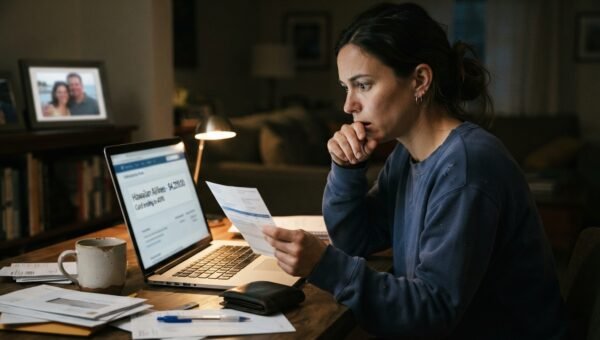
It was not an insurance statement. It was a formal diagnostic summary from a regional fertility genetics laboratory dated five years earlier, stamped with my mother’s full name, Evelyn Harris, as the billing guarantor, and my name as the patient.
I scanned the rows of technical language. Halfway down the page, my eyes locked onto two bold headings: *Karyotype Analysis* and *Oocyte Quality Marker Assessment*.
At the bottom of the first section, in clear, clinical type, the laboratory director had written:
*Patient Cara Harris exhibits normal chromosomal profile. All hormonal baseline panels and follicular reserve markers fall well within standard fertile ranges for age cohort. Previous early pregnancy losses present no structural genetic etiology; primary clinical recommendation is low-intervention monitoring and partner sperm motility assessment.*
I stopped breathing. The air left my lungs all at once.
“What is this?” I whispered. “Where did you get this?”
“I told you,” Lauren said, her voice cracking. “In Mom’s purse. Tucked behind the inside zipper pocket with her spare checks.”
My hands started shaking so violently the paper fluttered against the table.
Five years ago, after my second miscarriage, I was completely shattered. I was twenty-nine years old, sitting on the bathroom floor of our old apartment, convinced my body was broken. David and I were barely keeping our heads above water financially, and the fertility clinic we consulted had quoted us nearly six thousand dollars for a comprehensive genetic and chromosomal screening.
We didn’t have six thousand dollars.
My mother had stepped in. She told me she had a cousin who worked in billing at a private diagnostic group in Philadelphia. She said if I went to a local collection lab to have the blood drawn, she would pay the testing fee directly through her cousin’s office to get the family discount. She told me she would handle the paperwork and the billing so David and I wouldn’t have to carry the stress.
Three weeks later, Mom came to my apartment on a rainy Sunday afternoon. She sat on my sofa, took both of my hands in hers, and looked at me with tears in her eyes.
She told me the doctor had called her directly with the results. She said the lab had found severe, irreversible ovarian degradation and profound genetic chromosomal fragility. She looked me in the eye and told me that my eggs were non-viable, that carrying a child to term was nearly impossible, and that every month I tried naturally was simply risking another traumatic loss.
I spent the next three years living inside that lie.
I quit my promotion track at work because the grief made it impossible to focus. David and I emptied our small savings account, borrowed against our car, and took on twelve thousand dollars of high-interest medical debt to pay for aggressive hormonal protocols and third-party specialist consultations. We put our lives on hold for four agonizing years, weeping in exam rooms, because our mother had looked me in the face and told me I was biologically defective.
“Why would she have this?” I asked. My throat felt like it was coated in gravel. “Why does this report say my tests were completely normal?”
Lauren pulled her knees up slightly, her heavy belly shifting under the sweatshirt. She looked like she wanted to disappear through the floor.
“Keep reading,” Lauren whispered. “Turn it over.”
I turned the sheet over. Attached to the back was a carbon copy of a handwritten doctor’s note on the same clinic letterhead, addressed to Evelyn Harris:
*Per your request, formal paper results mailed directly to your home address. Patient authorization for parent communication on file. Please note that while patient Cara’s reproductive outlook is positive, second patient profile (Lauren Harris, age 22) indicates diminished ovarian reserve (AMH 0.4 ng/mL) and early-stage follicular depletion. Prognosis for spontaneous conception low; recommend immediate reproductive counseling.*
The room seemed to tilt sideways. The hum of the fluorescent lights grew deafening.
“When I was twenty-two,” Lauren said, her voice dropping into a dull, flat monotone, “I had irregular periods for six months. Mom told me she was taking me to her gynecologist for routine bloodwork. She came back and told me the results were clear, that it was just stress from college. She never told me what the lab actually found.”
Lauren looked up at me, tears finally spilling over her lower lashes.
“Mom knew eight years ago that I was the one who was going to struggle,” Lauren said. “She knew my window was closing before I even started my life. But she never told me. She kept it in her purse.”
“I don’t understand,” I said. My chest ached with a deep, physical throb. “If she knew you had the fertility issue, why did she tell me I was the one who couldn’t have children?”
“Because she couldn’t stand the idea of you having what she thought I never would,” Lauren said.
PART 3
The consultation room stayed silent for a long time. Outside in the hallway, an orderly wheeled a cart of plastic trays past our door, the casters rattling rhythmically against the linoleum tiles.
“Mom called me three days before your baby shower,” Lauren said, wiping her face with the sleeve of her sweatshirt. “I had just found out I was pregnant. My husband, Mark, and I hadn’t even told his parents yet. We were going to wait until fourteen weeks, after the first genetic panel came back. We wanted to be safe.”
I looked at my sister. The anger that had lived in my chest since that afternoon by the cake began to shift into something far colder.
“Why did you do it, Lauren?” I asked. “Why at my shower?”
Lauren stared down at her hands. Her knuckles were white where her fingers interlaced.
“Because Mom came to my house on Thursday,” Lauren said quietly. “She was sitting at my kitchen island, and she looked miserable. She kept talking about how unfair it was that you were getting your nursery, your stroller, your shower. She told me, ‘You are the younger sister, Lauren. You were always supposed to give me my first granddaughter. It was supposed to be you.'”
Lauren swallowed hard. Her breath caught in her throat.
“She told me that you had already had your moment,” Lauren said. “She told me that everyone in the family knew how hard you had it, but nobody was paying attention to me. She told me that if I announced my pregnancy at your shower, it would prove that our family was blessed, that God was giving us two babies at once. She pushed me, Cara. She said, ‘Do not let your sister have the whole year to herself. Stand up and claim your place.'”
“And you listened to her,” I said.
“I was twenty-six years old and terrified,” Lauren cried, her voice cracking. “All my life, Mom made me feel like I was her special project, like everything had to revolve around keeping her proud of me. When she laughed at that awful joke about our babies competing, I felt sick to my stomach the second the words left my mouth. But Mom squeezed my hand under the table and whispered, ‘That is my girl.’ I went along with it because I was weak. Because having her approval felt like the only thing that kept me safe.”
She reached out and touched the edge of the lab report lying between us.
“Then tonight, the police called,” Lauren continued, her voice trembling. “They said Mom had swerved off the road on Route 9. Her car was crumpled against a guardrail. When I got here, the ER nurse asked me to look through her purse for her medical cards. I unzipped the inner pocket, and I found an old envelope. On the front, Mom had written in her neat cursive: *Girls’ lab results—do not show.*”
Lauren began to sob, pressing her forehead against the cool laminate of the table.
“She kept you in despair for four years, Cara,” Lauren choked out. “She let you believe you were broken so you wouldn’t get ahead of me. And she hid my own medical diagnosis from me for eight years, letting me risk permanent infertility, just so she wouldn’t have to admit her favorite daughter had a flaw. She manipulated both of us like dolls on a shelf.”
The door to the consultation room clicked open.
A nurse stepped in, carrying a clipboard. She looked between the two of us, taking in Lauren’s tears and the medical papers spread across the table.
“Mrs. Harris is awake in room 314,” the nurse said gently. “The doctor finished the CT scan. There is no internal bleeding, just a minor concussion and some bruising from the seatbelt. She is asking for her daughters.”
I stood up slowly.
I picked up the laboratory report, folded it along its original creases, and slipped it into the back pocket of my jeans. Then I took my mother’s leather handbag by its brass handle.
“Come on, Lauren,” I said.
We walked down the corridor side by side. Room 314 was near the end of the hall. The door was open, and the room was lit by a single overhead examination light.
My mother was propped up in the hospital bed. She had a white bandage taped over her left eyebrow and a dark purple bruise blooming along her collarbone where the three-point belt had caught her. When she saw us walk in, her face brightened with that familiar, practiced warmth.
“Oh, thank heavens,” Mom said, reaching out both hands toward us. Her voice was thin, slightly raspy. “The officer said he called you. I told him not to worry my girls, especially with Lauren so close to her due date. Lauren, sweetheart, come here. Did you bring my purse?”
Lauren stopped three feet from the foot of the bed. She didn’t move toward her.
I walked forward and set the purse down on the rolling tray table beside the water pitcher.
“We brought your purse, Mom,” I said.
My mother reached for the zipper, then paused, noticing our faces. Her eyes flicked from Lauren’s swollen, tear-stained cheeks to my hands, which were empty.
“What is wrong?” Mom asked, her brow furrowing under the white gauze. “Is it the baby, Lauren? Did the stress bring on contractions?”
“The baby is fine,” Lauren said. Her voice was completely cold, devoid of the eagerness to please that had defined her entire adult life. “We found the envelope, Mom.”
ENDING
My mother went utterly still.
The color drained from her cheeks, leaving her skin the color of damp parchment. Her gaze dropped instantly to the brass buckle of her handbag, then lifted toward me. For a single second, I saw pure panic in her eyes, followed immediately by the practiced defensiveness she had used for thirty years.
“Cara,” Mom began, her voice dropping into a soothing, maternal cadence. “You don’t understand the context of what happened back then. You were so fragile after that second loss. You were falling apart. The doctor told me that stress was the worst thing for you. I was trying to protect you from obsessing over numbers.”
“You told me my eggs were non-viable,” I said. My voice was completely steady, so quiet the nurse passing in the hallway didn’t even look in. “You sat on my sofa in my apartment, held my hands, and watched me cry for two hours. You let David and me spend twelve thousand dollars we didn’t have. You let me spend four years believing my body was a graveyard.”
“I was trying to keep your expectations realistic!” Mom said, her voice rising, a sharp defensive edge cutting through the medicine. “You always took things so hard, Cara! If you had known the tests were inconclusive, you would have driven yourself crazy trying every single month! Look at you now. You have Maya. You got your baby in the end, didn’t you? What difference does the paperwork make now?”
“The paperwork says you knew Lauren had diminished ovarian reserve when she was twenty-two,” I said.
My mother snapped her head toward Lauren.
Lauren stood with her arms wrapped around her pregnant stomach, looking at our mother as if she were a total stranger sitting in that bed.
“You hid my own body from me,” Lauren whispered. “If Mark and I hadn’t gotten lucky on an off month, I could have missed my entire window because you didn’t want anyone to know your golden child had a low egg count. You almost cost me my daughter, Mom. Just to keep up appearances.”
“I did everything for you girls!” Mom shouted from the pillows. Her face was mottled red beneath the white bandage. “I gave up my entire adult life to make sure you two had everything! And now you stand here in a hospital room, attacking me while I am injured? After everything I sacrificed?”
“You didn’t sacrifice anything for us,” I said. “You used us to keep score.”
I took the folded laboratory report out of my back pocket and dropped it onto the rolling tray table beside her water cup.
“I am going home to David and Maya,” I said.
I turned toward the door.
“Cara!” my mother called out, her voice shrill and desperate from the bed. “Cara, don’t you dare walk out of this room! You owe me respect! I am your mother!”
I didn’t turn around. I kept walking down the corridor, my sneakers silent on the linoleum.
A moment later, I heard fast footsteps behind me. Lauren caught up with me at the elevator bank. She was breathing hard, her hand pressed against the small of her back.
“Can I come to your house tomorrow?” Lauren asked. Her voice was small, like the eight-year-old girl who used to ask to sleep on the trundle bed in my room during thunderstorms. “Just to see Maya? If you don’t want me there, I understand. I would understand completely.”
I looked at my younger sister. I looked at the dark circles under her eyes, the swell of her belly, and the genuine, unvarnished grief on her face. The sister who had clinked her glass by the punch bowl was gone.
“Come over at ten,” I told her. “David will make coffee. We can look at the crib.”
Lauren let out a broken, shuddering breath and nodded.
The elevator doors slid open with a soft chime. We rode down to the ground floor together in silence.
That was six months ago.
My mother was discharged from the hospital the following afternoon. Over the next three weeks, she sent twelve lengthy text messages explaining that she had acted out of maternal love, followed by five angry voicemails accusing David of turning me against her, and finally an email to our extended family claiming that her daughters had abandoned her in her hour of need over an old misunderstanding.
I never answered any of them. David changed our front door locks the following Tuesday, and I blocked her number on my phone.
Two weeks before Thanksgiving, Lauren gave birth to a healthy, six-pound baby girl named Clara. My mother was not in the delivery room. Mark had given the nursing staff strict instructions that Evelyn Harris was not permitted on the maternity floor under any circumstances.
Last Sunday, David and I hosted family dinner at our house.
The living room looked very different from the afternoon of my baby shower. There were no decorative mint-green napkins, no spun-sugar booties, and no clinking of crystal punch cups. Instead, there was a large foam playmat spread across the rug, covered in plastic stacking cups and soft cloth books.
Maya, nine months old now, was pulling herself up on the edge of the coffee table, her little legs wobbling with proud determination. Beside her on the mat, three-month-old Clara lay on her stomach, kicking her feet in a yellow onesie and laughing at the ceiling fan.
Lauren sat beside me on the sofa, holding a warm mug of tea. She looked tired in the honest, everyday way that mothers of newborns are tired, but the tension that had lived behind her eyes for years had completely cleared away.
When Maya lost her balance and plopped softly onto her padded bottom, Clara let out a loud, bubbling squeak.
Lauren looked down at the two of them, then looked across the sofa at me.
“They’re not competing,” Lauren said softly.
“No,” I told her, setting my hand over hers. “They never will.”