The smell of menthol rub was on my hands the first night I cared for Gordon. He was lying in bed, and I was checking the cuff on his arm when he suddenly grabbed my wrist.
“Don’t let Charlene find the letter.”
That was the first thing he’d said to me in years. I was standing in the home of the man who’d left me in 2003, being paid $11 an hour to help him get through the night.
I’m seventy now. Gordon and I were married for thirty-one years. Charlene was his wife after me, and she had no idea who I was.
I’d taken the overnight assignment through the agency because I needed the hours. I’d been doing home care long enough to know that a steady schedule matters, and I wasn’t going to turn down a shift before I’d even met the patient. I drove to the address with my thermos in the cup holder and parked by the house.
Then Charlene opened the door.
I knew her from old photographs and from the way Gordon used to say her name. She looked tired, but she didn’t recognize me. She showed me the kitchen, pointed out the medicine chart, and apologized for the clutter.
“He’s been restless lately,” she said. “You seem patient. That’s what he needs.”
I said I’d do my best. I didn’t tell her I’d once known which side of the bed Gordon slept on, or how he liked his eggs.
I had to decide quickly. I could leave and lose the shift, or stay and do the job. I stayed. Not because I felt kind. I needed the money, and Gordon was sick. That was enough to get me through the door.
The bedroom had been rearranged for his care. A walker stood near the bed, and the water glass had a lid on it. Charlene showed me where the supplies were, then touched Gordon’s shoulder.
“I’m going to try to sleep,” she said. “Call me if you need anything.”
Gordon had barely looked at me until she left. The moment the bedroom door clicked, his fingers closed around my wrist. He wasn’t strong, but he held on hard enough to hurt.
“Don’t let Charlene find the letter.”
I put my free hand over his. “What letter, Gordon?”
His eyes moved over my face. For a second, I saw the man I’d known. Then his grip loosened.
“Desk,” he said. “The old desk.”
I asked him where. He shut his eyes and started breathing through his mouth. I stayed beside him until his hand went slack.
I didn’t sleep. I sat in the chair and listened for the change in his breathing, watching the clock on my phone tick past one, then two. Every so often he called out a name that wasn’t mine. Once, he said “Wanda,” but when I leaned closer, he didn’t know I was there.
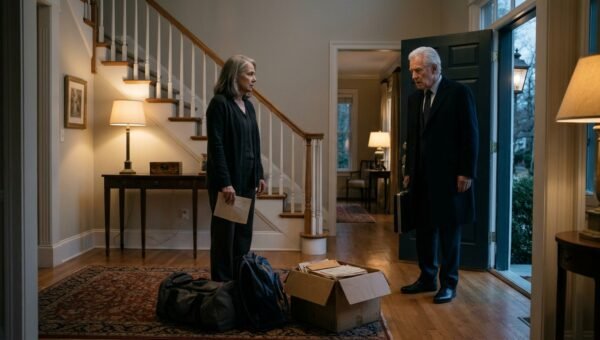
I remembered the day he left. It was 2003, and he packed two bags into his sedan while I stood in the doorway asking what was going on. He didn’t yell. That almost made it worse.
“I can’t do this anymore,” he said.
I asked if there was someone else. He looked down at the bag in his hand.
“I’m sorry.”
That was all I got. He left with Charlene and cut off contact.
I had to sort through the bills and the house and the parts of a life I’d thought were settled. There were months when I was angry enough to rehearse things I’d say if he ever came back. By the time I had the chance, I didn’t want to be the woman who kept a speech ready.
At five-thirty, Charlene came in carrying coffee. Her hair was pinned up, and she had a mark on her cheek from sleeping on her hand.
“Did he settle down?” she asked.
“A little.”
She set one cup on the table beside me. “You’re very good with him.”
I wanted to say, I should be. I knew him for thirty-one years. Instead I said, “I’ve done this kind of work a long time.”
Charlene gave me a tired smile and went to check the medicine chart.
The back sunroom was where she kept the things that didn’t fit anywhere else. I noticed the desk as I was leaving. It was rosewood, scratched near the bottom, with one leg that always looked a little shorter than the others.
Gordon’s grandfather had given it to him. He used to keep private letters in a small slide-drawer hidden in the base. I hadn’t thought about that desk in years.
I didn’t search then. I had no right to go through someone’s belongings while on the clock, and I didn’t know if the letter was even real. But I drove home thinking about the hidden drawer, and that thought followed me around for two nights.
When I came back for my next shift, Gordon was asleep before I finished checking his chart. Charlene told me she had a support group meeting and would be back later.
“I don’t like leaving him,” she said. “But I can’t sit in this house every night.”
“I understand,” I said.
I didn’t fully understand. Not yet.
She left around seven. I waited until Gordon’s breathing settled, then went into the sunroom. I told myself I was only checking the desk because he’d asked me to. I also knew that was a convenient excuse. I wanted to know what he’d written. I wanted to know if he’d ever understood what he did to me.
The desk drawers held old pens, folded manuals, and a stack of envelopes with bills in them. I ran my hand along the underside of the base, looking for the narrow edge of the hidden drawer. The wood caught on my fingernail.
There it was.
The drawer slid out with a dry little scrape. Inside was one yellowing envelope, sealed. My name was written across it in Gordon’s handwriting.
Wanda. If you ever hear this.
I took it into the hall. The paper smelled faintly of dust and old furniture polish. I opened it with my thumb, careful not to tear the writing.
The letter was dated seven years earlier, after his first neurological evaluations. He wrote that he was scared, and that he’d been scared for years before anyone had a name for what was happening to him.
Then he wrote about 2003.
He said leaving me had been his choice. Charlene had given him an ultimatum, but he’d let her take the blame in his mind because it was easier than admitting what he wanted. He’d been afraid of getting older, afraid his life was closing in around him. He thought starting over would make him feel young again.
It hadn’t.
He wrote that Charlene had pushed him to cut every financial tie to me during the divorce. He went along with it because he was afraid she’d leave if he didn’t. He knew it had left me scrambling. He knew I’d done nothing to deserve that.
“I was a coward, Wanda,” he wrote. “I knew I was hurting you, and I did it anyway.”
I sat on the floor with the letter in my hand. I’d spent years thinking that maybe I’d been cold, maybe I’d missed something, maybe there was a reason that would make the way he left less senseless. His letter didn’t make it less cruel. It did tell me the cruelty wasn’t proof that I was hard to love.
He wrote that leaving me was the worst mistake of his life. That he’d thrown away his true home. He asked me to forgive him, though he knew he had no right to ask.
I’d just read the last page when I heard the front door open.
Charlene was home early.
I folded the letter once and slid it into my coat pocket. I was still standing in the hall when she came in from the kitchen. Her face looked strained, and she was rubbing the heel of one hand against her forehead.
“Sorry,” she said. “I couldn’t stay there tonight.”
I asked if she wanted tea. She nodded, then sat at the kitchen table without taking off her coat. I put the kettle on and kept my hand over the pocket holding the letter.
“He’s not really here most of the time,” Charlene said. “I know it’s the disease. I know that. But I still feel like I’m losing him every day.”
I set a mug in front of her. She looked at my hands.
“You know how he likes things,” she said. “You knew to turn the pillow just now. You called him Gordy when he was restless.”
I hadn’t noticed I’d done that.
She stared at the tea. “You knew him before me.”
I could have told her then. I could have said I was the wife he left. I could have put the letter on the table and made her read it. For one second, I pictured her face as she learned what Gordon had carried all these years.
Then she looked so tired I couldn’t do it.
“I was married to him before you,” I said. “My name’s Wanda.”
She didn’t answer right away. She rubbed the mug with her thumb.
“I’m sorry,” she said. “I didn’t know.”
“I know.”
She didn’t ask about the letter. I didn’t tell her. We sat there until her tea cooled, and for a little while we were just two women who had spent years taking care of the same man in different ways.
When I went back to the bedroom, Gordon was awake. He looked toward me, searching.
“I found it,” I said. “I have it, Gordon. You can rest now.”
His eyes stayed on me for a moment. Then his hand relaxed against the sheet. He slept for the rest of my shift.
I kept the letter. I didn’t give it to Charlene or show it to anyone else. I finished my rotation, and when Gordon’s care moved to hospice, I left the house with the same quiet I’d used going in. Charlene knew who I was by then. We didn’t become friends, exactly. We didn’t need to.
At dawn, I sat in my sedan and took the envelope out of my coat pocket. My breath made a small blur on the windshield. I traced the old handwriting with one finger, then tucked the letter into the glovebox and turned the key.