The thing that didn’t fit was the yellow notepad beside my plate. Dad had brought it into the restaurant folded in half, and I figured he’d written down something he wanted to remember. Then I told my parents I’d accepted a job paying $650,000 a year, and he opened it like he was starting a meeting.
I was 42. The job was a senior operating role at a healthcare software company, the kind of position I’d spent years working toward.
I’d paid for my degree and later training myself, including a stretch when I took night classes after work and ate crackers in my car between shifts at a hospital billing office. I was proud. Not loud about it, but proud.
My parents didn’t say congratulations.
Dad, whose name is Cal, turned the pad toward me. He’d written three lines in his blocky handwriting: 50% for Mom and Dad, 30% for my sister, Beth, and 20% for me.
He pushed it closer to my untouched salmon.
I actually looked around to see if I’d missed a joke. The restaurant was loud enough that a server was asking someone for more iced tea at the next table. My fork was still under the paper napkin.
“Are you asking me?” I said.
Mom, Ruth, met my eyes.
“No.”
That was the whole answer. Not “we need help,” not “can we talk about this,” not even a reason. Just no, as if I’d asked whether she wanted the salt.
I smiled. “Absolutely.”
I meant it as a way out. I didn’t want to have the first fight of my new life over salmon while the server kept circling with a water pitcher. Dad took my smile as agreement. He closed the pad, and I spent the rest of dinner cutting food I barely ate while my parents talked about the roof and Beth’s car.
I drove home alone. I don’t remember much of the drive, except stopping at a red light and realizing I was still holding my napkin. I’d twisted it into a little rope. I set it on the passenger seat and kept both hands on the wheel.
For a long time, I’d told myself my family was close in a practical way. If Dad needed help with an online bill, I helped. If Mom had a form she couldn’t figure out, I handled it.
If Beth came up short, I found a way to cover it. I’d started doing those things before I had a steady job, when “covering it” meant skipping something I wanted and telling myself it was temporary.
I wasn’t entirely generous. I liked being the capable one. I liked hearing, “I don’t know what we’d do without you.” I let that sentence stand in for affection more times than I want to admit.
But the pad had made the arrangement hard to dress up. Dad hadn’t asked what the new job meant to me. He’d divided the money before the first paycheck existed.
I went through my accounts that night. I didn’t have a shared checking account with my parents, but I had a savings account I’d opened with Dad when I was 17. It held less than $200 and had been sitting there because closing it felt like one of those chores I could get to later.
Dad had access to it. He also had an old emergency contact login on a credit union account I’d stopped using years ago.
I’d never thought of those things as a danger. They were just leftovers. That night, I wrote them down on a legal pad of my own.
I made a list. Bank. Credit union. Passwords. Benefits. Mailing address. Old car loan.
The car loan took me back a few years. Beth had needed a car to get to a new job, and Dad asked me to co-sign because her credit was “still getting sorted out.” I did it. When she stopped making payments for a while, I paid enough to keep the account current. I told myself she’d pay me back after she got settled. She never did, and I never asked again. I’m not proud of that part. I’d rather be the person who quietly fixes things than the person who says no and has to hear everyone’s opinion about it.
The first call I made the next morning was to the credit union. A woman named Maribel helped me remove Dad’s access and close the old savings account. She asked if I was sure. I said yes. Then I called the bank where my new payroll deposit would go and set up an account in my name only, at a branch across town.
I changed passwords, updated my work benefits, and checked the emergency contacts attached to my accounts. I didn’t move money I owed anyone. There wasn’t any. I did make sure nobody else could see where my pay would land or log in on my behalf.
It was tedious, which helped. There was something calming about answering security questions and checking boxes. I could deal with each thing separately. Dad’s access. Dad’s old key. Dad’s name on a loan. It was harder to deal with the thought behind all of it.
By Saturday afternoon, I’d confirmed that the car loan was paid off. I had the account closed in writing. My parents had no co-signed debt or shared account left to use as a reason to reach into my finances. I didn’t feel brave. I felt like I was cleaning out a drawer and finding more loose batteries than I expected.
Then Beth texted.
“Dad says we can start looking at apartments next week.”
I read it twice. I asked what she meant.
“For me. He says your new salary makes it doable. I already found one near my work.”
There was a photo attached. A small apartment with a kitchen counter and a window. Beth had marked the monthly rent in a circle.
I didn’t reply right away. I stared at the photo until my phone screen dimmed. It wasn’t Beth’s fault that Dad had promised her money. She’d been raised to think he could promise things on my behalf. I knew that because I’d helped keep that belief going.
I typed, “Dad hasn’t talked to me about an apartment.”
She answered, “He said it was settled at dinner.”
I wrote three different responses, then erased them. In the end I sent, “It isn’t settled.”
She didn’t answer.
On Sunday morning, Dad emailed me. The subject line was “Payroll setup.” He said he needed the routing and account numbers before my first pay period ended, so he could set up the transfers. He’d attached a spreadsheet with the same percentages from the notepad.
I printed the email. I don’t know why I needed a paper copy. Maybe because he’d started this with paper, and I wanted something I could hold while I answered him.
He called less than an hour later.
“Did you get my email?” he asked.
“Yes.”
“Good. Send the account information today.”
“I’m not sending it.”
There was a pause. I heard the television in the background, some sports announcer talking too fast.
“You said absolutely.”
“I said that at dinner so I could leave without making a scene.”
“That’s not what it sounded like.”
“I know what it sounded like.”
He let out a breath through his nose. “We already made plans based on what you told us.”
“You made plans based on money I haven’t agreed to give you.”
“Your mother and I need help. Beth needs help. You know that.”
That was true, in a way. My parents had spent years putting off repairs and carrying balances they didn’t talk about directly. They worried about money constantly. Then they’d buy something they couldn’t afford because it made life feel normal for a little while. Dad wanted my salary to solve the anxiety without forcing anyone to change how they lived.
I understood the fear. I didn’t accept the bill.
I told him I’d meet them that evening. I thought I’d do better face-to-face. I also didn’t want him telling the family I’d made a promise and vanished.
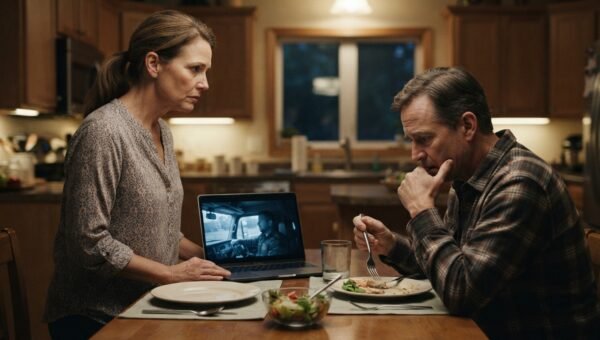
At my parents’ house, Dad sat at the kitchen table with the yellow notepad. He’d brought it home from dinner. The same percentages were still there. Mom stood by the counter, folding and unfolding a dish towel. I put the printed email on the table, then placed the pad beside it.
Dad tapped the page with his finger.
“Let’s just get this done,” he said.
“No.”
His mouth tightened. “You’re going to walk away from your family over money?”
I looked at Mom. She didn’t look back this time. She kept rubbing the towel between her hands.
I knew what Dad expected. He thought I’d start explaining. He thought I’d offer a smaller amount, or promise to help when I could, or get upset enough that he could call me selfish and end the conversation on his terms.
I didn’t do any of that.
“I accepted that when Mom said no,” I told him.
Mom stopped folding the towel.
Dad leaned back in his chair. “You’re being dramatic.”
“I’m not giving you my paycheck.”
“We raised you,” he said.
“And I’m grateful for what you did for me. That doesn’t make my income yours.”
He started to say something, then stopped and looked at the pad. His handwriting was neat. The numbers had been written with a ruler-straight line under them, like they were figures in a bill he expected me to pay.
I could see the whole trick then. The 50% was supposed to calm their money worries. The 30% was supposed to keep Beth dependent on them and me. The 20% was supposed to make the arrangement sound fair. It wasn’t a family plan. It was a test of whether I still believed being loved meant being useful.
Dad stood up. The chair scraped the floor.
“If you refuse, you can lose this family.”
I slid the notepad toward him. “I’m not paying to stay in it.”
That was the only time I saw his face change. Not much. His jaw worked, and he looked at Mom as if she might step in and put things back the way he wanted them. She didn’t.
I picked up the printed email. I left the pad on the table.
Mom followed me to the front door but didn’t touch my arm.
“Maybe give your father a few days,” she said.
“I gave him years.”
I didn’t raise my voice. I didn’t slam the door. I walked to my car and sat with the keys in my hand for a minute before starting it. My hands were shaking, which annoyed me more than it should have. I’d wanted to leave calmly, and I had. My body apparently had its own opinion.
The next few weeks were quiet. Dad sent one email saying I’d embarrassed him. Mom sent a photo of an old family Christmas and wrote that she hoped I remembered the good times too. I did remember them. I also remembered how often the good times came with a bill I was expected to cover later.
Beth found an apartment she could afford without my salary. She didn’t ask me for money. We haven’t talked much since, but she did send a text after she moved in: “I know this got weird. I’m sorry.” I wrote back, “I know Dad put you in the middle.” It wasn’t a full repair. It was a start.
I kept my distance from family gatherings where the invitation came with a hint about helping out. I didn’t announce a grand break. I just stopped agreeing to be the emergency account. My parents had to look at their own bills and make their own choices. That was hard for them. It was also not mine to fix.
My first day at the new job, I got to the office early. The room had a high window, and the morning light landed across the clean desk. I set down my coffee and opened a yellow notepad.
For a second I saw Dad’s handwriting beside my salmon. Then I turned to a blank page and wrote my own name at the top.
Nothing else was on it.