I was folding the last of Cal’s towels when I found the key in the back of his dresser drawer. I’d gone over to pack up the odds and ends he’d left after moving into his apartment. The key had a faded piece of string tied through its head, and I knew it belonged to my mother’s sewing cabinet.
I put it on the dresser and kept folding.
That sounds like nothing, but I’d been asking Cal about that key for weeks.
He said he’d lost it when he moved away. I thought maybe I’d find it in a box, so there it was. I remember feeling irritated more than relieved. He’d left half a drawer of socks and a grocery receipt from March, but somehow the one thing he’d said was gone had been sitting right there.
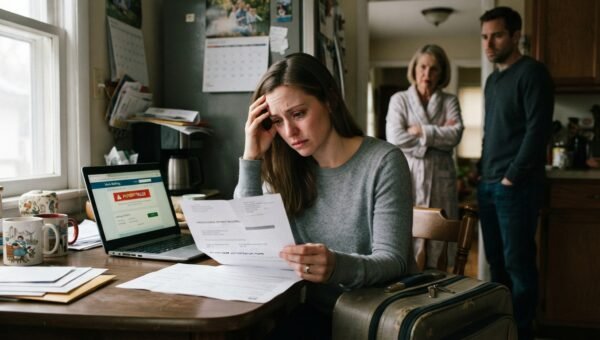
I had just put the key in my pocket when my phone rang. A woman from a fabric store asked if I’d placed an order using my loyalty number. Someone had bought twenty-seven identical baby blankets.
I said I hadn’t.
The woman, whose name was Denise, was careful about it. She said the order was marked for pickup and that my number had been used for the discount. It wasn’t a huge amount of money, but it was enough to be odd. I asked if she could tell me who placed it. She couldn’t, but she said the order included a delivery address.
“Can you send me the receipt?” I asked.
“I can send the order details,” she said. “I just wanted to make sure you knew.”
I thanked her and hung up. Then I called Cal.
He picked up with a grocery store in the background. “Hey, Mom.”
“Did you buy twenty-seven baby blankets?”
There was a pause. Then he laughed, that short little laugh he used when he thought I was being ridiculous.
“What?”
“Twenty-seven. At the fabric store. They used my loyalty number.”
“I don’t know what you’re talking about.”
I told him what Denise had said. He said the store must have mixed up the number. I asked if he’d been in that store lately.
“Maybe. I don’t know. Mom, it’s not a big deal.”
That answer bothered me more than the purchase. Cal usually hated owing anyone even a few dollars. He was careful with money, sometimes painfully so.
When I asked why the store had his new apartment address on the order, he stopped laughing.
“I’ll call them,” he said.
“Don’t. They’re sending me the receipt.”
“Mom, it’s probably just a mistake.”
“Then it’ll say that.”
The call ended awkwardly. I didn’t yell. I wanted to, but I didn’t. I’ve always been too quick to decide that if somebody’s avoiding a question, the worst answer must be the right one. It’s a bad habit. I was already adding up what else Cal might have kept from me.
The receipt came by email a few minutes later. The order was for twenty-seven matching blanket kits, billed with my loyalty discount, and the delivery address was a community family center near Cal’s apartment. I didn’t recognize the name.
I called him again. He answered right away this time.
“I’ve got the receipt,” I said.
He didn’t say anything.
“Cal?”
“I know.”
“What is this?”
“I’ll come over.”
“Why can’t you tell me on the phone?”
“I can. I just don’t want to do it on the phone.”
That made me more suspicious, not less. I had the little key in my pocket, and now I was wondering if the two things were connected. I took it out and set it on the table. The string tag was worn nearly blank. I could just make out my mother’s handwriting underneath the smudges.
I went to the hall cabinet. My mother’s sewing cabinet was mahogany, narrow enough to fit beside the coat closet. The lower drawers had been locked since she died. I’d never had much reason to open them. The upper part held a few old spools and the machine she used for mending. I hadn’t touched it in years.
One drawer was not shut all the way.
I pulled it open. The shears were there, along with a piece of tailor’s chalk and some scraps of flannel. But the pattern book I remembered was missing. So was the small ledger my mother used to keep beside her sewing things. I remembered seeing it when I cleaned out her house. I’d assumed I put it somewhere else.
I called Cal a third time, then stopped myself before I pressed his name. He’d said he was coming. I could at least let him walk through the door before I decided what he’d done.
Three weeks earlier, Cal had moved into his apartment. He’d been in a hurry, and we’d had a small argument about how much of his old stuff he planned to leave behind. I’m not proud of this, but I’d said, “You’re not twelve. You can pack your own boxes.”
He told me he had it handled. He always did. Cal is independent in a way that can make a mother feel useful only when something’s broken.
My mother, Mavis, had been the opposite with him. She found reasons to keep him busy. When he was little, she’d let him sit beside her while she sewed buttons back on my work shirts. I thought he was mostly there for the peppermints she kept in a bowl by the machine.
He was quiet at family gatherings, and my mother liked that he didn’t demand attention. I didn’t know he’d ever learned to sew. I’d have remembered. Or I thought I would have.
The first small thing I’d noticed after the move was a shopping bag Cal carried out of my mother’s house the week before. He said it had some old books and clothes. I didn’t ask to look. My mother had been gone for years, and I didn’t want to be the person who turned every box into an argument about what belonged to whom.
Then, the week he moved, he asked if I still had the cabinet key. I told him I thought I did. He said he’d lost his. At the time, it sounded like one more moving-day problem.
I didn’t connect any of it until the receipt showed the family center’s address.
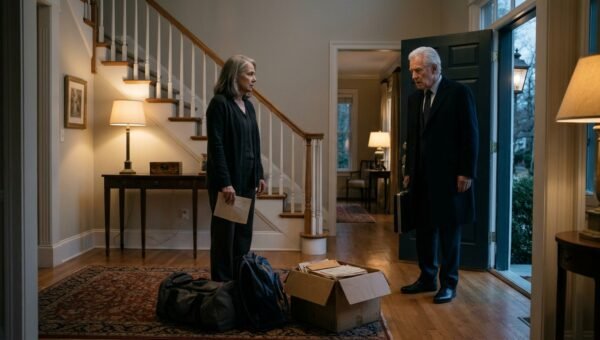
Cal arrived a little after eight. I heard his car pull in, then his steps on the porch. When I opened the door, he was holding a key on a faded string tag. It looked like the one I’d found, but older and more worn.
“Mom, I need you to forgive me before you ask who taught me this…”
I stepped back to let him in. I was still angry, but I heard how nervous he was. We sat at the kitchen table. He put the key down between us and kept one hand on it.
“I took it when I moved,” he said. “I’m sorry.”
“You told me you lost it.”
“I know.”
“Why?”
He looked at the key. “I didn’t want to explain before I knew I could do anything with it.”
That was a strange answer. I asked him what the blankets were for.
He told me a family center near his apartment had opened an emergency room for women with babies. A sudden housing problem had sent several families there over a couple of days. They needed supplies, and they needed blankets right away. The center had asked people nearby for help.
“I saw the list,” he said. “I knew what kind of fabric Grandma used.”
“Because you took her pattern book?”
“Because she taught me.”
He said it simply. I stared at him, waiting for the rest.
“She taught you to sew?”
“When I was a kid. A little at first. Then more.”
“Your grandmother?”
He nodded.
I had a whole set of questions ready, but that one had pushed the others out of the way. I felt left out, and that’s the plain truth. My own mother had spent afternoons with my son and never told me what they did. Cal had kept it from me too.
“Why was it a secret?” I asked.
“She didn’t want you to think she was making me do something I didn’t want to do.”
“I wouldn’t have thought that.”
“I know. I think I was the one who thought people would laugh.”
“Who would laugh?”
He shrugged. “The family. My friends. I don’t know. It seemed like a thing that was just hers and mine.”
I wanted to say I’d never have judged him. I did say it. But then I remembered a family cookout years ago, when Cal had helped my mother carry her machine into the dining room. I’d laughed and told him he was her little helper. He’d looked down at his shoes. I hadn’t thought about it again.
Maybe he had.
“She said sewing was useful,” he told me. “She said if somebody needed something, you didn’t have to make a big announcement. You just made it.”
That sounded like my mother. It also sounded like something I’d missed because she never said it to me that way.
Cal explained that he’d taken the key to get into the locked drawer. He wanted to find her pattern notes and see if he could make the same kind of blanket she used to make. He hadn’t planned on twenty-seven. The center had twenty-seven infants and small children coming in, and there weren’t enough blankets for the new families.
“I tried one first,” he said. “It was crooked.”
“Did you keep it?”
“Yeah.”
He reached into the canvas bag at his feet and pulled out a folded flannel blanket. The stitching wasn’t perfect, but it was close and even. I ran my thumb over the edge. The flannel felt soft, and it smelled faintly of the detergent he used in college, the cheap lemon kind that never quite covered the smell of a damp towel.
I knew that stitch.
My mother used it on the blankets she kept in a basket by her back door. She’d give one to anyone who came by with a new baby or a sick kid, and she never made a thing of it. I thought she’d bought them somewhere.
“Where did the store get my number?” I asked.
“I couldn’t open a business account on short notice, and your number gave me the discount. I thought I’d tell you after I got the order sorted.”
“You used my number without asking.”
“I did.”
“And you lied about the key.”
“I did that too.”
He wasn’t asking me to pretend those things were fine. That mattered. I was still mad, but it was not the same kind of mad I’d been before he came over. He had taken something that belonged to my mother and used my loyalty number. He’d also spent days trying to make blankets for people he didn’t know.
Both things were true.
“The second address is the center?” I asked.
“Yeah. I put their intake room, not the main office. The clerk sent the receipt there so the staff could watch for the shipment.”
I set the blanket down. “You could have told me.”
“I know.”
“You could’ve asked.”
“I know.”
I was making him say it because I wanted him to feel bad, which is not my best quality. He’d been afraid I’d judge him, and my first response had been to assume he’d done something shady. I could see my own part in it, even if I didn’t want to look too closely.
“Are the blankets finished?” I asked.
“Not quite. They need the edges hemmed. I can do it, but I’m slow.”
I glanced toward the hall. “Show me the pattern book.”
He picked up the tagged key. This time, I didn’t ask why he still had it. We walked together to the cabinet. He unlocked the lower drawer, and I saw the pattern book tucked behind the shears. The ledger was beneath it. My mother had written names, dates, and a short note beside each one. A baby expected in June. A family whose heat had been shut off. A girl from the church who had no crib.
No big stories. No speeches. Just enough information to remember what she’d promised.
Cal touched one page with a finger. “She let me help her choose what to make. Sometimes we’d sew something and she’d just say it was going to somebody who needed it.”
“She never told me.”
“I think she wanted it that way.”
I didn’t like being outside that part of my mother’s life. But looking at the ledger, I understood the choice better. There was no list of praise or who had given the most. Just names and small things that needed doing.
I also understood why Cal had wanted to carry it on by himself. He wanted to know he could do it before he brought me in. That didn’t make the lie okay. It made it human.
I asked him to bring the other blanket pieces over the next morning. He came back with the order, and I helped him check the seams against my mother’s notes. We called the family center together and confirmed the delivery time. The staff member thanked him, then thanked me, and I handed the phone back to him before she could say anything more.
I didn’t need credit for it. I had to think about that, because I’d spent years feeling like my mother had kept me out of the story.
The next afternoon, Cal and I finished the last blanket. He took the stack to the center and came back with an empty canvas bag. He said the staff had already given the blankets to the families. One woman had asked him to pass on a thank-you. He looked pleased, but he didn’t say much about it.
The key stayed on the table while we worked. This time it wasn’t proof of anything bad. It was just the way we got to the part my mother had left behind.
By the end, we were both tired. I set the final flannel edge under the presser foot, and Cal guided the fabric with one hand while I kept the seam straight with the other. The cabinet was open beside us. Under the work lamp, our hands moved together over the same piece of cloth.