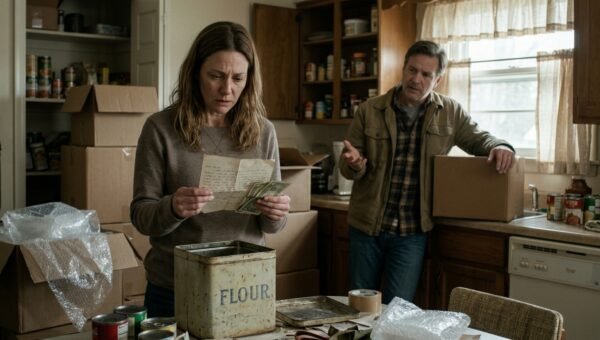
I had my knee against the last moving box and one hand under the flap when a stack of old report cards slid out onto David’s floor.
He was crouched beside me, sorting through a box marked KITCHEN in my handwriting. He picked up the papers before I could. They were in date order, clipped together, with a folded note tucked under the first one.
I recognized the school name. I recognized the years, too. Those were the years I worked evenings at the clinic and missed every parent conference.
David tapped the name written on the note. “Why did Marcus have these?”
There it was. The question I’d been trying not to make worse since David asked me to help him move. I sat down on the floor beside him instead of telling him he was being unfair. I’d done enough of that already.
The apartment was half packed. A roll of tape was stuck to my sleeve, and the box cutter was somewhere under a dish towel. David had been polite all afternoon, which is not the same thing as relaxed. Since I married Marcus, he’d kept his distance. He thought Marcus tried too hard to be his friend. I thought David was giving him too little credit.
I didn’t know yet that both of us had been missing something.
David looked at the stack again. “These are from the years you weren’t there.”
“I know.”
“I’m not trying to start a fight, Mom.”
“I know that, too.” I took a breath. “Let’s read it.”
I don’t know why I remember the paper feeling rough under my thumb.
Maybe because the rest of that day is fuzzy. I remember sitting on the floor. I remember David’s moving boxes. I remember that note. The rest comes back in bits.
David had been seven when I started working those evening shifts. I was on the clinic schedule until after the school conferences were over, and most weeks I picked up extra hours because rent didn’t care about my plans. I called the school when I could. I sent notes with David. I asked his teachers to call me after work, even when that meant talking in the car before I went inside.
I missed every scheduled conference anyway.
At the time, I told myself there would be another chance to show up. The next report card. The next school year. I was doing what I had to do, but that didn’t stop me from feeling like I was failing him.
I tried to make up for it in small ways. His lunch packed. His homework checked. The little notes I left near his cereal bowl when I’d already left for work.
David was a good kid. Quiet, mostly. He didn’t ask for much, which I used to take as proof he was doing fine. That was one of my mistakes.
He pointed to the corner of the first report card. There was a set of initials beside the school stamp: M.B.
“Those are Marcus’s,” I said.
“I know.” David turned the paper over. “He kept them in order. Why would he have any of this?”
The question was fair. Marcus and I hadn’t met until David was grown. We met at a community fundraiser, not through school or through David. I was in my late fifties then, tired of being the person who canceled dinner because a shift ran long.
Marcus made me laugh without acting like he was trying to impress me. We started having coffee. Then dinner. Then, after a while, I let myself believe I could have a life that wasn’t only work and worry.
David had been courteous when I told him I was seeing someone. He stayed courteous at the wedding. After that, he started getting short with Marcus.
Marcus would ask about his job, remember a detail David had mentioned, offer to help with something around the house. David heard all of it as forced. Once, after Marcus asked whether he wanted to come watch a game, David told me, “He’s trying too hard to be my friend.”
I got defensive. “He’s making an effort.”
“I didn’t ask him to.”
I said that wasn’t a reason to be rude. David stopped talking after that. Marcus didn’t complain, but I could tell he felt the distance. I also noticed he never pushed David to call him Dad. He never even hinted at it. Still, I thought he was trying to step into a place that wasn’t his.
Now Marcus’s initials were on David’s childhood papers.
The folded note had the old school letterhead at the top. The date was fifteen years earlier. I knew Marcus’s handwriting. His lowercase letters lean a little to the right, and he crosses his sevens with a short line. I’d seen it on grocery lists and birthday cards.
David unfolded it slowly.
“Do you want me to read it?” he asked.
“No. You read it.”
He read without moving his lips at first. Then his eyes stopped halfway down. I watched his face, trying not to fill in the blanks for him.
“What does it say?” I asked.
He handed it to me.
The note was a counseling memo. Marcus had written that David’s mother had called before each conference and explained her work schedule. He’d written that I was working long evening shifts and was still following up on David’s progress. Then, in one plain line, he’d written that David was a thoughtful boy who was deeply loved and doing well despite the strain at home.
At the bottom, Marcus had noted that he would keep the report cards together and make sure David wasn’t flagged as neglected for missed conferences.
I read it twice. It wasn’t a grand speech. It was a school employee making a record of what was true.
I pressed the paper flat against my leg. “He was there?”
David nodded toward the initials. “At my school?”
“I don’t know.” I could hear how weak that sounded. “I think we should call him.”
David didn’t answer right away. He stacked the report cards carefully, like they might tear if he moved too fast.
I had a choice. I could call Marcus privately, get a tidy explanation, and bring it back to David once I knew what to say. That was what I would have done years ago. I would have tried to manage everybody’s feelings, even if it meant leaving David out of the truth.
Instead I said, “Let’s call him now. We can all hear the same thing.”
David studied me for a second, then passed me his phone. I called Marcus.
He picked up after two rings. “Hey. Everything okay?”
“I’m with David,” I said. “We found something in his moving box.”
There was a pause. Not a long one. Long enough.
“His report cards,” David said. “You had them.”
Marcus let out a breath. “I did.”
“Why?”
“I was the vice principal at your middle school. I also handled counseling. Your mom’s name was on the conference schedule, but she kept calling to explain she couldn’t get away from work.”
I looked down at the papers. I remembered calling from the clinic hallway, trying to keep my voice low while the copier ran behind me. I remembered one teacher asking if I could come in before my shift. I’d said I’d try. I didn’t make it.
Marcus went on. “I knew you weren’t skipping because you didn’t care. I kept the cards together so your missed conferences wouldn’t turn into a note saying nobody was involved.”
David rubbed the corner of the memo with his thumb. “You wrote all this?”
“I did. I kept files on students I was worried about. It wasn’t just you. I didn’t want anyone getting marked as neglected when the parent was doing everything they could.”
“You remembered my mom?”
“I remembered her calls. I remembered that she always asked how you were doing before she asked about the grades.”
I had to look away from David. I used to start those calls with an apology. I’d say I was sorry I couldn’t be there, sorry I was calling late, sorry I’d missed another meeting. I thought the apology was the part people remembered.
Marcus said, “When I met her years later, I recognized the name. I recognized you, too, once she told me. I didn’t want to bring up something hard from when you were a kid. And I didn’t want her to think I was trying to claim a place in your life because I’d worked at your school.”
“Why didn’t you just tell us?” David asked.
“Because it wasn’t mine to use. I didn’t want your mom to feel guilty. I didn’t want you to feel like you owed me anything.”
I could hear him shifting the phone, probably sitting down. Marcus has a habit of doing that when he’s thinking. He doesn’t rush to fill a quiet spot.
David looked at me, then at the note. “So you weren’t trying to get in the middle of things.”
“No,” Marcus said. “I was trying to stay out of the middle of things.”
That was the first time all afternoon David smiled. It wasn’t much, just one side of his mouth. But it changed the way he was holding his shoulders.
I wanted to tell him I’d been right about Marcus all along. I didn’t. I wasn’t right. I’d defended Marcus without listening to David, and David had assumed every kind offer was an attempt to take over. We had both made the simple thing harder.
I said, “I’m sorry I kept telling you what you should think of him.”
David looked down. “I’m sorry I treated every question like it was a trick.”
Marcus started to say something, then stopped. That’s one thing he does well. He lets people finish.
David picked up the note again. “You really kept these all this time?”
“I kept records from a few kids I thought needed an adult in their corner,” Marcus said. “I never planned to hand them to you. I guess I should’ve figured you’d come across them someday.”
“Is that why you had that old school mug in your office?”
Marcus gave a small laugh. “That mug was from the school. I’m not sure it survived the move.”
David glanced toward the stack of boxes. “I still need help putting my shelves together.”
“I’d be glad to help,” Marcus said. “Only if you want me there.”
David was quiet, but this time it didn’t feel like a wall. He looked at me, perhaps checking whether I was going to answer for him.
“I want you to,” he said into the phone. “Could you come by Saturday?”
“Sure,” Marcus said. “Tell me what time.”
“After lunch. I’ll text you.”
They said goodbye. David gave the phone back to me, and I ended the call.
For a minute we sat on the floor with the old cards between us. I was thinking about all the times I’d left work with a paper lunch sack in my bag and found David asleep before I got home. I’d thought those years belonged to me alone, to carry as proof that I hadn’t done enough.
Marcus had seen me trying. Not every day. Not in some big, shining way. He’d heard the calls. He’d kept a record. And years later, he’d kept quiet because he didn’t want my old guilt to become the price of loving me.
I can’t say that undid the missed conferences. It didn’t give David back the times I wasn’t there. But it did make room for something else to be true. I had been working because I loved him. Someone else had noticed.
David put the report cards back in their stack. “I want to keep this note with my stuff.”
“Of course.”
He didn’t ask me to take the papers home. He didn’t tuck them into a drawer to deal with later. He set them on the kitchen counter, beside the new keys to his apartment, and placed Marcus’s note right next to them.
Then he picked up his phone and sent Marcus the time for Saturday.
The report cards stayed beside David’s keys, with Marcus’s note at the top.