PART 1
My son Tyler asked me to co-sign a $38,000 truck loan exactly fourteen days after he stood in my kitchen and told me I was too old-fashioned to understand how modern finances work.
I was sixty-one, living on a modest state clerk pension and a small life insurance payout my husband left behind five years ago. I kept an old green ledger on the corner of my counter where I balanced my utility checks down to the nickel.
Tyler hated that notebook. He called it an antique relic of people who were afraid of building leverage. He was thirty-two, selling commercial plumbing fixtures on straight commission, and convinced that looking wealthy was the first step to becoming wealthy.
“Mom, it is not a risk,” he had argued that afternoon, tapping the dealership brochure on my table. “It’s an F-250. Crew cab. My clients judge me the second I pull up to a job site. If I show up in that ten-year-old sedan, they think my company is failing. I just need your signature to bring the interest rate down four points.”
“Tyler,” I said gently, “if your commission dips during the winter freeze, that seven-hundred-dollar monthly payment still comes due. If you miss it, the bank comes after my house.”
He pushed his chair back so hard the wooden legs screeched against my linoleum. “You live like you’re waiting to starve, Mom.
You really do. You’re too old-fashioned to give advice to someone actually trying to get ahead.”
He walked out my front door and slammed it. For an entire month, he did not call. He didn’t bring my two grandchildren, Leo and Sadie, over for Sunday pot roast. When I dropped off a tin of homemade cinnamon rolls on his porch for his birthday, he texted back a single word: “Thanks.”
Then my bedside phone rang at 1:12 a.m. on a Tuesday.
The caller ID showed his wife, Kelly. When I answered, she was crying so hard she was gasping for air. Her voice sounded like paper tearing.
“Evelyn… please,” she sobbed. “Please come get the kids. Just take them to your house right now.”
“Kelly, what’s happening? Did Tyler get hurt?”
“No,” she choked out. “Just get them before they see this. Please hurry.”
I threw a heavy coat over my nightgown, slipped my feet into my sheepskin slippers, and grabbed my car keys without even washing my face.
It took me forty minutes to make the drive across town. The highway was empty, wet with mist, and my hands gripped the steering wheel until my knuckles turned white.
When I turned down their quiet suburban street, the first thing I saw was the strobing blue and red light reflecting off the wet asphalt. Two squad cars were parked crooked in Tyler’s driveway, blocking the garage.
I parked by the mailbox and stumbled out into the cold damp air. Tyler was sitting on the damp concrete curb in his sweatpants, his wrists cuffed behind his back. His face was red and twisted up with pure fury. Standing beside him was a uniformed patrol officer, and another man in a dark windbreaker was holding a thick manila folder under the yellow glow of the driveway security lamp.
The front door of the house cracked open. Kelly slipped out holding seven-year-old Leo and four-year-old Sadie by their hands.
The kids had their winter coats zipped over their pajamas. Kelly looked hollowed out, her cheeks stained with mascara, but she didn’t look toward the curb where Tyler sat. She shoved the children toward my car.
“Take them inside your car, Evelyn. Please don’t let them look,” Kelly whispered, her hands shaking as she buckled Sadie into the back seat.
Tyler spotted me through the flashing lights. He lurched upward, but the officer put a firm hand on his shoulder and pushed him back down onto the curb.
“Mom!” Tyler yelled across the yard, his voice cracking with desperation. “Tell them! Tell them I didn’t do this! Tell them it’s a mistake!”
The man in the windbreaker turned around. He pulled out a laminated badge showing he was a detective with the county sheriff’s financial crimes unit.
“Are you Evelyn Hayes?” the detective asked.
“I am,” I said, my slippers soaking through from the wet grass. “What on earth is going on here? Why is my son in handcuffs?”
“A local credit union flagged a fraudulent auto loan application submitted forty-eight hours ago,” the detective explained, his voice flat and routine. “For thirty-eight thousand dollars, drawn against your name as primary co-applicant. The loan was approved yesterday afternoon, and a delivery hold was placed when their fraud department caught an altered identity document.”
The detective opened the folder and pulled out a stapled copy of the digital paperwork.
“Tyler claims he has no knowledge of the application,” the detective said, angling the paper so the porch light hit the bold printed ink. “He claims someone else stole your identity.”
My eyes went straight down to the co-signer signature block.
My full name was typed there: Evelyn Marie Hayes.
Right below it was my correct Social Security number, along with my home address and my exact date of birth.
And right across the signature line, in dark, looping ballpoint ink, was a signature.
My son yelled from the curb again, “Mom, you know I wouldn’t forge your name! Tell him!”
I stared at that signature. The loops on the capital E were small and tight. The crossbar on the H didn’t touch the second vertical line. It was slightly slanted to the left.
It was not Tyler’s handwriting. Tyler wrote in sloppy, jagged, all-caps print, like an engineer rushing through a blueprint.
I knew that exact handwriting. I had looked at it on grocery lists stuck to their refrigerator. I had seen it on every Christmas card sent to my house for the past eight years.
It was Kelly’s.
PART 2
I looked from the paper toward the driveway where Kelly stood near the open door of my sedan.
She wasn’t crying anymore. She was standing completely still under the porch light, her arms wrapped around her ribs, watching my face. When our eyes met, she didn’t look surprised. She looked exhausted, like a woman who had been waiting for a floor to collapse beneath her feet.
“Mrs. Hayes?” the detective asked, studying my expression. “Does that signature belong to you?”
“No,” I said. My voice was surprisingly steady, though my heart was knocking hard against my ribs. “I never saw these papers. I never agreed to this.”
Tyler surged forward again from the curb, straining against the cuffs. “See? I told you! I told you she didn’t sign it! Now get these damn things off me! Somebody hacked our information!”
“Tyler, shut your mouth,” I said.
I had not spoken to him in that tone since he was sixteen years old. It cut right through his shouting. He froze, his mouth hanging half-open, blinking at me through the cold drizzle.
I turned back to the detective. “Did this application come from Tyler’s computer?”
“It came from an IP address registered to this house,” the officer answered. “Submitted Sunday night at 11:40 p.m. It included a scanned image of your driver’s license, Mrs. Hayes. But the file was cropped poorly, and when the loan processor checked the state registry database, the document issue date didn’t match their verification system. That’s what triggered the manual fraud review.”
My driver’s license.
Two weeks ago, while Tyler was still giving me the silent treatment, Kelly had offered to take me to my annual eye exam. I had left my purse on their kitchen island while I helped Leo find his missing soccer cleats in the garage. My purse had been unzipped when I came back into the room. At the time, I assumed Sadie had been digging for peppermint candies.
“Detective,” I said, keeping my hands deep in my coat pockets so he couldn’t see my fingers trembling. “My grandchildren are half-asleep in my backseat. Can I please walk my daughter-in-law inside for five minutes to figure out what needs to happen with the kids?”
The detective looked at Kelly, then looked back at me. He was an older man, maybe fifty-five, with tired eyes that had seen plenty of family messes.
“The children can stay with you tonight regardless, ma’am,” he said. “Your son is being taken downtown for processing on suspected identity theft and grand larceny. If you need to speak with his wife, do it on the porch. She stays in my sight.”
“Fair enough,” I said.
I walked over to my car, rolled down the driver’s side window an inch, and told Leo that Grandma was going to take them to her house for warm cocoa and cartoons in just a few minutes. The little boy nodded, his eyes heavy with sleep, clutching his stuffed dinosaur.
Then I walked over to the porch where Kelly was waiting.
She didn’t try to run inside. She pulled her sweater tighter around her neck as the cold wind whipped around the corner of the garage.
“You used my Social Security number, Kelly,” I said, keeping my voice low so the officers couldn’t hear every word. “And you took a picture of my license off my kitchen island.”
A tear tracked down Kelly’s cheek, catching the yellow light of the bulb above us. She looked down at her bare feet on the wooden decking.
“He was going to lose his job, Evelyn,” she whispered. Her voice was cracked, raw from hours of private panic. “You think he wanted that truck to look fancy? The company cut his base salary to zero in August. They gave him an ultimatum: either he starts traveling the rural commercial accounts three counties out, or they replace him with an outside hire. His old car broke its transmission three weeks ago. He’s been renting a car on a maxed-out credit card just to drive to meetings.”
I stared at her. “He told me he wanted a crew cab to impress high-end clients.”
“Because he would rather choke to death on his own pride than admit he’s failing,” Kelly said, her jaw tightening. “We are four months behind on the mortgage. The foreclosure notice came on Friday in a bright pink envelope. Tyler hid it under the floor mat in his trunk, but I found it.”
She looked up at me, and the desperation in her face made her look twenty years older.
“He begged you for help, Evelyn. When you said no, he came home and threw a plate across the kitchen. He said his own mother was sitting on cash while his kids were about to lose their bedrooms. He told me he was going to apply online anyway and just put you down as a guarantor because ‘she’ll never know once I start making the payments.'”
“So he asked you to forge it?” I asked.
Kelly shook her head slowly. “No. He sat at the kitchen table with a bottle of whiskey until two in the morning on Sunday, trying to copy your signature from an old birthday card. His hands were shaking so bad the pen went through the paper. He passed out on the rug.”
She took a shuddering breath.
“I looked at the pink notice on the table. I looked at the eviction date. And I did it myself. I uploaded the scans. I typed in your numbers. I signed the line. Tyler woke up yesterday morning thinking the loan had gone through on his own submission. He didn’t even know I touched the computer.”
Down on the driveway, the officers were helping Tyler into the back of the cruiser. He was still craning his neck, yelling my name, demanding that I fix this. He honestly believed he was a victim of an anonymous internet hacker.
“Kelly,” I said, my chest aching with an unbearable heaviness. “The police aren’t going to let this go. If I tell them Tyler didn’t do it, they are going to arrest you.”
Kelly looked down at the patrol car, where our boy sat trapped in the steel cage of the back seat.
“I know,” she whispered. “If they take both of us, what happens to Leo and Sadie?”
PART 3
The cruiser door slammed shut with a heavy, metallic thud that echoed down the quiet street. The sound cut straight through the cold air.
I turned around and looked at the patrol car. Tyler’s face was pressed against the glass, distorted and furious. He was watching his wife and his mother standing on the porch, waiting for the cavalry to arrive. He had spent his whole life believing that when things went sideways, someone else would quietly absorb the damage.
I looked back at Kelly. Her teeth were chattering, partly from the cold and partly from sheer terror.
“Go inside,” I told her quietly. “Get the kids’ backpacks. Pack three days of clothes for Leo and Sadie. Grab their school folders and Sadie’s medicine.”
“Evelyn, what are you going to tell them?” Kelly’s voice was a desperate whisper.
“Go pack the bags, Kelly. Do it right now.”
She turned and slipped through the front door.
I walked down the three porch steps, my slippers dragging through the wet grass, and approached the detective. He was leaning against the hood of his vehicle, writing notes on a clipboard.
“Mrs. Hayes,” he said, clicking his pen. “We’re transporting your son to the central booking facility. The credit union is pressing charges for attempted bank fraud. Because your personal identifiers were used, the county attorney will need a formal sworn statement from you in the morning confirming you did not authorize the loan.”
I stood there in the damp mist, looking at the manila folder resting on the hood of his car.
“Can I see that signature page one more time?” I asked.
The detective hesitated, then flipped the folder open. He pointed his flashlight beam directly at the bottom of the page.
There it was. Evelyn Marie Hayes. Written in the neat, rounded hand of a thirty-year-old mother who had spent midnight trying to keep a roof over her children’s heads.
“Detective,” I said slowly, measuring every single syllable. “My son did not submit this application.”
The detective paused, his pen resting above the yellow legal pad. “Ma’am, the IP address matches his home internet. The vehicle was slated for his delivery.”
“I am aware of that,” I replied. “And Tyler is an arrogant, reckless boy who refuses to admit when he is drowning. But Tyler did not sign my name. I know his handwriting. That signature is not his.”
The detective looked at me closely. His eyes drifted over my shoulder toward the front door of the house, where the hall light was blazing. He wasn’t stupid. He worked fraud cases for a living. He had probably seen this exact tragedy play out a hundred times in middle-class neighborhoods where pride outpaced the bank account.
“If your son didn’t sign it,” the detective said quietly, “then someone else in that house committed a Class 3 felony. You understand what happens if you point that finger, Mrs. Hayes?”
My throat felt tight, like someone had wrapped a rough cord around it.
I had forty-one thousand dollars left in my husband’s retirement account. That money was supposed to be my safety net for the next twenty years. It was supposed to pay for my roof repairs, my dental work, and the heating oil when the winter temperatures dropped into the single digits. It was my independence. The very independence Tyler had mocked two weeks ago when he told me I lived like I was waiting to starve.
If I let Tyler sit in that jail, his commission job was gone by sunrise. If I let Kelly take the fall, my grandchildren would watch their mother led away in irons, and the state would come knocking on my door with protective custody paperwork while their parents fought felony charges in separate courtrooms.
“Detective,” I said, looking him dead in the eye. “What is the status of the loan itself right now?”
“It was flagged before funding,” he said. “The dealership never released the truck. No funds were disbursed. The credit union caught it at the verification desk.”
“So the bank suffered zero financial loss.”
“Attempted fraud is still a crime, ma’am.”
“Yes, it is,” I said. “And identity theft requires a victim who claims they were defrauded.”
The detective stopped writing. He lowered the clipboard.
“Are you telling me you authorized this, Mrs. Hayes?”
The lie sat heavy and bitter on my tongue. It felt like swallowing ashes. Everything in my upbringing, everything my late husband and I had built, was rooted in honesty and personal accountability. Lying to an officer of the law went against every grain of my character.
“I am telling you,” I said, each word deliberate and firm, “that my family was in the middle of a catastrophic breakdown over this purchase. I am telling you that my documents were accessed with my knowledge two weeks ago when I brought them into this house. I am telling you that I will not sign a sworn complaint against my son, and I will not sign a complaint against his wife. If the credit union wants to decline the loan, they should decline it. We have no intention of pursuing that vehicle.”
The detective stared at me for a long, silent minute. The rain was starting to fall harder now, drumming against the metal roof of his squad car.
“You’re covering for them,” he said flatly. It wasn’t an accusation; it was a simple statement of fact.
“I am taking my grandchildren home,” I said. “Their father is sitting in your car in his sweatpants because he is too cowardly to tell his family he went broke. If you want to hold him overnight on suspicion, that is your discretion. But you will not have my signature on a criminal complaint.”
The detective looked at the squad car, where Tyler was still watching us through the glass. Then he let out a long, slow breath through his nose and closed the manila folder with a sharp slap.
“Wait here,” he said.
He walked over to the squad car, opened the rear door, and spoke to the patrol officer inside. There was an argument. Tyler started shouting again. The detective leaned in, said three or four sharp words, and Tyler went instantly quiet.
Two minutes later, the patrol officer stepped out, opened the opposite rear door, and pulled Tyler out onto the wet asphalt. He unlocked the handcuffs.
Tyler rubbed his red, chafed wrists, looking completely bewildered. He took two steps toward me, his face pale and slack.
“Mom,” he stammered, his voice trembling. “They… they let me go. Did you tell them about the hacker? Did you tell them someone stole your info?”
Kelly opened the front door of the house carrying two small backpacks and a plastic grocery bag stuffed with children’s sneakers. She stopped on the porch, seeing Tyler standing free on the driveway.
I didn’t answer Tyler. I didn’t look at his face.
I walked past him, took the bags from Kelly’s trembling hands, and set them on the passenger seat of my car.
“Get in the house, Tyler,” I said without looking back. “Both of you. Sit at the kitchen table. Do not touch your phones. I am putting the children to bed at my house, and I will be back here in one hour.”
ENDING
I tucked Leo and Sadie into the twin beds in my spare room at 2:45 a.m.
Leo was confused, but I told him that Mommy and Daddy had some grown-up plumbing work to do at the house and that he was on special sleepover duty. I left the small ceramic turtle nightlight burning in the corner of the hallway, closed the door partway, and drove back across town.
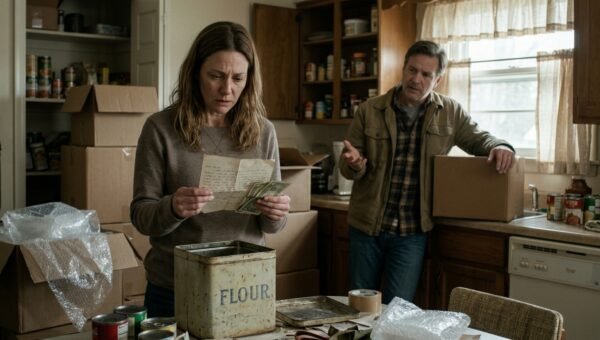
The pink foreclosure notice was sitting in the middle of Tyler’s kitchen table when I walked in through the unlocked back door.
Tyler was sitting on the left, his head buried in his hands. Kelly was sitting across from him, her eyes swollen completely shut, staring at the scarred wooden tabletop. The bottle of cheap whiskey was sitting on the counter, unopened.
I didn’t take off my winter coat. I stood at the end of the table, pulled my damp slippers off, and stood there in my wool socks.
“You’re not going to jail,” I said. The room was deathly quiet except for the hum of the refrigerator. “The detective cleared the call as a domestic civil dispute because I refused to sign the victim affidavit. The credit union will cancel the file and blacklist your names from their branch. That is the end of the police.”
Tyler looked up, his eyes bright with tears. “Mom, I swear to God, I didn’t know Kelly did that. I swear I didn’t ask her to sign your name. I just… I didn’t know how to stop it. The company cut my pay, and every time I looked at the kids, I felt like I was suffocating.”
“You let your wife believe that committing a felony was the only way to keep your children from being thrown into the street,” I said. My voice was quiet, but it filled that kitchen like lead. “You bragged to me about leverage. You called me an old-fashioned relic because I don’t buy things I cannot afford. And when the walls closed in, you let the mother of your children commit identity theft because you were too proud to say the words ‘I failed.'”
Tyler flinched as if I had struck him across the face. He didn’t speak. He couldn’t.
I pulled an envelope from my coat pocket and placed it on the table right over the pink foreclosure notice.
“There is four thousand dollars in cashier’s checks in that envelope,” I said. “That will cure the mortgage arrears through next month and stop the sheriff’s sale.”
Kelly let out a broken, ragged sob and reached for my hand, but I pulled my hand back.
“Do not thank me,” I said. “That is not a gift. It is not an advance on an inheritance. In the morning, Tyler, you will drive your broken car to the scrap yard and sell it for parts. You will call the bus line, and you will take the transit bus to your office. If your company fires you because you don’t have a thirty-eight-thousand-dollar truck, then you walk across the street and you apply for work at the distribution warehouse. They are hiring night-shift pallet loaders at twenty-two dollars an hour.”
Tyler looked down at the envelope, his jaw working silently.
“And tomorrow afternoon,” I continued, looking directly at Kelly, “the two of you are coming to my bank. You will sign a legally binding promissory note securing that four thousand dollars against the equity of this house. Every single Friday, you will bring forty dollars in cash to my kitchen table. Not a check. Not a digital transfer. Cash. You will hand it to me, and you will watch me write it down in that old green ledger you laughed at.”
“Mom,” Tyler whispered, tears rolling down his cheeks. “Please.”
“If you miss one Friday,” I said, “I will take that promissory note to the county courthouse myself. And Kelly, you will surrender your power of attorney on Tyler’s accounts. Every single dollar that comes into this house will be accounted for on paper.”
I turned toward the back door.
“Evelyn,” Kelly cried out softly. “Why are you doing this? After what I did to you?”
I paused with my hand on the brass doorknob. The cold air was seeping in through the bottom weatherstripping, chilling my feet.
“I didn’t do this for you,” I said without turning around. “And I certainly didn’t do it for Tyler. I did it because Leo and Sadie are sleeping in my spare room right now, and they deserve to wake up tomorrow believing their family is still worth saving.”
I walked out into the dark yard, pulled the door shut behind me, and drove home through the empty streets.
The rain had finally stopped by the time I reached my driveway. The dawn was just starting to break over the tops of the pine trees, turning the grey clouds to pale silver.
I went inside, washed my hands with hot water, and sat down at my kitchen table. I opened my green ledger to a fresh page, took out my black ballpoint pen, and wrote the date at the very top. Then I closed the book, went down the hall, and sat in the rocking chair outside my grandchildren’s bedroom door to wait for them to wake up.