PART 1
The store debit card was supposed to be for milk, sandwich bread, and the brand of string cheese my grandkids liked.
I gave it to my daughter, Lauren, eleven months ago. She was thirty-four, working in medical billing, and constantly stressed about money. Her husband, Mark, had taken a pay cut after his warehouse changed shifts, or at least that was what Lauren told me. I am sixty-seven, living on my late husband’s pension and Social Security.
I do not have a fortune, but I had enough in my checking account to link a two-hundred-dollar weekly limit to a regional grocery debit card.
The agreement was simple. Every Friday afternoon, I drove twenty minutes over to their house to take care of nine-year-old Toby and six-year-old Chloe. Lauren told me her department had taken on contract work for an outpatient surgical center three counties over. She said the overtime hours were mandatory, running from four in the afternoon until close to midnight every single Friday.
“Mom, you’re saving our lives,” she told me when it started. “Mark gets home around six, but he’s dead on his feet and has to be up by five on Saturdays. If you can stay until I get back, we won’t have to pay after-school care.”
PART 2
The room went completely still, except for the hum of the refrigerator.
Mark didn’t drop his fork. He just froze, his thumb resting against the rim of his plate. He didn’t look at me. He looked straight at his son.
“Toby,” Mark said, his voice dropping low and quiet. “Finish your dessert in the living room. Take Chloe with you.”
“Did I say something bad?” Toby asked. His eyes darted between his mother’s pale face and his father’s rigid shoulders. “I saw the key card in your glove box when we got the soccer cleats, Dad. It had the same green mountain picture on it.”
“Living room, Toby. Right now,” Mark repeated, not shouting, but with an edge that left no room for an argument.
Toby grabbed his bowl and his sister’s hand, sliding off the stools. The television in the den clicked on a few seconds later, the muffled sound of a cartoon filling the silence they left behind.
I turned back to my daughter.
Lauren had both hands pressed flat against the laminate countertop. She looked like she wanted to run out the back screen door.
“Mom,” she started, her voice shaking so hard the word barely came out. “It’s not what you think. I swear to God it’s not what you think.”
“Then tell me what I should think, Lauren,” I said. My voice was level. When my husband Arthur was alive and things got bad, he taught me never to raise my voice when you hold all the facts. It gives the other person room to claim you’re hysterical. “Because for eleven months, I have sat on that sofa every Friday night until midnight. I thought you were working sixty miles away to pay your electric bill. And every Friday, seventy dollars gets pulled out of my checking account to rent a room at a highway motel.”
I looked across the table at Mark.
“And now my grandson tells me his father has the key cards in his truck.”
Mark put both hands on the table and let out a long, ragged breath.
He rubbed the bridge of his nose, right between his eyes, looking older than thirty-six.
“Tell her, Lauren,” Mark said. He didn’t look at his wife with anger. He looked at her with a heavy, exhausted bitterness. “Tell her, or I will.”
“Mark, please don’t,” Lauren whispered, tears suddenly spilling over her lashes. “Please.”
“No,” Mark said, turning his chair toward me. “I’m done lying for you, Lauren. I’ve been done for six months. Your mother deserves to know why her money is gone.”
“Mark!” she cried out.
“Your daughter doesn’t have an overtime shift, Evelyn,” Mark said directly to me. “She hasn’t worked at the surgical billing group since last September. They fired her for falsifying payroll sheets.”
The air felt thin in my lungs. “She told me she was promoted.”
“She was let go,” Mark said plainly. “She couldn’t find another billing job without a reference. So she started doing contract medical coding from her laptop. Only she wasn’t doing it. She was spending eight hours a day on online sweepstakes and retail auctions. By November, she had run our credit cards to the limit. Twenty-two thousand dollars in debt.”
“I was trying to win it back!” Lauren sobbed, burying her face in her hands. “I had a system, Mark! I was going to pay off the minivan!”
“You didn’t pay off anything,” Mark said. His voice was entirely flat now, stripped of emotion. “When our bank accounts went negative in October, I took her name off my paycheck deposit. I put us on a cash allowance. I took her car keys during the day so she couldn’t drive around spending money we didn’t have.”
I sat there, looking from my daughter to my son-in-law. “If she didn’t have money, and she didn’t have a job, what is the hotel?”
Mark pointed a finger at the receipt sitting between us.
“She rented that room every Friday so she had an address with high-speed internet that didn’t show up on our home router,” Mark said. “She was taking cash advances off whatever cards she could find. When I found out in March, I followed her there. That’s why Toby saw the key card. I went to that motel room on a Friday night, kicked the door until she opened it, and found her sitting on the bed with three burner phones and your grocery card on the nightstand.”
I felt my heart thump against my ribs, hard and dull.
“You knew in March?” I asked Mark. “You knew in March that she was using my card?”
Mark flinched. For the first time, he looked down at the table.
“I didn’t know whose card it was at first,” Mark said quietly. “She told me it was a prepaid card a friend gave her. When I saw your name stamped on it, I took it away from her. I cut it in half right in front of her.”
“Then how,” I asked, tapping the paper on the table, “did she charge seventy-four dollars on it nine days ago?”
Lauren didn’t answer. She just stood by the sink, crying into a dish towel.
Mark looked back up at me, his jaw clenched tight.
“Because she didn’t need the plastic card anymore, Evelyn,” he said. “She had the numbers memorized.”
PART 3
I didn’t yell. I didn’t push my chair back.
I reached into my purse, took out the entire stack of register tapes Beverly had printed for me, and dropped the heavy roll onto the table. It uncoiled across the wood, spilling past the butter dish and hanging off the edge like a white paper ribbon.
“Look at it, Lauren,” I said.
She wouldn’t look. She kept her face pressed into the damp yellow towel.
“Three thousand, four hundred and twenty dollars,” I told her. “That is five months of my grocery budget. That is the property tax on my house for an entire year. You stood in this kitchen every single Sunday and asked if I could watch your children so you could ‘get ahead.’ You watched me pack peanut butter sandwiches from home so I wouldn’t spend money eating out.”
“Mom, I was going to pay you back,” she wept, her voice muffled by the cloth. “I swear I was. I hit a four-thousand-dollar payout on a digital bingo app two weeks ago, but they put a hold on the transfer because of tax verification. As soon as it clears, I was going to put every dollar back into your account!”
“There is no four-thousand-dollar payout, Lauren,” Mark interrupted. His voice was cold. “You told me the exact same story about an auction payout in April. And in June. And in August. It’s a scam. You give them fifty dollars to buy tokens, they show you fake winnings on a screen, and then they ask for three hundred more to ‘release’ the funds. You’ve been pouring her grocery money down an internet hole.”
“It’s not a scam!” she screamed, dropping the towel. Her face was blotchy, her eyes swollen red. “I’m trying to fix this family! You treat me like a child, Mark! You took away my debit card! You check my mileage! What was I supposed to do?”
“You were supposed to get an honest job!” Mark shouted back, finally losing his temper. “You could have worked at the grocery store! You could have worked at Target! But you were too proud to let your mother know you got fired, so you stole from her instead!”
“Stop it,” I said.
I didn’t yell, but the tone of my voice cut through the kitchen like a razor.
Both of them stopped. Mark closed his mouth, his chest heaving. Lauren sank slowly into an empty chair, clutching her elbows.
In the living room, the cartoon theme song was still playing. Neither of the children made a sound. Toby was old enough to know what angry adult voices meant.
I looked at Lauren. I remembered holding her when she had the chickenpox at seven years old. I remembered helping her pick out her first business suit when she graduated from community college. I had spent thirty-four years believing my daughter was responsible, capable, and honest.
“You stole from me,” I said. “Not a bank. Not an insurance company. You stole from your mother.”
“Mom, please,” she whispered.
“I called the credit union yesterday morning, before I came here,” I said. “I spoke with the branch manager. Because your name was never on the checking account, and because you only had authorization to buy groceries at the local store, every single hotel charge qualifies as unauthorized card use.”
Lauren’s eyes widened with terror. “What does that mean?”
“It means if I sign the fraud affidavit, the bank reverses the charges, investigates the motel’s terminal records, and files a police report for identity theft and credit card fraud,” I said.
Mark didn’t say a word. He knew what a felony charge would do to their family, to their house, and to his custody of those two children in the next room.
“Are you going to send me to jail, Mom?” Lauren asked, trembling. “Over three thousand dollars? I’m your daughter.”
“Don’t you dare use being my daughter as a shield,” I told her, my voice steely and steady. “You didn’t remember you were my daughter when you handed that motel clerk my card forty-four times while I wiped your children’s noses for free.”
I stood up from the table. I picked up my purse and slung the strap over my shoulder.
“I am not signing the fraud affidavit tonight,” I said.
Lauren let out a ragged sob of relief, but I held up a hand to stop her.
“Do not thank me,” I said. “I’m not doing it for you. I’m doing it because Toby and Chloe don’t deserve to watch police cruisers pull into this driveway on a school morning. Here is what is going to happen.”
I looked directly at Mark.
“You are going to take three hundred dollars in cash out of your paycheck every two weeks, starting this Friday,” I told him. “You will bring it to my front door in an envelope. If an envelope is one day late, I walk into the credit union branch on Main Street and I sign the criminal fraud packet. It will take you just under six months to pay back the three thousand, four hundred and twenty dollars.”
“I’ll pay it, Evelyn,” Mark said immediately. “I have a side job lined up doing drywall on weekends. I’ll make sure you get every cent.”
“Good,” I said.
Then I turned back to Lauren.
“As for you,” I said, “I have cancelled the card entirely. My accounts are locked with a security password you will never guess. And as of tonight, I am done babysitting.”
“Mom, no,” Lauren pleaded, reaching toward my sleeve. “I need you. We can’t afford child care. Mark has to work.”
“Then you will stay home and look those two children in the eye every day,” I said, pulling my arm away from her touch. “You will find a job within walking distance, or you will figure out how to be a mother without using me as your cover story. Do not call me to complain about money. Do not call me to ask for a ride. The only reason we will speak for the next six months is when Mark drops off my money, or if my grandchildren want to hear my voice on the phone.”
ENDING
I walked out of the kitchen, down the short hallway, and stepped into the living room.
Toby and Chloe were sitting cross-legged on the carpet, their empty ice cream bowls on the coffee table. Toby looked up at me as I zipped my jacket. His face was guarded, the way children’s faces get when they know the ground underneath them has shifted.
I knelt down on the rug between them. I pulled Chloe into a hug, kissing the top of her hair, and then I put my hand on Toby’s thin shoulder.
“Grandma has to go home now, sweetheart,” I told him gently.
“Are you coming back next Friday?” Toby asked.
I swallowed the lump in my throat. It was the hardest thing I had done since burying my husband six years ago.
“Not next Friday, Toby,” I said, keeping my voice soft so he wouldn’t hear the break in it. “Your dad and mom are going to be taking care of you on Fridays now. But I love you. Both of you. That never changes, okay?”
He nodded, not fully understanding, but accepting it the way kids do.
I walked out the front door, got into my sedan, and drove home in the dark.
When I reached my house, the living room felt colder than usual. I hung my coat in the hall closet, set my keys in the ceramic dish by the door, and walked into the kitchen. My tablet was on the counter, blinking with an unread text notification from Lauren.
I didn’t open it. I pressed the power button on the side until the screen went completely black.
That was four months ago.
Mark has kept his word. Every other Friday afternoon, right around five o’clock, his beat-up work truck pulls into my driveway. He walks up the front steps, rings the doorbell, and hands me a white business envelope with three hundred dollars in twenty-dollar bills. He doesn’t stay long. We talk for five minutes on the porch about Toby’s soccer games and Chloe’s reading tests. He told me Lauren is working the morning shift at a dry cleaner’s three blocks from their house, and that she is seeing a counselor at their church once a week for compulsive behavior.
She has called me three times. I let all three go to voicemail.
In her messages, she sounds tired, smaller than she used to sound. She says she is sorry. She says she misses me. She says she wants to earn my trust back, even if it takes years.
Maybe someday she will. I am a mother, and I do not hate my child. But forgiveness is not the same thing as pretending nothing happened, and love does not mean letting somebody clean out your bank account while you watch their children.
Yesterday, I took the latest three-hundred-dollar envelope down to the credit union. I had the teller deposit it into a separate savings account I opened in Toby and Chloe’s names.
When I got home, I opened my kitchen drawer and found the old plastic supermarket loyalty fob that Arthur and I had used for twenty years. The little barcode on the back was worn down at the edges, scratched from years on my keychain, but it was mine, and it was clean.
I clipped it back onto my house keys, set the kettle on the stove for tea, and sat down at my kitchen table in the quiet afternoon light.
So every Friday, I was there. I picked the kids up from the bus stop at three-fifteen. I helped Toby with his third-grade fractions. I read Chloe the same picture books until the pages were dog-eared. When the fridge was bare, Lauren would text me from work: “Use the store card to grab them rotisserie chicken and macaroni, Mom. I’ll pick up the rest on the way home.”
I never checked the paper statements. They were set to paperless when I opened the account at my credit union, linked to an email address I rarely opened on my tablet. As long as my direct deposits cleared and my mortgage payment went through on the first of the month, I didn’t fuss with digital records.
That changed two weeks ago.
I was at the customer service desk at the supermarket near my neighborhood, trying to replace the physical plastic card because the black magnetic strip on the back had cracked down the center. The clerk behind the counter, a woman named Beverly who has bagged my groceries for ten years, tapped at her screen and frowned.
“Mrs. Gable, did you know this card has two secondary authorization merchants attached to the revolving credit line?” she asked.
I looked at her over my reading glasses. “It’s just a grocery debit card, Bev. It pulls from my credit union checking.”
“It’s a co-branded card,” Beverly explained, turning her small monitor slightly. “It works as store debit here, but it runs on the regional network as a limited Mastercard. The charges this month aren’t from our store. They’re from the Valley View Motor Lodge out off Highway 9.”
I stood there by the rack of lottery tickets, clutching my purse.
“How much?” I asked.
“Sixty-two dollars and eighty cents on October second. Seventy-five dollars on October ninth. It looks like it’s been running every single Friday night since last November. Always between sixty and ninety dollars. Always the same motel.”
I didn’t argue with her. I asked Beverly to print out the last twelve months of itemized activity. She had to print it in four separate batches because the register spool ran out of paper twice. When she handed me the warm thermal paper, it measured nearly six feet long.
I sat in my sedan in the grocery parking lot with the air conditioner blowing cold air into my face. I had my calculator out on my phone.
Every single Friday. Forty-four Fridays in eleven months.
The total was three thousand, four hundred and twenty dollars. Not a penny of it had gone toward groceries. Every single charge hit between 4:45 PM and 5:15 PM on Friday afternoons, right when Lauren was supposed to be sixty miles east at an outpatient billing office.
She had not been working late. She had been taking my grocery card, checking into a cheap two-story motor lodge twenty minutes from her house, and leaving me on her living room couch with her children.
I felt a sickening tightness in my chest, but I did not call her. I did not text her. My husband, Arthur, used to say that when somebody hands you a lie, you don’t swat at the first fly; you wait until you see the whole swarm.
I folded the paper receipts, put them in a plain manila folder, and kept my mouth shut all week.
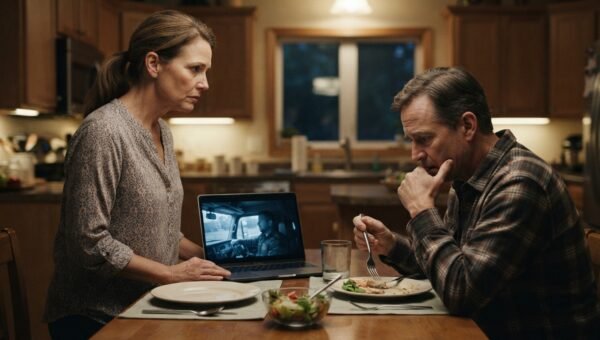
On Sunday evening, Lauren invited me over for family dinner. Pot roast and canned green beans. She was cheerful, pouring sweet tea into heavy tumblers while Toby and Chloe colored at the kitchen island. Mark was sitting at the head of the table in his gray work sweatshirt, quiet as usual, scrolling through his phone.
Near the end of the meal, Lauren cleared the dinner plates, set down a bowl of vanilla ice cream for the kids, and smiled across the table at me.
“Mom,” she said, leaning on the back of a kitchen chair. “Next Friday is going to be brutal at the clinic. They asked if I could do another double shift, maybe stay until one in the morning. Could you take the kids again? I know it’s a lot, but that overtime check is going to help us get new winter tires for the minivan.”
I reached into my handbag on the floor beside my chair. I pulled out the top receipt from the Valley View Motor Lodge, dated nine days earlier, stamped 5:02 PM for $74.50.
I laid it flat on the wood grain table between her water glass and the salt shaker.
Lauren looked down. Her eyes hit the bold logo at the top of the paper, and her shoulders pulled tight toward her neck.
Before she could open her mouth, nine-year-old Toby looked up from his bowl of ice cream, his spoon hovering in mid-air.
“Grandma,” Toby said in his matter-of-fact little boy voice, “Dad already knows about that place. He goes there too.”