The empty square on the living room floor was the first thing that didn’t fit. I remembered the old rug being there for as long as I could remember, brown and flat in the middle where we used to sit and sort school papers. Now I could see the pale outline it had left on the boards.
I was standing in our childhood house with my residency badge still in my coat pocket, holding the apology I’d rehearsed all the way from the highway.
I’d expected Elena to be mad. I hadn’t expected most of the room to be gone.
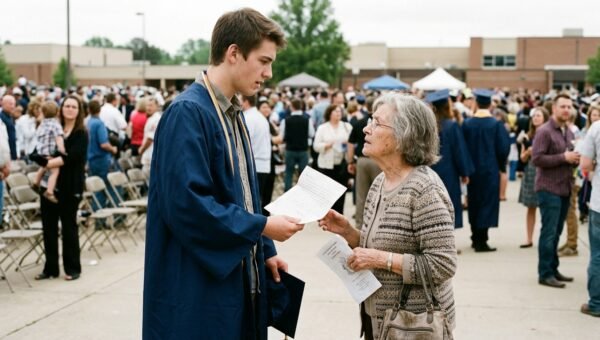
Three months earlier, at my medical school graduation, I’d looked right at the woman who raised me and said, “See? I climbed the ladder. You took the easy road and became a nobody.”
Elena smiled. Then she turned and left.
I told myself she was hurt and would get over it. That was easier than admitting I’d meant every word when I said it. I’d been proud of the degree, proud of the white coat, and so full of myself I couldn’t see the person sitting in the front row.
I’m writing this like a letter to Elena because I still don’t know how to say it to her without making it about how bad I feel.
The last time I walked into that house before the visit, I was twelve. Mom had just died, and Elena was nineteen.
I don’t remember much of the funeral, honestly. I remember the blue dress Elena wore, and how she kept a hand on my shoulder in the parking lot because I wouldn’t get in the car.
She didn’t have to raise me. She did anyway.
For years, I thought of that as something she had simply done, like packing lunches or driving me to school. It wasn’t that I didn’t love her. I did. I just got used to her taking care of things before I knew there was anything to worry about.
When I started college, I got scholarships and modest loans. I assumed that covered it. Whenever a bill came up, Elena told me she had it handled. I didn’t ask many questions. I was busy, and, if I’m being honest, I liked believing I’d made it on my own.
I went from college to medical school. I learned how to talk about debt in neat numbers and future plans. I didn’t ask what Elena was doing to keep the house.
The rug was gone. So was the sofa, the little wooden table Mom used to keep beside her chair, and the lamp with the crooked shade. There were boxes lined up against the walls, each marked in Elena’s handwriting: KITCHEN, BEDROOM, KEEP.
My childhood bedroom door was open. Inside, the room was empty except for a cardboard box and a strip of tape stuck to the floor.
I could hear my shoes on the boards. That’s what I remember most, the sound of my own steps in a house that used to make room for both of us.
I nearly turned around. Then I saw the accordion folder on the kitchen counter.
I’d gone there to apologize. I told myself I could do that first, then leave before I made things worse. But the folder was open, and the first paper I saw had the university’s name at the top. I knew I shouldn’t read it. I read it anyway.
There were cashier’s checks to the bursar, canceled checks, bank statements, and tuition transfer receipts going back years. The amounts were different each month. Some were for a few hundred dollars. Some were much more. On a separate page, a loan balance had been written in Elena’s careful block letters.
At first I didn’t understand what I was looking at. Then I found the copy of a second mortgage, with Elena’s name on it and the house listed as security.
The paper felt thin in my hand. I checked the dates. Those payments lined up with the semesters I’d thought my scholarships and loans had covered.
I pulled a chair out, but stopped before sitting. The chair had a SOLD sticker on it.
The folder also held a sale notice and an auction receipt. I read them twice. The house was being sold to pay the remaining balance. The checks weren’t a few kind gifts. They were payments Elena had made, month after month, so I could finish school without wondering how close she was to losing the place we grew up.
I heard a knock at the screen door and put the papers down. Mrs. Gable, who’d lived next door for years, came in carrying a roll of packing tape and a paper bag with two muffins inside.
“I thought Elena might need these,” she said. Then she noticed me. “Oh. You’re home.”
I said I was visiting. It sounded small, even to me.
Mrs. Gable looked at the open folder. She didn’t have to ask what I’d found. She’d seen Elena leave for night shifts and come home in the morning with her lunch still in the bag. She said Elena had been working double shifts as a logistics clerk, often sixty hours in a week, and covering whatever the school bills didn’t.
“Your sister never wanted you to worry,” she said.
I wanted to defend myself. I wanted to say I thought scholarships covered it. But the receipts were right there, and I’d made no effort to find out.
Mrs. Gable set the tape on the counter. She said Elena had finished her last warehouse week now that the young doctor was safe. That word hit me harder than the rest. Safe. I’d thought I was the one climbing out.
“Did she tell you about the loans?” I asked.
“No,” Mrs. Gable said. “She didn’t tell me everything. But I saw her come home.”
Then Elena came through the door with another roll of tape tucked under her arm. She stopped when she saw me. Her eyes moved from my face to the papers spread across the counter.
I started to say her name, but nothing else came out.
Mrs. Gable picked up the paper bag and left without making a fuss. Elena put the tape down beside the folder. She didn’t ask why I was there.
I picked up the bank statements. My hands had started shaking. I got down on my knees, not because I thought it would fix anything, but because I couldn’t keep standing there with those papers in my hands.
“I read the folder,” I said.
Elena looked at the floor. “I was going to tell you.”
“When?”
She didn’t answer right away. I could see how tired she was. Not tired from one bad night. The kind that sits in your shoulders and stays there.
“I didn’t want you carrying it while you were in school,” she said.
I tried to tell her that I had thought the money was scholarships and loans. I stopped because it sounded like I was asking her to make me feel less guilty.
At graduation, I’d seen her smile and decided it meant she was proud of me. Maybe part of it did. But I’d also watched her leave and let myself believe she was just being dramatic.
“I heard you,” Elena said. “I heard what you called me.”
I said I knew.
“No,” she said. “I don’t think you did.”
She told me she’d smiled because the promise she made Mom was finally finished. I had my degree. I was going to be a doctor. Then I said I’d climbed the ladder and she’d become a nobody, and she realized I could get all the way to the top without understanding who had held it steady.
That was her reason for walking away. She had nothing left to say to me right then.
I wanted to apologize with all the right words. I didn’t trust myself to find them. So I said the plain thing.
“I was cruel. I was wrong.”
Elena looked at me, but didn’t move closer.
“I’m sorry,” I said. “Not because I saw the bills. I’m sorry because I thought your life counted less than mine.”
She pressed her lips together. I could tell she was trying not to let me turn her pain into a job where she had to comfort me.
I kept the papers in my hands. I asked her to show me what was still owed, what was already settled, and what the house sale would cover. I wasn’t going to leave with a quick hug and a promise that I’d make it up to her someday.
The records showed a remaining balance tied to the second mortgage and the final school costs. The sale was already in motion. Elena planned to move into a small studio after the closing and keep working until the last bills were paid.
I called my new hospital’s payroll office from the kitchen. I had a signing bonus coming and a residency salary starting soon. I canceled the luxury apartment I’d planned to rent near the hospital. The deposit was going to cost me, but I could live with that. I used the bonus to cover the immediate overdue amount, then arranged a loan in my own name for the rest.
I didn’t ask Elena to keep the house. It had to be sold, and neither of us could pretend otherwise. I asked her to let me cover the studio and her basic expenses while we sorted out the final numbers. I also asked her to stop taking warehouse shifts.
She said, “I don’t want your guilt paying my rent.”
“I know,” I said. “I’m not offering it as a trade.”
She didn’t agree that minute. She read the paperwork with me, called the bank herself, and made me explain every number I was signing for. It wasn’t a clean fix. The house still had to go. The years of work had still happened. My apology didn’t give her those years back.
But she agreed to let me take over the financial obligations and to pause the move until we had the studio set up. She said she’d stop the extra warehouse shifts. We’d talk about the rest after she’d had a day to sleep.
It was almost dark by then. Neither of us had eaten. I found two paper cups and a thermos of coffee in one of the boxes marked KITCHEN. The coffee was cold, and the lid had a dent that caught against my thumb.
Elena had kept the framed photograph of Mom. She’d wrapped it in old newspaper and set it carefully beside her. We sat together on the bare floorboards, not touching, with the picture between us.
I wanted her to say everything was forgiven. She didn’t. She told me she loved me, and that we had a lot to work through.
I took a drink of the cold coffee. Elena held Mom’s photograph in her lap, safe between us.