The soup ladle was dripping into the pot when I looked up and saw my son at the pantry counter. Daniel had a little girl in his arms and a boy holding tight to his coat. I hadn’t seen him in fifteen years.
I knew him right away. He knew me too. His hair was shorter than it used to be, and there was a deep crease between his eyebrows I didn’t remember. He looked at the food, then at me.
“Mom,” he said. “I don’t need food. I just need someone.”
He stopped there. The girl was rubbing her cheek against his shoulder. The boy watched my face like he was trying to decide if I was safe.
I was behind the serving counter with Martha and three other volunteers. I could feel them listening. For fifteen years I’d told people Daniel was doing fine somewhere out West. I’d said Portland so often it had turned into a place in my mind, though I had no proof he’d ever been there.
I stepped out from behind the counter.
“Come with me,” I said.
Daniel hesitated, then shifted the girl higher on his hip. “Okay.”
The boy didn’t let go of his coat.
I led them to the supply room. It smelled like cardboard and canned tomatoes. I shut the door, not because I wanted to hide him, but because I didn’t want the whole pantry hearing the first words we’d spoken in fifteen years.
The little girl was four, Daniel told me. Maya. The boy was Toby, seven. Both had clean clothes, but the knees of Toby’s pants were shiny from wear. Daniel’s hands were rough and cracked around the knuckles. On a chain at his neck hung a wedding band.
I looked at it. Then I looked away.
“Where’s Sarah?” I asked.
He rubbed his thumb against the chain. “She died.”
I sat down hard on the folding chair. There was a squeak in the metal. I remember that sound. I don’t know why.
“When?”
“Last year. Eighteen months ago.”
He said she’d been sick fast. Aggressive illness, he called it. They used their savings on treatment, then the funeral and bills that kept coming after. He didn’t give me all the details. I didn’t ask for them. I had not earned the right to make him explain his life to me.
“I’m sorry,” I said.
“Yeah,” he said. “Me too.”
The words were plain. They were all I got.
Maya had fallen asleep on his shoulder. Toby was still gripping his coat, though not as hard. I wanted to touch their hair. I didn’t.
“What do you need?” I asked.
Daniel stared down at the floor. “I have a certification test. Two days. There’s an interview after that, for equipment maintenance. It’s two towns over.”
He pulled a folded sheet from his pocket and laid it on the table. The paper had creases down the middle and a small greasy mark by one corner. It listed the testing schedule and the interview time.
“I got hurt at the plant a few weeks ago,” he said. “Nothing dramatic. Just enough that they cut my hours, then let me go. I’ve been picking up what I can.”
He touched the paper with one finger.
“If I pass, and the interview goes right, I can get steady work again. But I don’t have anyone to keep the kids for forty-eight hours.”
I watched his finger move along the schedule. My eyes kept going back to the ring on his chain.
“Why didn’t you call me?” I asked. It came out sharper than I meant.
His face changed. Not much. Enough.
“I did call once,” he said. “A long time ago.”
I had no memory of that. Or maybe I did. There were years when I saw an unfamiliar number and let it go to voicemail because I didn’t want to find out it was him. I can’t swear that was the call he meant.
He bent to settle Maya more comfortably. “I’m not asking for money. I’m not asking you to fix my life.”
“I know.”
“I need someone who loves them enough to watch them for two days so I can fix this.”
There it was. The end of the sentence.
I had asked him to build a life. He had done it. He had married Sarah, the girl he’d loved since high school, and worked whatever hours he could find. Their oldest boy was away at trade school now. Daniel had raised him, raised Toby and Maya, and kept a home going without me.
Then Sarah died. Then his job went away.
And still he’d come asking for time with the children, not a check.
“I can take them,” I said.
He didn’t answer right away.
“I have a house,” I added, though of course he knew that. “They can stay with me. You can go to the test.”
“Are you sure?”
The question was fair. I had not been sure of anything about him for fifteen years, because I’d avoided knowing.
“Yes,” I said. “I’m sure.”
He looked at the paper again. “I can’t have this turn into you telling me how I should do everything.”
“I won’t.”
“I mean it.”
“I know you do.”
I kept my hands on my knees. I wanted to make a speech, but every version of it sounded like a way to make him comfort me. So I told him the truth that belonged to me.
“I was wrong in 2010.”
He looked up.
“When you told me Sarah was pregnant, you were eighteen. I gave you $250 and told you, ‘If you want to be a man build your own life.’ I called it tough love. It wasn’t. I was scared, and I was stubborn, and I didn’t want people in town thinking I’d raised a son who got a girl pregnant.”
Daniel’s mouth tightened.
“I know,” he said.
I had pictured him as angry all those years. Maybe he was. But there was something worse in the way he said it. He’d known what I was doing then. He’d known I cared more about what people thought than whether he had somewhere to sleep.
“I’m sorry,” I said.
He folded the schedule along its old crease. “I can’t do this right now.”
“I understand.”
“I’m not saying no to the kids staying with you.”
“I understand that too.”
We sat there without fixing anything. It felt like a pantry shift that had stopped, though the pots were still out there and people were waiting for soup. I had spent years setting out food for strangers and calling myself a caring person. That was a pretty easy kind of care. Nobody needed me to admit I had failed them.
I stood up.
“I’m leaving with you,” I said. “Martha can close my station.”
Daniel looked startled. “You don’t have to do that.”
“I do.”
When I opened the supply-room door, Martha was standing by the counter. She looked from Daniel to me.
“Is that your successful son from Portland?” she asked. She didn’t mean harm. She’d heard my story so many times it had become hers too.
“No,” I said. “I lied about Portland.”
Martha’s smile faded. I felt the other volunteers go quiet.
“Daniel left in 2010 because I threw him out,” I said. “I gave him $250 and told him to build his own life. I haven’t seen him since today.”
My face felt hot. I didn’t try to soften it.
Martha set down the ladle. “I’m sorry.”
“So am I.”
I took my purse from the shelf. There was no applause, no big moment. Someone turned the soup burner down. Someone else carried the bread basket to the front. The shift went on without me.
At my house, Daniel stopped in the doorway with the kids. My place was clean and quiet. Too quiet, if I’m honest. I had a guest room with a made bed and no toys in it, and a kitchen table where I’d eaten alone more nights than I wanted to count.
“Shoes off,” I said, then caught myself. I was already giving instructions.
Daniel glanced at me.
“Sorry,” I said. “You can do it however you want.”
He set Maya down. She woke and clung to his leg. Toby looked around the room without moving far from him.
“Is this Grandma’s house?” he asked.
I felt the name land in me. I hadn’t earned it, but he’d said it anyway.
“Yes,” I told him. “It is.”
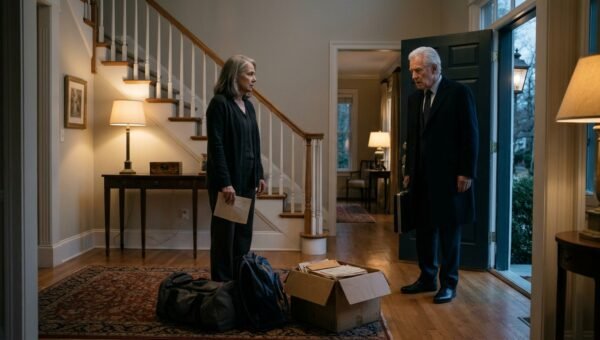
Daniel put his old duffel bag by the stairs. It was the same kind of bag he’d carried out in 2010, though I couldn’t swear it was the same one. He didn’t unpack. He said he wanted to see the kids settled before he left for the test the next morning.
I showed them the bathroom, then found two clean towels. Maya asked for water. Toby asked if there was cereal.
“There’s cereal,” I said. “And pancakes in the morning, if that’s all right.”
Toby looked at Daniel first.
“Pancakes are fine,” Daniel said.
It was the first time he’d let me do something without checking what it might cost him.
That night, I slept badly. I could hear small footsteps from the hall, then a door closing. In the morning, I made pancakes and burned the first one. Toby ate the second one with his fingers. Maya wanted hers cut into small squares, but only after I’d cut it into strips.
“Sarah did squares,” Toby said.
“All right,” I said. “I can do squares.”
I didn’t say anything about how sorry I was. They had already heard enough from me. I cut the next pancake into squares.
Before Daniel left, he stood beside the kitchen table with his keys in his hand.
“If something happens, call this number,” he said, writing it down. “That’s my friend from work.”
“I will.”
“Don’t let them call you Mom if they don’t want to.”
“I won’t.”
He looked at the kids. Toby had both hands around a mug of milk. Maya was pulling a loose thread on her sleeve.
“Dad’s coming back,” Daniel said.
“I know,” I said.
He looked at me for a long second. “I’ll be back in two days.”
“I’ll be here.”
He drove off. I shut the door and turned around to find Toby watching me.
“You’re Grandma,” he said, not quite asking.
“I am,” I said. “I’m still learning how.”
He nodded once, as if that was a good enough answer for now.
The two days were long in ordinary ways. Maya had a hard time napping. Toby wanted to know if Daniel had called, so I let him check my phone when it rang. We made toast and watched a nature show. I folded the children’s clothes after they went to bed, then put them in a basket instead of putting them away. I didn’t know what they’d want close at hand.
I found an old photo album while looking for a deck of cards. Daniel was in one picture at six, missing a front tooth and holding a paper plate of birthday cake. I closed the album before Toby saw it. I wasn’t ready to make him responsible for my memories.
Daniel came back late on Thursday. He looked more tired than when he’d left, but there was something different in his face.
“I passed,” he said.
I stood up from the table.
“And they hired me,” he added. “It starts Monday.”
Maya ran to him. Toby followed, then stopped to see if Daniel was ready for a hug. Daniel opened his arms. Toby went in.
I stayed where I was.
“That’s good,” I said. “That’s really good.”
Daniel held both children close. His eyes were shut for a few seconds. Then he opened them and looked at me.
“I need after-school care,” he said. “At least until I can sort out the rest.”
“I can do that.”
“On my terms,” he said. “No telling the kids I’m doing it wrong. No deciding things for them without asking me.”
“Okay.”
“And if I say I need space, I need you to listen.”
“I will.”
I had promised things before, when I wanted to feel like a good mother. This time I knew the promise would count only if I did the work.
He set the duffel bag by the door again. I glanced at it, then stopped myself from asking if he was leaving.
“I have an extra key,” I said. “Only if you want it.”
He took a breath. “Maybe later.”
“Okay.”
A week after that, he let me pick the kids up from school. I didn’t tell him what to pack for lunch. I didn’t ask where he’d been every hour. When he said Maya needed her blue cup, I washed the blue cup and put it where she could reach it.
Some days Daniel still went quiet around me. I let him. I’d spent too many years believing silence meant I was right.
He didn’t forgive me in one conversation. I didn’t deserve that. But he started calling about small things. Toby’s school picture. Maya’s cough. Whether I still had the recipe for the pancakes he remembered from when he was little.
Last night, the three of them came for dinner. Daniel brought his work thermos and set it on the table. Toby and Maya ate cereal afterward because neither one liked the casserole. Two small bowls sat beside the thermos, half-full and getting soft.
The old duffel bag rested by the door. This time it was open, with the children’s spare clothes folded inside, not packed for Daniel to leave.
I didn’t ask him to stay. He already had.