PART 1
My son Evan and I have run the appliance repair shop my husband started thirty-two years ago, and last week he asked me to tell a fire investigator that we had cleared a customer’s dryer vent.
The customer’s house had burned two nights earlier. Her elderly mother was still in the hospital with smoke inhalation, and Evan told me that one sentence from my mouth would keep our shop from being blamed.
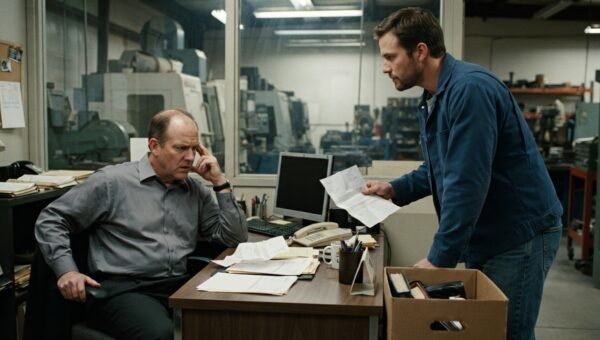
He asked me in the back room, with the door shut and the front office phone ringing unanswered. He put a typed statement down on my workbench. It said that I had inspected the dryer on May 12, cleaned out the vent line, and left the machine in safe working order.
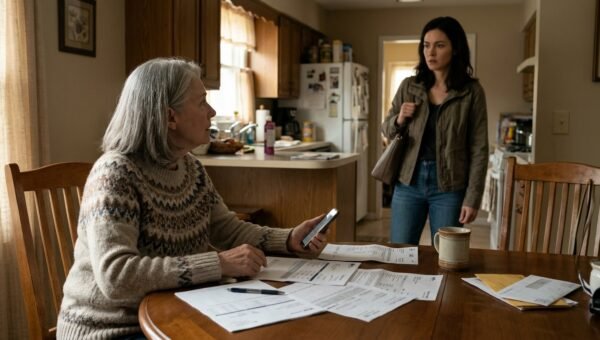
I remembered May 12 clearly. I had gone to Mrs. Pruitt’s small brick house because she called twice about a burning smell in her back utility room. When I pulled the dryer out, the flexible foil vent behind it was crushed flat against the wall, full of scorched lint, with a gray heat mark scorched into the baseboard. I told her straight out that the vent had to be replaced with rigid pipe before anyone pushed start on that machine again. She nodded, looked worried, and told me she would call her landlord because he handled all the maintenance.
I had written that exact warning on our yellow service ticket. I remembered it because I underlined “do not operate” twice and stood there until Mrs. Pruitt signed her name right underneath it.
Evan tapped the paper on my bench. “Mom, you might be remembering a different visit.”
“No,” I told him. “I’m not. You know my handwriting, and you know how I do those calls.”
He leaned back against the tool rack. He had the same gray circles under his eyes that he had four years ago when his dad was sick in hospice. Ever since Arthur died, Evan had carried the mortgage on the building, the payroll for two young technicians, and every customer who called demanding the owner. Our commercial insurance carrier had already sent a formal notice warning us that a single negligence claim could lead to immediate cancellation. The county fire investigator had called our desk twice before noon.
“Mom, we owe eighteen thousand dollars to our parts distributor,” Evan said, keeping his voice low so the boys in the bay wouldn’t hear. “If our policy gets dropped, the bank calls the building loan. We lose the shop. Luis and Marcus lose their jobs. I have to look out for us.”
I pushed the paper back across the bench to him. “Then tell the investigator the truth.”
He didn’t argue. He picked up the typed paper, folded it in half, and walked out without looking at me.
The next morning, I arrived early and went straight to the gray metal cabinet where we kept the paper service records. Evan had reorganized the files when he painted the front counter, putting the older folders into storage boxes. I found the yellow duplicate book for May, but the slip for May 12 had been torn out right at the perforation.
My stomach dropped, but I knew our old routines. Arthur always bought three-part carbon pads from the printer in town.
Even after Evan moved our daily scheduling over to a computer tablet, I kept an old receipt book in the bottom drawer of my desk for days when the system crashed or when I went out on a call alone.
I opened the bottom drawer, pushed aside my spare safety glasses, and pulled out the pad. The carbon copy for Mrs. Pruitt was still pressed firmly against the cardboard backing. My notes were plain as day: “Vent crushed flat. Duct requires immediate replacement. Do not use dryer until repaired.” Mrs. Pruitt’s signature sat right at the bottom line.
I took a clear photo of it with my phone and slipped the pad into my handbag.
When Evan came in through the side door at eight, I showed him the photo. His face went completely still. Then he told me he must have misplaced the original slip when he was cleaning out the drawer.
“The customer keeps the yellow copy, Evan,” I said. “The white original stays in the filing cabinet. Why was it torn out?”
He looked down at his boots. “I didn’t alter anything. I just didn’t want someone reading a ticket that says we saw a hazard and walked away without fixing it.”
“We told her not to turn it on,” I said. “I did my job.”
“And she turned it on anyway,” he snapped, his voice cracking. “And now her mother is breathing through a tube, and the investigator wants to know why we didn’t pull the breaker or call the city inspector.”
He wasn’t entirely wrong. That question had kept me awake half the night. I had trusted Mrs. Pruitt to call her landlord. I had meant to follow up two days later, but Evan’s little girl had ear surgery that Thursday, and I had stayed in the shop answering phones for ten hours straight. I let a signature on a receipt do the work of a phone call.
I walked into the office, picked up the phone, and called the fire marshal’s office myself. Evan stood in the hallway watching me, but he didn’t move to take the receiver. I told the investigator, a man named Sergeant Miller, that I had our original paper record and wanted to deliver it.
That afternoon was quiet and miserable. Evan told Luis and Marcus that we might have to suspend field calls until the insurance inquiry cleared up. Luis came into my small office with his cap in his hands, asking quietly if he should update his resume. I told him he had a family to feed and I would never lie to hold him back.
At five o’clock, Sergeant Miller called my cell phone. He told me he had reviewed the scan of my carbon copy, but he had another paper on his desk that didn’t match mine at all.
It was a property management invoice submitted by Mrs. Pruitt’s landlord. It showed that our shop had returned to the house the very next morning, on May 13, cleared the lint trap, and marked the entire ventilation run fully approved.
Right next to that approval was a set of initials that looked just like mine.
“Mrs. Miller,” the sergeant said over the line, “I have the original signed work order in my hand. I am heading over to your shop right now, and I want to know what you have to say about the back of this ticket.”
PART 2
The line went dead before I could answer.
I set my phone down on the desk. Evan was still leaning against the doorway, watching my face. He had heard my side of the call, and he knew something had gone wrong.
“What did he say?” Evan asked.
“He has a ticket from May 13,” I told him. “He says someone from our shop went back to that house the day after I was there, marked the vent cleared, and signed my initials on the line.”
Evan didn’t yell or deny it. He just closed his eyes, let his head fall back against the doorframe, and let out a long breath. That was the moment I knew he wasn’t surprised.
“Who went to that house, Evan?” I asked. “Did you send Marcus? Did you send Luis?”
“Neither of them,” Evan said quietly. “They don’t know anything about it. Leave them out of this.”
“Then who signed my name?”
Before he could answer, headlights swept across our front window. A county car pulled into the gravel lot, its tires crunching slow and heavy. Sergeant Miller stepped out. He was a broad-shouldered man in a tan jacket, carrying a manila folder under his arm.
I walked out to the front counter to unlock the door. Evan followed two steps behind me.
Miller came inside, touched the brim of his hat to me, and set the folder on the counter. He didn’t waste time on pleasantries. He opened the folder and laid two documents side by side.
On the left was the digital printout of my carbon copy from May 12, showing my handwriting and Mrs. Pruitt’s signature. On the right was an official carbon slip from our company’s pad, dated May 13. It listed Mrs. Pruitt’s address. Across the description box, written in blue ballpoint, were the words: “Secondary check completed. Vent line cleared to outside wall. Unit approved for service.” In the technician box were the initials “M.M.”
My name is Margaret Miller. Arthur always had our tickets printed with a space for the technician’s initials. For thirty years, every ticket I wrote had that exact mark.
“Is that your handwriting, Mrs. Miller?” Sergeant Miller asked.
I looked at it closely. The letters were neat, trying hard to look like mine, but the second M was narrow at the bottom. I write with an open loop because of the arthritis in my thumb.
“No,” I said. “It is not.”
Sergeant Miller turned the paper over. The back of the slip was stamped with an official intake stamp from Henderson Property Management, dated May 14. But there was also a handwritten note penciled on the back: “Cash paid on site. $150. Account credited.”
The sergeant looked directly at Evan. “The landlord claims your company cleared this vent so he wouldn’t have to hire a duct contractor to cut into the drywall. He says he paid cash to the technician who brought him this slip.”
The room was so quiet I could hear the hum of the fluorescent light above the cash register.
“Evan,” I said, “talk to me right now.”
Evan stared at the paper. His jaw worked, but no words came out.
“We found the heat source,” Sergeant Miller said, leaning over the counter. “The fire started six inches inside the wall where the foil pipe collapsed into the framing. The dryer blew hot lint directly into dry studs. Mrs. Pruitt’s mother has second-degree burns on her arms and severe lung damage. If your company certified that line as safe, this isn’t just an insurance dispute anymore. This is gross negligence. And if someone forged a safety document after being told the line was compromised, that becomes a criminal matter.”
“I needed the payroll,” Evan whispered.
He didn’t look at the sergeant. He looked straight at the floor.
“What did you do, Evan?” I asked. My voice sounded thin, like paper tearing.
“Mr. Henderson called the shop that afternoon after you left,” Evan said, his words tumbling out fast and ragged. “He was furious. He said you were trying to drum up business for a contractor friend by telling his tenant she couldn’t use her dryer. He said if we didn’t give him an all-clear slip, he was pulling his account with us. Mom, Henderson owns sixty-four rental units in this county. He gives us four thousand dollars a month in basic service calls. We couldn’t lose him.”
“So you wrote an all-clear?” I asked.
“I didn’t think it would catch fire,” Evan cried out, his hands shaking as he gripped the edge of the counter. “I drove over there myself on the morning of the thirteenth while Mrs. Pruitt was at work. Henderson let me in with his key. I pulled the lint trap out, vacuumed the cabinet, and blew out what I could from the back. I thought that was enough. Henderson gave me a hundred and fifty bucks in cash, and I wrote the slip so he would keep giving us his rental contracts.”
“And you put my initials on it,” I said.
Evan looked at me then, his eyes full of tears and shame. “You’re the master technician on our business license, Mom. My name isn’t on the county certification. If I signed it, Henderson’s insurance wouldn’t have accepted it. I thought I was fixing it. I swear to God, I thought I was saving the shop.”
PART 3
The silence in the office after Evan stopped talking was heavier than any argument we had ever had.
Sergeant Miller didn’t look angry; he looked tired. He took a pen from his pocket, pulled a small spiral notebook from his jacket, and wrote down two short sentences.
“Mr. Miller,” the sergeant said, looking up at Evan. “Did you tell Mrs. Pruitt that you had cleared the line?”
Evan shook his head. “She wasn’t there. Only Henderson was there. He told me he’d let her know she could use the machine again.”
“And you never replaced the crushed foil duct inside the wall cavity?”
“No,” Evan said. “I didn’t have the tools to cut the drywall. I just hoped the vacuum had pulled enough lint out.”
“You didn’t hope,” I said, unable to keep the bitterness out of my voice. “You gambled. You gambled with that woman’s house, and you gambled with my name.”
Evan flinched, but he didn’t look away. For years, I had treated him like he was still the boy learning to rebuild washing machine pumps at Arthur’s elbow. When Arthur died, I stepped back from the books because the numbers made me think of hospital bills and lost years. I had handed my son a failing business, an eighteen-thousand-dollar debt to our supplier, and all the pressure of keeping our family name afloat, and then I acted shocked when he cracked under the load.
I looked at Sergeant Miller. “What happens now?”
“Now I take this statement,” Miller said. “I take both tickets into evidence. I report to the district attorney that the certification of safety was forged without your knowledge, Mrs. Miller. That clears you personally from the criminal inquiry. But as for the shop, and as for your son, that is a different matter.”
Miller looked at Evan. “You need to come down to the station tomorrow morning at nine o’clock with an attorney. Do not contact Mr. Henderson. Do not try to clean out your files. Do you understand me?”
“Yes, sir,” Evan said.
Miller gathered the photocopies, left the original carbon in an evidence sleeve, and walked out into the dark. We watched his red taillights disappear down the two-lane road toward town.
Evan sat down on the customer bench by the front door. He buried his face in his hands and wept. He didn’t sound like a business owner or an adult. He sounded like a terrified boy.
I wanted to sit next to him and put my arm around his shoulders. Every motherly instinct I had told me to tell him we would find a way through it, that family comes first, that money is just paper.
Instead, I stayed behind the counter.
“Why didn’t you come to me when Henderson threatened to pull his business?” I asked.
“Because you would have told me to let him walk,” Evan choked out. “And we couldn’t afford to let him walk. We’re two months behind on the building, Mom. The bank sent a demand letter last Tuesday. I hid it in my desk because I didn’t want you to worry.”
“You didn’t want me to worry,” I repeated. “So you put my initials on a lie that nearly killed an eighty-year-old woman.”
“I’m sorry,” he whispered. “I’m so sorry.”
“Being sorry doesn’t pay for her lungs, Evan. And it doesn’t fix what you did to this shop.”
I walked back into my office, took my purse, and locked the cash drawer. When I came back out, Evan was still sitting on the bench.
“Go home to your wife and your girl,” I told him. “Get some sleep. Tomorrow morning, we’re calling Arthur’s old lawyer, David Vance. We’re going to use whatever savings I have left to pay for your counsel. But we are not lying to the police, and we are not covering for Henderson.”
He looked up at me, red-faced and miserable. “What about the shop, Mom?”
“The shop is done, Evan,” I said plainly. “You killed it the minute you signed my initials.”
ENDING
We met David Vance at his office the next morning at eight. David had handled Arthur’s will and our business incorporation back in the nineties. He listened to Evan’s confession without interrupting once, taking notes on a yellow legal pad.
When Evan finished, David looked at both of us over his reading glasses.
“The best thing you have going for you is that you told the truth before Henderson could spin it,” David said. “Henderson already told his insurance company that our shop gave him a clean bill of health. When Sergeant Miller shows the prosecutor that Evan acted under Henderson’s pressure and that Henderson knew the duct hadn’t been replaced, Henderson’s liability skyrockets. But Evan, you forged a signature on a commercial safety ticket. You are facing reckless endangerment charges, and the shop’s license is gone.”
Over the next four months, the truth came out in cold, formal legal filings. Henderson tried to claim Evan had acted entirely on his own, but Sergeant Miller pulled Henderson’s phone records, showing five calls to our shop in forty minutes on the afternoon of May 12, followed by a withdrawal of one hundred and fifty dollars from an ATM down the block from Mrs. Pruitt’s house.
Faced with the phone logs and Evan’s sworn statement, Henderson settled with Mrs. Pruitt and her mother for seven hundred and fifty thousand dollars through his property insurance.
Evan avoided prison time because he had no prior record, gave full cooperation to the investigators, and pleaded guilty to a misdemeanor count of falsifying a commercial record. He was sentenced to two hundred hours of community service and three years of supervised probation.
The shop, just as I told him, did not survive.
Our commercial insurance was canceled within forty-eight hours of the plea agreement. Without coverage, we couldn’t keep our business license active. We put the building up for sale in August. It sold to an auto body outfit for just enough to pay off the bank loan, clear the eighteen-thousand-dollar balance with our parts distributor, and give Luis and Marcus two months of severance pay each.
Luis found a job with a commercial refrigeration outfit in the next county. Marcus went to work for the county school district’s maintenance department. Both of them hugged me in the parking lot on the day we cleared out the tools. Neither of them said a harsh word about Evan, but neither of them asked to speak to him, either.
Evan works as an hourly mechanic at a tire shop out on the bypass now. It is hard, dirty work, and the pay is half of what he made when we were running our own calls. He doesn’t complain. He works his shift, goes home to his family, and does his probation check-ins on the first Tuesday of every month.
Our relationship changed. It had to. You cannot look at your child the same way after you watch him hand your name over to a fraud. For months, our conversations were limited to lawyer bills, bank transfers, and how his daughter was doing in kindergarten.
Last Sunday, Evan came by my house alone. He brought a box of peaches from the orchard near the bypass, the way his father used to do every August.
We sat on my back porch and peeled them together in silence for a long time. The bowl between us filled up with orange slices and sweet juice.
“I called Mrs. Pruitt yesterday,” Evan said quietly, keeping his eyes on the paring knife in his hand. “Her mother is living in an assisted care place now. Her breathing isn’t great, but she’s out of the hospital.”
“Did she talk to you?” I asked.
“She listened,” Evan said. “I told her I was the one who signed the paper. I told her it wasn’t you, and it wasn’t an accident. I told her I did it because I was a coward who wanted to keep a landlord happy.”
“What did she say?”
“She told me she hoped God worked on my heart, and then she hung up.” Evan set his knife down on the rim of the bowl. “It was better than I deserved.”
I looked at his hands. They were nicked and stained with tire grease that never quite washes out, the same kind of working hands his father had.
“We start from where we are, Evan,” I told him.
He didn’t ask for more than that. He picked up another peach, turned it slowly in his fingers, and went back to work.