I was pouring coffee into my travel mug when Cynthia told me I was too old to drive around with a child. The coffee went over the rim and onto my hand. I remember that more clearly than I remember what I said back.
I was 62. Leo was nine. I’d been picking him up from school three days a week for almost two years, and I’d never had so much as a parking ticket.
Still, I wiped my hand on a dish towel and said, “All right, Cynthia.” I didn’t want a fight over something I thought I could live without.
That was my mistake. I told myself I was keeping the peace.
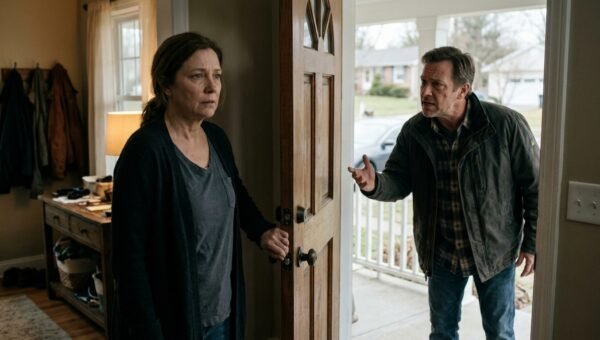
Cynthia had called me that morning, two weeks before the school office called me. Her voice was tight and businesslike. She said she and Mark wanted to handle school pickup themselves from then on. When I asked what had changed, she said, “You’re too old to be driving around with a child.”
I was hurt, naturally. But I also knew how quickly a small disagreement could turn into a whole week of cold shoulders. I’d seen it happen over smaller things, like what Leo wore to a birthday party. So I said fine, and I stayed out of it.
I should say I wasn’t worried about my driving. I’d spent years driving to and from work, first as a hospital unit clerk and then doing errands for my mother after she got sick.
I know how to check a mirror. I know how to get a kid buckled in. What I didn’t know was why Cynthia suddenly needed me out of the picture.
The school called on a Thursday. Mrs. Gable, the secretary, said Leo had been sent to the nurse because his cheek was swelling. She’d tried both parents and couldn’t reach either one. Leo had given her my number from the emergency contact card.
I almost asked why he still had my number on the card. I didn’t. I grabbed my keys.
At the school, Mrs. Gable met me in the office with a clipboard held against her chest. Leo was sitting in a chair beside the counter, his backpack between his shoes. His cheek was swollen and red on one side. He kept his eyes down.
“His parents haven’t called back,” Mrs. Gable said. “I can’t release him without checking the contact list.”
“I’m on the list,” I said, maybe sharper than I needed to.
She checked it again, then nodded. “Yes. You are.”
Leo stood up. He didn’t ask me for a hug, which was strange.
He usually did, even if it was just leaning his head against my arm for a second. I wanted to touch his cheek, but I didn’t know if it hurt, so I asked if he could see all right.
“I’m fine,” he said.
He wasn’t. But he was nine, and there was a school secretary watching us both, so I didn’t push him there.
Mrs. Gable handed me the office form. I signed it, then took Leo out to the car. He buckled himself in without help. His fingers shook a little at the clasp.
I started the engine, but I didn’t back out right away. I asked him whether he wanted to go to his house or mine.
He stared at his shoes. “Grandma, please don’t take me home yet.”
I put the car in park again. “Why, honey?”
He looked at me then, and his voice got so low I had to lean closer. “Because Dad finally found out what Mom has been hiding.”
I didn’t ask him to explain everything in the parking lot. I asked if he felt safe with me.
He nodded. So I told him we were going to urgent care first, and he could tell me what he could when he was ready.
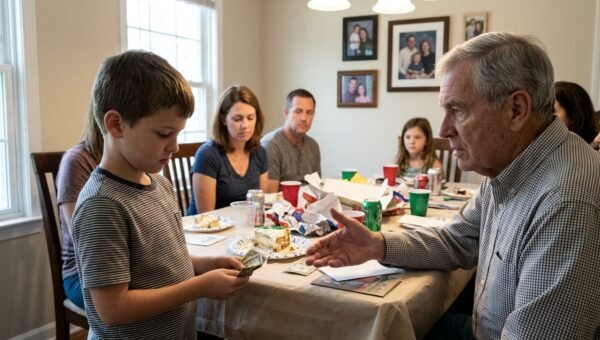
On the drive, he said his dad had found papers in the garage that morning. Mark and Cynthia started arguing. Leo was in the kitchen when Cynthia went out the back door with a folder. She slammed the screen door behind her, but the heavy aluminum frame bounced back and hit him across the face.
“It was an accident,” Leo said. “She didn’t see me.”
I kept my eyes on the road. “Did she know it hit you?”
He nodded. “She said not to tell anyone. She said Dad was being dramatic.”
I wanted to say something about that. I didn’t. I was trying not to make him feel like he had to take care of my feelings too.
Leo pulled a manila envelope from his backpack. He said it had fallen out during the fight, and he’d picked it up because he heard his dad say the word “foreclosure.” He hadn’t opened it. He thought he was supposed to keep it safe.
I took it from him at the next red light and set it on the passenger-side floor. There were unopened legal notices inside. The names on the papers were Mark’s and Cynthia’s. The signatures on the loan documents looked like Mark’s, but I knew my son’s handwriting well enough to see that something was wrong.
I didn’t try to read every page while I was driving. I called urgent care and told them we were coming.
The nurse took Leo’s temperature and asked how he’d been hurt. Leo started with “the door,” then stopped. I sat beside him and waited. He said it again, more clearly. The nurse took a few pictures and had the doctor examine his cheek.
The doctor said it was a blunt impact injury consistent with a closing exterior door. He checked Leo’s eye and jaw, asked him to open and close his mouth, and told us what signs to watch for that night. It wasn’t a serious injury, thank goodness. It was still an injury that had happened during a fight and then been carried into school without anyone checking on him.
I asked for the visit summary and made sure it included what Leo had told us. The paperwork felt cold in my hand, but I was glad to have it. My old hospital habit came back. One thing at a time. Check the injury. Write it down. Keep the child safe.
I took Leo to my house and made him toast. He ate half of it, then said he was tired. My neighbor, Ruth, had known me for twenty years and had watched Leo before. I asked her to sit with him while I went to Mark’s house. I told her not to answer the door for anybody but me.
“Do you want me to call the police?” she asked.
“Not yet,” I said. “If I need to, I will.”
I hated leaving Leo, even for twenty minutes, but I needed to see what was happening and I needed Mark to know where his son was. I drove over with the medical papers and the manila envelope on the seat beside me.
Mark’s house was on a neat street where the lawns all looked cut, even in the middle of the week. I’d driven that road hundreds of times. I’d never thought about how easy it was to mistake a tidy yard for a tidy home.
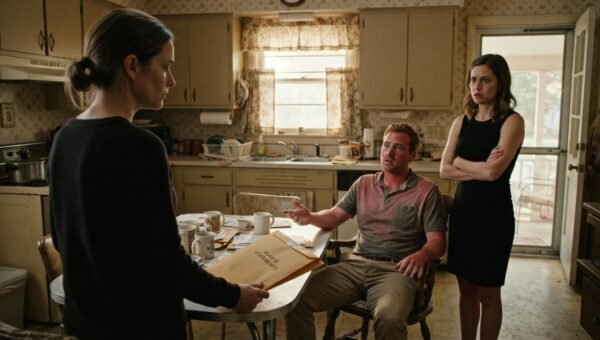
The front door was unlocked. Mark was at the kitchen table, surrounded by opened certified mail. He looked like he hadn’t moved since the morning. Cynthia was near the back door, shoving papers into a bag and checking her phone.
Mark looked up at me. “Where’s Leo?”
“He’s safe at my house. I took him to urgent care.”
Cynthia stopped packing. “You had no right to take him.”
I set the medical summary on the counter. “He had a swollen cheek and neither of you answered the school.”
“He bumped into the door,” she said. “It was an accident.”
“I know. The doctor wrote down what happened.”
Mark looked at the report, then at the envelope I placed beside it. He pulled out the notices and started reading. His hands shook. I watched him find the loan paperwork with his name on it.
He looked at Cynthia. “You signed this for me?”
She said she’d been trying to save the house. She said she’d put money into a private investment that was supposed to pay back quickly. When it went bad, she’d borrowed against the house, then borrowed again to cover the first payments. She’d used the college funds too. She kept saying she thought she could fix it before Mark found out.
“I was trying to keep us from losing everything,” she said.
Mark stared at the papers. “You were hiding foreclosure notices in the garage.”
“I had a plan.”
“You used my name.”
“I was going to tell you.”
I could feel myself wanting to believe there was some clean explanation. There wasn’t. The notices were real. The signatures were not Mark’s. The home was in danger, and Leo had been told to keep quiet while the adults scrambled around him.
Cynthia turned on me. “You’ve wanted to get between us for years.”
I felt that old pull to soften my words. To say I was only there to help. To make myself smaller so the room might calm down.
I didn’t do it.
I slid the medical papers next to the default notices. “I’m not covering this up. And I’m not paying your debts.”
Cynthia stared at me like she’d expected me to offer money. Maybe I would have, a few years earlier. I’d helped with a car repair once and paid a late utility bill when Mark was between jobs. I’d called it helping. Sometimes, if I’m honest, I also wanted to be needed.
Not this time.
Mark stood up. “You need to leave.”
Cynthia said his name, then told him he couldn’t throw her out over one bad morning. He said he wasn’t doing it over one morning. He was doing it because she’d forged his name, put their home at risk, and left their son at school hurt while she shut off her phone.
She packed the bag and went out the back door. Mark didn’t follow her. He stayed at the table with the papers spread around him.
“I’m sorry,” he said to me. “I let her talk to you like that.”
I sat down across from him. “You did.”
He rubbed both hands over his face. I didn’t make it easy for him by saying it was all right. It wasn’t. But I stayed.
Over the next few days, Mark filed for separation and took the records to a lawyer. The medical report, school call notes, and loan papers all went into the file. He asked for emergency custody and a temporary order to keep Cynthia from taking Leo or showing up at school without agreement. A judge granted the order while the case moved forward.
The bank notices weren’t something we could wish away. Mark had to deal with the lender, the liens, and the money missing from Leo’s college fund. Cynthia had to answer for the loans and forged signatures. I didn’t pay her way out of it.
Leo stayed with me while the court sorted out the schedule. Mark came over every evening after work. Some nights he brought dinner. Some nights he just sat at my table and tried to understand how far behind he’d been in his own house.
A week later, the school put a copy of the court order in Leo’s file. I signed the primary pickup binder with the office staff watching. Nobody questioned my age or my driving.
Leo stood close beside me. He slipped his small hand into the pocket of my jacket as we walked out into the crisp afternoon sun. I held the pen steady, and signed my name.