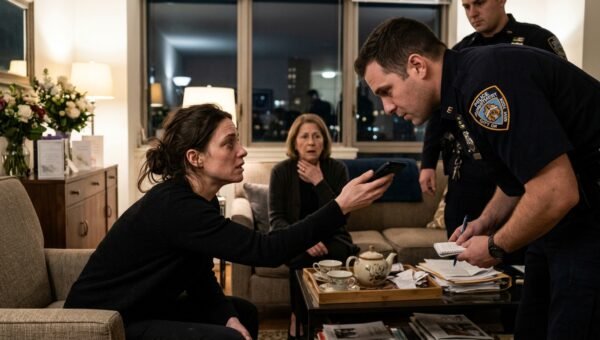
I spent eight months caring for Mom, and part of me wanted my sister to pay for every one.
I know that sounds ugly. It is ugly. But I remember the small things from that time, and they kept adding up before I knew what they meant.
The first was my sister Marcy’s guest room. Mom had broken her hip, and the hospital was ready to send her home after a short stay.
She couldn’t get up the stairs alone, couldn’t bathe without help, and had just started using a walker. I asked Marcy if Mom could stay with her while I got the downstairs room ready at my place.
Marcy stood by her guest room door and told me she had work, errands, and a life. Then she shut the door before I could answer. I drove Mom to my house instead. I had the old recliner moved out of the living room that same afternoon.
I live in Wichita, in one of those cul-de-sac neighborhoods where everybody knows whose trash bin blew over. I’m fifty-four and work in the school district office. I thought I understood being tired. I did not understand how many times a night a person can wake up because a walker bumped a wall, or because Mom needed help getting to the bathroom.
Still, she came home with me. I didn’t think it through much.
I just put clean sheets on the downstairs bed and moved the coffee table where it wouldn’t catch the walker. Mom said she was sorry for being trouble. I told her she wasn’t, and meant it then.
The second thing I ignored was Marcy’s first visit. It was about three weeks after the surgery. She brought a grocery-store bouquet and stayed long enough to ask Mom if she was “getting settled.” Mom had to ask her to pass the water glass because it was just beyond reach. Marcy passed it, then checked her phone.
She said she had another stop to make. I was standing at the sink, rinsing out the little plastic cup the hospital sent home with Mom’s pills. I wanted to say something sharp. Instead, I asked if she could come back Saturday and sit with Mom for an hour.
Marcy said she’d see how the week went.
She didn’t come Saturday.
By then, I was learning how to help Mom stand without pulling on her bad side.
The physical therapist showed me where to put my hands. Mom practiced walking from the bed to the kitchen and back, stopping twice to rest. She got frustrated when her leg shook. I got frustrated when she tried to do too much, then felt bad for being frustrated.
That was the part I didn’t tell anybody. I could be patient all morning and then snap over a wet towel on the floor. Mom would look at me, and I’d say I was sorry while I picked it up. She never made me feel like a bad daughter. That almost made it worse.
The third clue came in a phone call with Marcy. She asked how Mom was paying for things. I told her Mom had Social Security and savings, and we were keeping track of the bills. Marcy said she hoped Mom wasn’t using up all her money just to cover the house and medical costs.
I said the insurance had paid some of the hospital bill, but not everything. The walker, the shower seat, and the extra home care visits added up. Marcy said, “That’s what I mean. It can go fast.”
She didn’t ask what Mom needed. She didn’t offer to help with a bill. I remember wiping a spot of dried oatmeal off the counter while she talked, because I didn’t know what to say and didn’t want Mom to hear me get mad.
The house was still in Mom’s name. She’d lived there for thirty-one years. Marcy had always talked as though one day it would be hers, or half hers, or something she could count on. Mom had never promised that. But when Marcy talked about the house, nobody corrected her, and I used to let it pass.
I had my own reasons. I didn’t want another argument with her. We’d been doing that since we were kids, and somehow I’d become the one who smoothed things over. I was good at it. Or I thought I was.
The fourth clue was that Mom stopped asking when Marcy was coming. In the first month, she’d say Marcy might visit after work or maybe she’d bring dinner. After a while she didn’t say that anymore. She’d just ask me what day the therapist was coming.
That change bothered me more than I expected. I wanted Mom to stop hoping, but I also wanted Marcy to notice she was missing something. Both things were true. I don’t know how to make that sound nicer.
By month four, Mom could get around the downstairs with her walker. The therapist said she was making good progress, but the steps were still a problem. I was doing laundry, helping with the shower, driving her to appointments, and checking the pill box every Sunday night. I kept a little notebook on the counter because if I trusted my memory, I’d forget something.
Marcy came over once during that stretch. She said she couldn’t stay long because she had plans. I could hear Mom trying to keep her voice cheerful from the living room. Marcy asked if Mom had heard from the realtor. I was in the kitchen and stopped with a dish towel in my hand.
I hadn’t known Mom had spoken with one. Later, I asked her about it.
Mom said she’d been thinking about selling the house. She didn’t want to keep paying for repairs and yard work, and she didn’t want to move back there just to sit alone in it. She said she was only asking questions. I believed her, or I thought I did.
The fifth clue was the stack of mail Mom kept beside her chair. She’d always been careful with bills, but now there were envelopes from a lawyer and a title company among the pharmacy notices. I asked whether she wanted help sorting them. She said she had it handled.
I didn’t push. I felt guilty for being relieved she was making some decisions without needing me to do them. That’s the honest truth. I was tired enough to be grateful for anything that wasn’t one more task.
Mom was still Mom. She’d correct me if I put the wrong mug by her chair. She liked the blue one with a chipped handle, not the newer one I’d bought. She started standing at the kitchen counter to make toast again, even though it took longer. I’d stand nearby pretending to look for something in a drawer.
By month eight, she could walk without the walker inside the house, though she still used a cane outside. We decided to have a small dinner at my place to mark the progress. Nothing fancy. Chicken, potatoes, green beans. Mom said she was tired of eating meals that tasted like a hospital.
Marcy said she’d come. She arrived late and asked if there was any wine. She complimented the food, then asked Mom how she was managing the expenses. I’d heard that question before, so I watched Mom instead of answering for her.
Mom set her fork down. She reached into her purse and took out a folded paper. The notary stamp was visible at the bottom. She slid it across the table toward Marcy.
Marcy smiled at first. She thought Mom had sold the house for money to cover her care. She said that was probably smart, because the place had been too much for Mom to handle anyway.
Then Mom told her to read who bought it.
Marcy picked up the paper and looked at the first line. Her smile went away. She read it again, slower. I could hear the refrigerator making its little clicking sound behind me.
My name was on the purchase agreement.
Marcy turned to me like I’d taken something from her. She said I’d bought Mom’s house behind her back and that she deserved a share. Her voice got louder with each sentence. She said Mom was vulnerable and I’d been in the house every day, so of course I’d gotten what I wanted.
I didn’t answer right away. I wanted to remind her that Mom had asked me to help with the paperwork, not the other way around. I wanted to list every night and every appointment. I wanted to say she had no idea what she was talking about.
Instead I said, “Mom made the choice.”
Marcy shook the paper. She said the house was family property. She asked what kind of daughter let her mother give away an inheritance.
That was when Mom spoke. She said there wasn’t an inheritance to divide while she was alive, and she wasn’t giving the house away. She’d sold it to me for $31,400. The house was worth far more, but she’d chosen the price with her attorney and had the sale papers notarized and the deed recorded. She kept the money for herself, along with her retirement savings. She’d wanted to be able to pay her own way without worrying about the roof, the taxes, or the yard.
Marcy said Mom was being unfair. She said she couldn’t believe Mom would reward me for doing what a daughter was supposed to do.
Mom looked at her and said she’d asked Marcy for help and been told she had a life. Then she said she’d spent eight months watching me help her bathe, dress, and learn to walk again. She wasn’t going to pretend those were the same thing.
I looked down at my hands. I was embarrassed by how much I wanted to hear Mom say it. I’d spent months telling myself I didn’t need credit, and then there I was, waiting for it.
Marcy said I’d manipulated Mom. Mom told her the choice was hers, and if Marcy wanted to be angry, she could be angry at her. Marcy stood up so fast her chair scraped the floor. She left the paperwork on the table and walked out.
I didn’t follow her. I also didn’t call after her, which was new for me. Mom and I sat there while the front door closed softly. Her plate was still in front of her, and mine was cold.
The transfer was complete. The deed had been recorded, and Mom’s lawyer had made sure the paperwork was in order. There was no court fight, no surprise bill, no family meeting to renegotiate it. Marcy sent me two texts the next morning. I didn’t answer either one.
I asked Mom if she wanted me to put the paper away. She said yes, and asked me to get the blue mug from the cupboard. So I did. She held it in both hands while the evening light reached the kitchen table.
The house was still mine on paper. Mom was still home with me. We sat there, and neither of us had to explain why.