PART 1
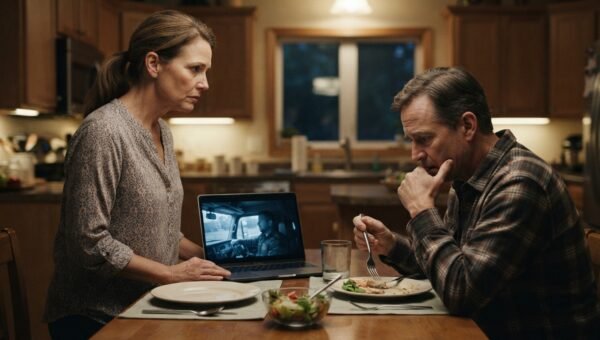
My son asked me to say I had removed the safety guard from the press before my hand was injured. He said it in the break room at the machine shop where I had worked for thirty-one years, with my old locker key sitting between us on the table.
“Just tell the investigator you took it off to clear a jam,” Evan said. “That is what the report says.”
“I did not take it off.”
“You remember it happened fast.”
“I remember the guard was not there.”
He looked down at the table. “If they shut the line, forty people lose their checks.”
My son had started at the shop after trade school. He was now the safety coordinator, the one who walked the floor with a clipboard and reminded everyone to keep their gloves clear of moving parts.
He had grown up hearing me say a steady job was worth protecting. I had not expected him to ask me to protect it with a lie.
The accident had happened six weeks earlier. I had been loading a sheet of aluminum when the press came down. I still had two fingers stiff and a pale scar across my palm. The company had paid for my surgery, but the plant manager had called it an unfortunate operator error before I had even left the emergency room.
Evan said the company could lose its biggest contract if the investigation found a pattern of unsafe work. “They will close the line,” he said. “Not just this shift. The whole place.”
“Was the guard removed?”
He rubbed his thumb over the edge of the locker key. “It was on the maintenance list.”
“That is not what I asked.”
He stood. “You taught me not to let one bad thing wreck everything.”
“I taught you to tell the truth when it mattered.”
His face tightened. “You taught me to keep the lights on.” He left without taking his coffee.
The investigator was due the following afternoon. I did not want to bring my son down with me.
I also did not want the next operator to lose a hand because the company had called a missing guard a mistake.
At home, I found the shop old safety manual in a box under my bed. I had kept it after retiring because the pages had my notes in the margins. I remembered asking for a replacement guard two weeks before the accident. I remembered the supervisor saying the part was back-ordered.
On the manual last page, I had written the date and the name of the supervisor. Underneath, in different ink, someone had added: “Guard restored before shift.” The handwriting looked like Evan.
I called him. He did not answer.
The next morning, I went to the shop early. My old locker still had my name taped inside the door. The key Evan had left on my table fit it. I found my work gloves, a folded pay stub, and a small envelope with “MOM-KEEP” written across the front.
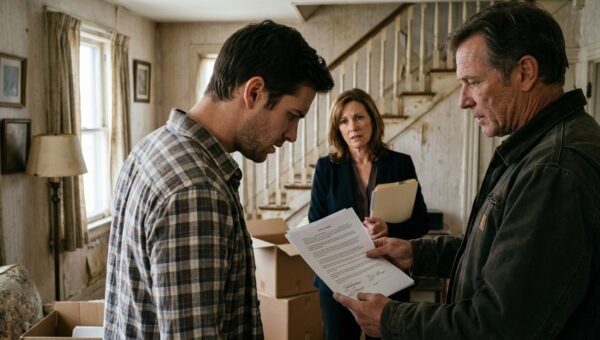
Inside was a maintenance request form dated two days before my accident. It asked for a replacement guard. The request had been marked completed. The signature beside the word was Evan.
I read it twice. He had either believed the repair had been done, or he had signed off without checking. Either way, the form put his name beside the one thing the company was trying to blame on me.
I took the envelope to the plant manager office. Evan was already there, waiting beside the investigator. He looked at the paper in my hand and said, “You do not know what happened after I signed that.”
The investigator asked whether I had any other records. I thought of the little voice recorder I had kept in my locker to dictate maintenance notes when my hands were too stiff to write. I had brought it home after the accident, and I still hadn’t listened to the last file.
Evan saw my face change. “Mom, do not play it here.”
I set the recorder on the table. The investigator pressed the button, and Evan voice came through, followed by a second voice I recognized saying, “If Mae asks about the guard, tell her I was the one who removed it.”
PART 2
The second voice on the tape belonged to Larry, the shift foreman. The recording had captured a conversation from three days before my accident, recorded automatically when I left the machine running while I went to answer a page.
Evan sat down hard in the metal chair, his hands flat on the manager desk. The silence in the small room lasted longer than any machine downtime I had ever seen.
“That was not supposed to be on there,” Evan whispered.
“You told me to sign off so the audit would pass,” Larry said from the doorway, having just walked in. “You told me nobody checks old tapes.”
The plant manager looked at the investigator, then at the maintenance request form still in my hand. The paperwork showed the repair was closed, but the tape proved the part had been missing deliberately to speed up production before an inspection.
“Mae,” the plant manager said, his voice dropping. “We can handle this quietly. We can revise the report to reflect mechanical failure.”
“Mechanical failure,” I said. “That is what you called my hand.”
Evan looked up at me, his eyes wide and young, the way they used to look when he scraped his knee and tried to hide it so I would not worry. “They were going to cut the shift, Mom. My department. I just needed one clean month.”
“To look good for the district managers?”
“To keep my job.” He swallowed hard. “I have a mortgage now. You know what things cost.”
I looked at my stiff fingers. I could barely curl them around a coffee cup. The company insurance was covering the therapy, but the plant had not offered a light-duty station since the accident. They had expected me to take the blame, take my small settlement, and stay quiet.
“You signed my name off on the safety log too, didn’t you?” I asked.
Evan did not answer. He just looked down at his boots.
The investigator reached out and picked up the recorder. “This changes the scope of the inquiry. OSHA will need the original file.”
PART 3
The inquiry took three weeks. I did not go back to the shop, even when Evan was suspended pending an internal review. Word got around the neighborhood quickly. People I had known for decades stopped looking me in the eye at the grocery store, or they looked too hard, wanting to know if my son was really going to lose his certification.
My sister called twice a day. “He was just trying to protect his livelihood,” she said. “You were already retired from the floor anyway.”
“He lied to pin an injury on his own mother,” I told her.
“Families get tangled up in things like that when the pressure gets high.”
“Not this tangled.”
On a Tuesday morning, Evan came to my house. He did not knock; he just stood on the front porch until I opened the screen door. He looked thinner, his jacket collar turned up against a cold wind.
“I have a hearing with the state board tomorrow,” he said.
“I know.”
“They are talking about revoking my safety license. If they do that, I cannot work anywhere in the county.”
“You signed off on a machine with no guard, Evan. You knew I was running it.”
“I thought Larry fixed it,” he said, his voice breaking. “I signed the digital form without walking the line. That was my mistake. I did not think the press would cycle twice.”
“You did not think at all.”
He stepped closer, but stopped at the edge of the mat. “Will you tell them you misunderstood what Larry said on the tape?”
I looked past him at the maple tree in the yard. The leaves were nearly gone, leaving bare gray branches against the sky. I had spent thirty-one years keeping that shop running, making sure the younger operators checked their locks, double-checked their clearances, and never took shortcuts. I had taught Evan those same rules before he ever set foot in a vocational school.
“No,” I said.
He stood there for a long moment, waiting for me to soften, the way I always had when he was a boy and broke a window or missed a curfew. When he realized I was not going to change my mind, his shoulders dropped.
“They are going to fine the company,” he said quietly. “And I am out.”
“You need to find a new line of work,” I said.
ENDING
Evan left without saying anything else. He walked down the driveway with his hands in his pockets, his truck idling at the curb.
I closed the door and locked it. On the kitchen table sat the small voice recorder, the batteries removed and the plastic casing scratched where I had dropped it on the concrete floor.
My hand throve a dull, steady ache as the room cooled down. I picked up my coffee mug, using my left hand to steady the weight, and carried it to the sink. The kitchen was quiet except for the hum of the refrigerator. I set the mug down, wiped the counter with a damp cloth, and sat down at the table by myself.