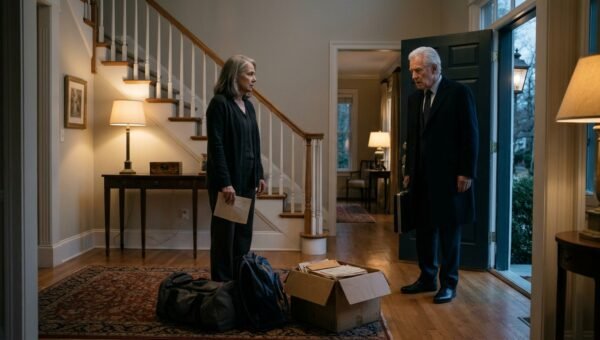
The fellowship hall at New Hope was where I learned what Pastor Williams had done with the money people gave to help families.
I almost didn’t go to the October potluck. Earl had been tired all week, and I didn’t like leaving him alone for long. But he told me to go eat something hot, and I had already made a tuna noodle casserole. So I put the bank statements in my purse and went.
I wasn’t planning to say anything. I thought I’d eat, listen to the quarterly report, and go home. That was what I’d done for years. I’d brought casseroles, folded chairs, and helped count the collection after Sunday service. I knew where the extra coffee filters were kept. People knew me as Earl’s wife, which was fine by me.
Pastor Williams stood by the podium with a printed report in his hand. Two hundred and ten people were in the hall, though I didn’t count them until later. I remember the smell of warm mayonnaise from my own dish, which is not a detail I’d choose to remember, but there it is.
He said, “Our benevolence fund assisted 14 families this year.”
I put my hand up before I could talk myself out of it.
Earl was home on the couch, waiting for his next call from the transplant team. He had liver failure, and the surgery estimate was $387,000.
We’d applied for help in April. Pastor Williams had looked me in the eye and told me the fund was empty.
The numbers didn’t match. I knew that much. I just didn’t yet know how badly they didn’t match.
In April, Earl and I sat across from Pastor Williams in his office. Earl had a folder of medical papers on his lap and kept rubbing the edge of it with his thumb. I had our bank balance written down on a yellow notepad, because I didn’t want to forget a number when I was nervous.
Pastor Williams was kind at first. He asked after Earl’s appetite and prayed with us. Then he glanced at the application and folded his hands.
“Helen, I’m sorry,” he said. “The fund is empty.”
I asked if there might be another way to help. I wasn’t asking the church to buy us a new house.
I was asking about a transplant that might keep my husband alive.
He looked toward the window. “This isn’t the time.”
I didn’t know what that meant. There was never a good time to need help, I guess. I thanked him, because I’d been raised to thank people even when they’d just shut a door in my face. Earl didn’t say much in the car.
At home, he put the folder on the kitchen table and said, “We’ll figure it out.”
I told him not to worry. I said it because he was sick and I didn’t want him carrying my fear too. But the next morning I called the hospital and asked if the number could be right. It was. The person on the phone explained what the estimate included, then explained it again because I couldn’t take it in the first time.
For a while I thought we’d just picked a bad month to ask.
We cut back where we could. I took extra shifts at the grocery store, mostly late ones, and came home smelling like floor cleaner. Earl’s energy went up and down. Some mornings he sat at the table and ate toast. Other mornings he barely made it from the bedroom to the recliner.
I didn’t tell the whole church how scared I was. People had their own problems. And I was embarrassed. I know that’s backward. We’d paid into that fund for years, but I still felt like I was asking for something that belonged to somebody else.
Diane worked at First National and had been my friend since our kids were in school. She called one afternoon in June and asked if I could meet her after work. She looked like she’d been awake all night, though she said she was fine.
“I saw something strange on the church account,” she told me.
Diane wasn’t supposed to hand out bank records. I want to be clear about that. She said she’d noticed a pattern of outgoing transfers from the church’s nonprofit account to a business in Shelbyville. She didn’t give me private customer information. She showed me enough to tell me the payments were real, and she said the amounts kept adding up.
“Don’t repeat this yet,” she said. “I need to make sure I’m not wrong.”
I didn’t want to pull her into trouble. I also didn’t want to let it go. So I asked her to check what she could through the proper channels. We didn’t meet again for a while.
That was the summer. A long stretch of shifts, appointments, and waiting for calls. Church went on as usual. Pastor Williams preached about looking after one another. I sat in the same pew and tried to make my face look normal.
There were small things I couldn’t stop noticing. When I asked about the fund in July, one of the deacons said the books were “being cleaned up.” At the end of August, Pastor Williams mentioned an outreach project but didn’t say where it was. In September, I saw Martha Williams carrying a new leather bag and told myself that wasn’t my business.
It wasn’t proof of anything. I know that. I was tired and mad, and sometimes I took ordinary things and turned them over in my head until they looked like evidence. Still, the one sentence kept sitting there: the fund is empty.
Diane called me the week before the potluck. She said she’d found the account statements through the review process, and there was enough there to show where the money went. She had made copies of documents she was allowed to share with me as a church member. She warned me not to leave them in my car, then met me at the bank on her lunch break.
The total was $94,000.
I read it twice. The outgoing payments all went to one place, a cosmetic procedures clinic in Shelbyville. The business belonged to Chloe, Martha Williams’s daughter and Pastor Williams’s stepdaughter.
The ledger description called them “emergency community outreach.”
I’m not a person who knows much about accounting. I know what a bill looks like and what it means when the money’s gone. I knew what those papers meant. The fund hadn’t been empty when we applied. It had been sent somewhere else.
I went home and put the statements in a drawer. I thought about taking them to the board privately. Then I thought about how many times I’d been told to wait, to be patient, not to make trouble. Earl was asleep in the recliner with a blanket over his knees. I stood there with the drawer open and realized I was still trying to keep the peace for people who hadn’t kept their word to us.
So I put the papers in my purse and went to the potluck.
When Pastor Williams said 14 families had been helped, I asked, “Why wasn’t mine one of them?”
People stopped moving around the tables. He held the report at his side.
“Helen, this isn’t the time,” he said.
“It was the time in April,” I told him. “Earl is on a waiting list. You told me the fund was empty.”
He said I was upset and that this wasn’t the place to discuss private church business. I could hear forks being set down. A chair scraped behind me.
I took the statements out of my purse.
“These are from First National,” I said. “There’s $94,000 in payments from the benevolence account to a clinic in Shelbyville.”
Pastor Williams reached toward the papers. I held them away from him.
“Please sit down,” he said. “You’re disrupting the meeting.”
That was when an older woman near the coffee urn stood up. I can’t remember her name, which bothers me. She asked him to tell us who the 14 families were. He looked down at the report and then back at her.
“We have to protect people’s privacy,” he said.
A man from the deacon board said, “Then show us the receipts.”
Pastor Williams didn’t answer right away. He flipped through the pages in his hand, though there wasn’t anything new on them. He said the transfers had been approved for outreach. I asked what outreach had been provided by Chloe’s cosmetic clinic.
He said, “You don’t understand how these accounts work.”
“I understand the fund was empty when I asked,” I said. “I understand where the money went.”
A few people began speaking at once. Some were angry with him. Some were angry at me for making it public. One woman came over and put a hand on my arm, then took it away when Martha Williams looked at her.
The elders asked me to step outside. I said I would, after the board agreed to an outside audit.
Pastor Williams called it an attack on the church. He said I was putting people’s private matters on display. That line might have worked on me in April. It didn’t work in that room with the statements in my hand.
“Then give us the records,” I said.
He had no beneficiary list for the 14 families. No receipts. No names he could offer the board to back up the report. The room had got quiet again, but it wasn’t the same kind of quiet as before. People were waiting for him to answer.
He couldn’t.
The deacons called an emergency meeting that afternoon. By the time I got home, the church treasurer had called me twice and left one message asking me to bring the documents in. I called back and said I’d bring copies, not the originals. That was the first useful thing I’d said all day.
The board suspended Pastor Williams while the records were reviewed. The church accounts were frozen, and the statements went to an independent auditor and local authorities. I didn’t know what the legal outcome would be. I still don’t know all of it. I do know the church changed who could approve payments, and the benevolence money came under a community committee instead of one pastor’s office.
The people split. Some stopped speaking to me. One couple I’d known for years told me I should have handled it privately. A few others admitted they’d had questions but were afraid to ask. Diane worried she’d lose her job. I told her I was sorry she’d had to carry any part of it.
“I’m glad you stood up,” she said.
I didn’t feel brave. I felt wrung out, and I was angry that speaking up had become my job.
Meanwhile, Earl’s medical situation kept moving. The transplant team needed a plan for the cost before they could confirm the next steps. The church fund couldn’t be counted on, so neighbors, former members, and people from two nearby congregations started a separate trust for his care. One donor wanted to stay anonymous. Others held a food sale and gave what they could.
I hated needing that much help. I also hated that I’d once thought asking for it was shameful. Both things were true.
A few weeks later, the hospital called to say the trust had enough committed for the team to move forward with Earl’s financial review. It wasn’t the same as having every bill settled. It meant they could keep working on his case instead of putting it on hold while we tried to find an answer alone.
Pastor Williams was removed from his role. The audit confirmed the $94,000 in transfers to Chloe’s clinic had been labeled as community outreach, and the claimed list of 14 families couldn’t be supported. The clinic money was referred for recovery through the legal process. I’m not going to pretend every dollar came back quickly, or that I got an apology that fixed anything.
One Sunday, Earl was too tired to sit through the service, so I stayed home with him. He was in the hospital recliner, wearing the old flannel shirt with the loose button. I’d sewn it back on twice. He asked if the church check had come.
I said it had. The community trust had the check signed, and the hospital had received the payment plan documents. The amount wasn’t the whole $387,000. It was what the trust had raised and what the hospital needed to keep Earl’s transplant process moving while the rest was worked out.
Earl nodded. “People came through.”
“They did,” I said.
I sat beside him with the check in my hand. The afternoon sun landed across the paper, and for once I didn’t feel like I had to explain why we needed it. I just held it there while Earl rested, and let the promise on that check be plain: the money was for him, and nobody in a church office could quietly send it somewhere else.