The text came in while I was still sitting in the airport lot with my suitcase in the back seat.
“Jo’s porch light is on. She hasn’t answered me all morning.”
I read it twice. The sender was Mrs. Alvarez, who lived three houses down from my sister. I’d been back in our Nebraska railroad town for the first time in years, and I’d been telling myself Jo was just mad at me. Three months of silence seemed to prove it.
At my medical school graduation, I’d said, “See? I climbed the ladder. You took the easy road and became a nobody.”
Jo had smiled. Not a big smile. Just the one she used when she was trying not to make a scene. Then she left before I could decide whether I’d said something awful or merely honest.
I had a reservation for dinner with my classmates that night. I canceled it and drove to Jo’s house.
The house looked the same from the street. Same little porch. Same flowerpot by the steps, empty except for the dry dirt. I knocked. No answer. I called her, then knocked again, harder.
Her front door was unlocked.
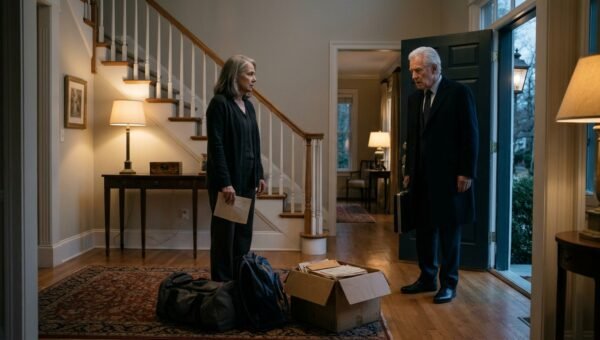
I called her name as I stepped inside. The house was quiet enough that I could hear the refrigerator clicking on. Her work boots were by the door, toes split at the seams.
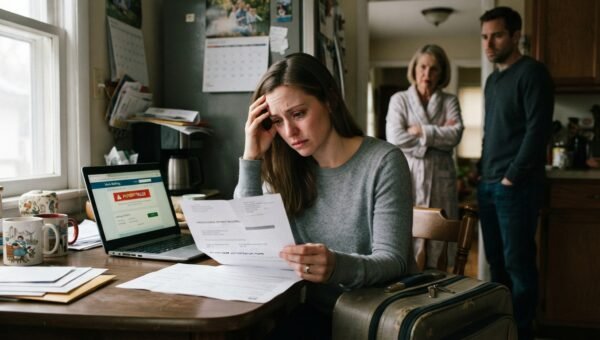
On the table, beneath a mug with a dried brown ring in it, sat a pile of envelopes.
I noticed the bills first. Then the notebook beside them.
There was no Jo.
I called Mrs. Alvarez. She came over in her house slippers, breathing hard from the walk. She looked at me for a second, then at the open door.
“Didn’t she tell you?” she asked.
“Tell me what?”
“She’s at the clinic. She went in yesterday.”
I asked if Jo was sick. Mrs. Alvarez pressed her lips together, like she was picking her words.
“She’s been pushing herself a long time.”
I hated that answer. It sounded like blame, and I was already looking for some place to put mine. I went back inside and picked up the notebook.
It was a ledger, though Jo had never called it that. She used it to keep track of the jobs she’d worked, the hours, and what she’d paid.
There were years of entries. A diner, a grocery store, a nursing home kitchen, then the laundry plant. Some weeks had two jobs listed. Some had three.
I knew she’d worked. I’d never asked how much.
The pages were full of small notes in Jo’s handwriting. “Tuition due.” “Rent sent.” “Books.” “Car repair.” There were payments marked beside my name. I kept turning pages, though my hands had started to shake enough that the paper rustled.
I’d spent a lot of time thinking about my grades, my rotations, my exams. I had never sat down and added up what it took for me to stay in school.
At the bottom of the pile were medical bills. A prescription receipt. A clinic appointment card with two dates crossed out and one circled. I looked at the date. It was from the month before graduation.
The trouble was, I remembered that month. I’d called Jo once to tell her I was busy and couldn’t come home. She’d said, “That’s all right. You’ve got enough going on.”
I’d believed her because I wanted to.
Mrs. Alvarez stood near the kitchen doorway. She looked at the ledger in my hand.
“She never wanted you to know,” she said. “She said you had enough to carry.”
I tried to ask what Jo had told her, but I couldn’t get the words out right. So I called the clinic and said I was Jo’s sister. The receptionist said Jo was still there and could have a visitor.
Before I left, I took the ledger with me.
Mrs. Alvarez touched my sleeve. “She loves you, honey.”
“I know,” I said.
I did know. That was part of the problem.
The clinic was small, the kind of place where the chairs had cracked vinyl seats and the front desk had a bowl of peppermints nobody seemed to take. A nurse showed me to a room at the back. Jo was sitting on the edge of the bed in her own clothes, a paper cup of water on the table beside her.
She looked smaller than I remembered. Not thinner exactly. Just worn out. Her hair was tied back with the same elastic band she always used, and the skin around her eyes looked dry and sore.
She smiled when she saw me.
“Hey, Doc.”
I’d spent years imagining my first visit back. I thought I might be angry. Or she might be angry. I didn’t imagine her making a joke before I’d even sat down.
I dropped my bag on the floor. “What happened?”
“Nothing dramatic.”
“Jo.”
She looked at the floor. “I got dizzy at work. Then I sat down.”
“You passed out?”
“I didn’t say that.”
The nurse came back in and explained what she could. Jo had collapsed after a long shift and was badly run down. Her blood pressure was high, she was dehydrated, and her blood work needed follow-up. The clinic wanted more tests and rest. The nurse said Jo had been putting off care.
Jo gave me a look as if to say, Don’t make a thing of it.
I made a thing of it. I asked for the test results. I asked what follow-up they wanted. I asked whether she had someone to drive her home. All the questions came out in my doctor voice, neat and quick, like I could fix what I was seeing by putting it in order.
When the nurse left, Jo said, “You don’t have to do all that.”
“I do.”
“You’ve got your residency.”
“I know.”
“It starts soon.”
“I know.”
She nodded, then took a sip from the paper cup. Her hand shook a little. I looked at the hand and thought of the ledger, the boots by the door, the crossed-out clinic dates.
I wanted her to yell at me. I wanted her to say I was selfish, because then I could answer, apologize, and have a clear next step. Jo just sat there, tired and quiet.
So I brought the ledger over and set it on the bed between us.
“I didn’t know,” I said.
“You didn’t ask.”
That was fair. I didn’t try to argue.
She opened the cover. Her fingers moved over the first page like she knew the entries by touch. There were notes from the years after Mom died, when Jo was nineteen and I was twelve. She had taken whatever shifts she could get and kept me fed and in school. Later, she paid my college expenses. Then medical school. I had told myself I earned every part of my life because I studied hard.
I did study hard. I also never had to choose between buying a textbook and paying for dinner.
Jo closed the ledger. “You worked for it too.”
“That doesn’t make what I said okay.”
“No,” she said. “It doesn’t.”
I looked down at my hands. I still had a faint red mark across my finger from the strap of my bag. Jo’s hands rested on the bedspread, rough and cracked around the nails.
The line I couldn’t stop hearing was the one I’d said at graduation. I climbed the ladder. You took the easy road.
I had turned her whole life into a comparison and called myself the winner.
“Why didn’t you tell me you were sick?” I asked.
Jo rubbed the side of her thumb. “You were almost done.”
“That’s not an answer.”
“It’s the one I’ve got.”
I was angry then, but not at her. I was angry that she’d hidden it, and ashamed that she thought she had to. I could see how I’d helped teach her that. Every time she called and I said I was studying. Every time she asked how I was doing and I talked for twenty minutes without asking how she was.
I sat down in the chair beside her. It made a small squeak.
“I’m sorry,” I said.
Jo looked at me. “I know.”
That was all. No speech. No easy forgiveness that made me feel better.
Three weeks later, I was still in town.
My residency program had given me a start date and a moving timeline. I called them and asked for a delay. I was embarrassed to explain why. I had spent years treating my future like a fragile thing that needed every hour of my attention. But Jo was not an interruption. She was the reason I’d had those hours.
The clinic arranged more tests and a follow-up plan. I helped Jo get appointments, picked up her prescriptions, and made sure she ate before taking them. I also found out what I could not do. I couldn’t make her body bounce back in a week. I couldn’t make her trust me just because I had a medical degree.
The first night at home, I tried to take over everything. I cooked too much food, moved her laundry, and made a list of what she should do the next day. Jo read it and put it face down.
“I’m not one of your patients,” she said.
“I know.”
“Then don’t talk to me like one.”
I took the paper back. I was used to fixing things by giving instructions. That didn’t mean it was always helpful.
The next morning, I asked what she wanted me to do. She said she wanted to sit on the porch and drink coffee without talking about blood pressure. So we did. I let the coffee get cold in my cup.
The ledger stayed on the kitchen table for days. I kept picking it up, then putting it down. I wanted to understand every entry, as if adding the numbers would tell me how to repay her. It wouldn’t. I knew that. I still tried.
Mrs. Alvarez filled in some of the gaps without meaning to. Jo had been picking up extra shifts after I left for school. She’d tell people she was fine, then cover another shift when somebody’s kid got sick. She’d sent money to me on the weeks she had almost none left.
“She never wanted you to feel poor,” Mrs. Alvarez told me.
I remembered the way Jo used to tuck grocery money into my backpack before I left for college. She’d say it was for emergencies. I thought emergencies meant a flat tire or a missed bus. I never thought about what she went without to put it there.
I had admired the ladder. I’d talked about it like it was something I climbed alone. Jo had been holding it steady while working nights.
That didn’t make me noble for realizing it late. It made me late.
Over the next month, Jo started taking the follow-up care seriously. I helped organize the bills and set up a budget so she could cut back on work. I used my first paycheck to pay what she owed the clinic and cover the next few months of household expenses. She didn’t want to accept it at first.
“I’m not taking charity,” she said.
“It’s not charity.”
“What is it, then?”
“My turn to help.”
She looked at me for a long time. “You’re going to have to keep showing me.”
“I know.”
And I did. I stayed. I drove her to appointments. I learned when to ask and when to stop hovering. I learned that care wasn’t the same thing as control, which I should probably have known before I got the degree.
We didn’t become close again in one grand conversation. We started with small things. Jo told me when she was tired. I tried not to make her repeat herself. She asked about residency, and I answered without making it sound like my life was more important than hers.
Sometimes I still heard my graduation voice in my head. I hated how proud I’d sounded. I hated that Jo had smiled and walked away instead of making me face it right then. But I understood why she had. She’d spent my whole life keeping me focused. Even when I hurt her, she’d tried not to make me stumble.
One evening, we sat at the kitchen table with the ledger between us. Jo had just come back from a checkup. She said the doctor wanted her to keep resting and come back again in a few weeks. There was no quick fix. We both knew that.
She turned the ledger around and pushed it toward me.
“You can keep it,” she said.
“I don’t want it as a bill.”
“It isn’t.”
I looked at the pages again. They weren’t a bill. They were a record of a life she had spent making room for mine.
I reached across the table. Her hands were rough from years of work, and one knuckle had a small split in the skin. She let me hold them.
For a minute, neither of us said anything. I put my stethoscope on the table, took her hands to the sink, and washed them myself.