The twenty-dollar bill didn’t belong beside the Martin’s thirty-dollar tag.
I noticed that before I noticed the boy holding it. He was standing at the edge of my father’s driveway, studying the guitar like he’d come across something he’d been told wasn’t for him. The bill in his hand was crumpled into a tight little square.
I was packing up Arthur’s life one folding table at a time. I’d been at it since eight that morning, and I was already tired of answering questions about whether the old things worked.
I had priced the guitar at $30 because I didn’t want to carry it back into the house. It was worth around $500, maybe more, but I wasn’t thinking clearly about money that day.
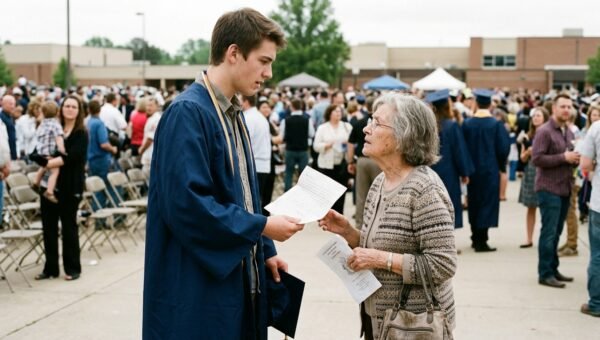
The boy looked about sixteen. He had a backpack over one shoulder and a careful way of moving around the sale, like he didn’t want to bump anything. When I told him the price, he glanced at the twenty in his hand.
Then he asked if he could play it once.
That was how I met Leo.
I said yes before I had time to talk myself out of it. I set the guitar on his lap while he sat on the curb. He tuned it by ear, turning the pegs slowly and plucking one string at a time. He didn’t make a show of it. He just listened.
Then he started playing “Blackbird.”
Dad played that song most evenings. Not every night, but often enough that I still half expected to hear it when I came through his back door.
His timing wasn’t perfect. He’d sometimes miss a note and make a little sound under his breath, then keep going. Leo’s version had that same small pause before the next part.
I stood there with a box of old kitchen things in my arms until I remembered I was holding it.
For a few minutes, I was back in Dad’s house with the screen door open and the smell of his coffee sitting in the kitchen. Then Leo finished the song, and I was in the driveway again, holding a box of chipped mugs.
I asked where he learned to play. He said he was self-taught and borrowed a friend’s guitar when he could. His school had cut the music program. He’d been watching videos and trying to figure out songs by listening.
He told me all this while looking down at the guitar, not at me.
I asked if he had anything at home to practice on. He shook his head.
The friend with the guitar was kind, he said, but he couldn’t borrow it whenever he wanted.
I looked at the Martin. Then I looked at the twenty in his hand.
I thought of Dad letting kids from the neighborhood sit on his porch and try his instruments. I knew he’d done it now and then, though I couldn’t have said how often. I also knew he’d hated the thought of a good instrument being left in a closet.
So I took the bill from Leo. I could have made some speech about it. I didn’t.
“Take good care of it,” I told him. “Some things are meant to make music.”
He stared at me like he hadn’t heard right. I said it again, and handed the guitar back.
He asked if I was sure. I said yes. He said he could pay me the rest later. I told him there wasn’t any rest to pay.
That was it. No big scene. Leo put the twenty in his pocket, thanked me, and walked home with the guitar held against his side. I watched him get to the corner before I went back to the sale.
I don’t know why I watched that long. Maybe because the guitar looked too large for him, or maybe because it had been Dad’s for so long that seeing it leave felt different from seeing a stranger carry off a box of dishes.
The rest of the afternoon went on in the usual way. A woman bought Dad’s old desk lamp. A man took a stack of gardening books for a dollar. I made change and tried not to look through the front window at the empty spots in the house.
The yard sale was supposed to make things easier. Dad had been gone for four months, and I thought the house would feel less like his once I cleared it out. That isn’t how it worked. Every shelf I emptied seemed to leave a new thing I hadn’t decided what to do with.
His study was the worst room. I kept putting things into boxes, then stopping because I couldn’t tell if something mattered or if I just recognized it. There were old receipts in one drawer and guitar picks in another. I even kept a chipped blue cup because Dad used to set his picks in it. I was not being very sensible.
My brother had told me to take my time. He also didn’t want to sort through the house, so I had all the time in the world, as long as I did it myself. I was a little angry about that. I know I was.
Near closing, a neighbor named Marlene came over with a dish towel folded in her arms. She had lived on our street longer than I had. She’d known Dad well enough to drop by without calling.
She asked if I was selling the Martin. I told her I’d given it to a boy who came by. I said his name was Leo.
“Arthur would’ve liked that,” she said.
I asked what she meant. Marlene said Dad used to help kids with music. Not in any official way. He’d show them a few chords, let them practice on his guitar, and sometimes send them home with sheet music. She remembered seeing a couple of kids at his house after school.
I told her I knew he let people play. I hadn’t known it was a regular thing.
“He didn’t talk about it,” Marlene said. “He just did it.”
Then she asked if I had found the old music notebook. I said I didn’t know what she meant. She said Arthur had kept one in the guitar case, or at least she thought he had. I told her I hadn’t seen it.
That bothered me more than it should have. I had looked in the case that morning. I thought I had. I remembered lifting the lid and seeing the smell of old leather and a few loose picks. But I had been rushing and probably hadn’t checked the pocket inside.
After Marlene left, I went out to the folding table where I’d set the case. It was empty now except for a spare strap and a small black clip-on tuner. I picked those up, then checked the inside pocket.
There was a thin notebook tucked underneath the lining. The cover was bent, and the first few pages had come loose. I don’t know how I missed it. Maybe it had been pushed down all the way, or maybe I just wasn’t looking for anything that belonged to Dad beyond the guitar itself.
The notebook was full of handwritten chords, song titles, and names. The names had dates beside them. Some had little notes in Dad’s small, slanted handwriting: “Needs slower changes.” “Good ear.” “Practice the G chord again.”
A few names were crossed out, then written again months later.
I found one page with a short list of songs. “Blackbird” was near the bottom. It had a note beside it that said, “For Jamie, keep at it.”
Jamie was a kid who lived two houses down when I was in high school. I remembered Dad showing him a few chords, but I hadn’t known he’d written it down. I could picture Jamie sitting at our kitchen table, eating peanut butter crackers while Dad tuned the guitar.
I sat on the edge of the driveway with the notebook open on my knees. I thought about all the times Dad came home from work, washed his hands, and sat down to play. I had treated it as a habit. It was a habit. It was also a door he kept open for people.
The next day, Leo came back.
I was inside the study, trying to decide what to do with the last box of sheet music. I heard a car door shut and went to the front window. Leo was on the porch with the guitar case. For a second I worried he’d changed his mind or something was wrong with it.
When I opened the door, he held out a folded piece of notebook paper. He said he’d spent most of the night playing, stopping when his fingers got sore. He’d written down the first song he was trying to learn on the guitar.
“It isn’t finished,” he said.
I told him it didn’t have to be.
He said he’d wanted to bring me something. The paper had a few lines of music and some chords, written in careful block letters. At the top, he’d written, “For Arthur, and for you.”
I didn’t know what to say. It was only a scrap of paper. It was also the first thing anyone had given me because of Dad since the funeral.
Leo asked if he could show me what he had so far. I told him yes, and brought the guitar out to the porch. He sat on the top step and tried the song. He stopped twice to work out a chord. The second time he shook his hand and said his fingers hurt.
I said Dad used to tell me sore fingers meant I was practicing, not that I was good. Leo smiled a little and tried again.
It was a simple tune. He hadn’t finished it, and he missed a note near the end. I could tell he was embarrassed, so I didn’t say anything about the mistake. I just listened.
When he stopped, I asked if he wanted the notebook from the case. I told him about the names and the notes in Dad’s handwriting. Leo turned the pages slowly. He didn’t know any of the names, but he read the comments beside them.
“Your dad helped kids like me?” he asked.
I said it looked that way.
Leo ran his thumb over one of Dad’s notes, careful not to smudge it. He said he wished he’d met him. I said I wished Dad had been here to meet him too.
That was when I started crying, which annoyed me because I had been doing pretty well up to that point. Leo looked down at the guitar and gave me a minute. I was grateful he didn’t try to fix it with a nice line.
After that, the practical part came back. I had a stack of music books and spare strings that I hadn’t priced. I told Leo he could have those too. He said he didn’t want to take everything. I told him I wasn’t giving it to him because I felt sorry for him. I was giving it to him because it was meant to be used.
He nodded and took the books. I asked if he knew other kids who wanted to learn. He said there were a few, and one of them had been looking for a cheap guitar for months.
That night, I called the high school and asked who handled the music program. It had been cut, but there was still a teacher helping students put together an after-school group when she could. I told her I had Dad’s sheet music and some spare strings. She said a few kids could use them.
I didn’t make a grand plan. I put the remaining music books in a box, wrote the teacher’s name on it, and left it by the front door. I also kept the notebook. I couldn’t hand that part over. Not yet.
Clearing Dad’s study still hurt. I still found things I didn’t know what to do with, and I still got irritated when I came across a receipt from a meal he and I had shared. I wasn’t suddenly done grieving because one boy had played a song on a curb.
But the guitar wasn’t in a closet anymore. Leo was using it. The music books would reach other kids. And Dad’s little notes, written for people whose names I might never have heard, were no longer only his private way of remembering them.
At twilight, I stood on the front porch with the study door open behind me. I heard a few notes drifting from somewhere down the street. I couldn’t tell if Leo was playing “Blackbird” or trying his new song. I didn’t go looking.
I just listened until the sound faded, with Dad’s notebook tucked under my arm and the house still open behind me.