The Voss farm is where the word missing finally stopped explaining anything.
I know what was found there now. I didn’t know when I paid $80 for an old mirror at a flea market, or when I saw the first Polaroid tucked behind its backing. I only knew that my sister June had been gone since 1999, and that I’d spent years trying not to picture what might have happened.
The mirror was propped against a folding table between a box of old lamps and a stack of picture frames. The seller said it came from an estate cleanout. I bought it because it looked like the mirror that used to hang in my parents’ house. The frame had a small notch near one corner. I remembered that notch, though I didn’t know why I’d kept it in my head.
I carried it into my house and leaned it by the hallway wall. When I wiped the glass, the cloth snagged near the bottom. There was a narrow gap between the mirror and its backing. I could have left it alone. Instead, I found a flat screwdriver in the kitchen drawer and worked it under the loose edge.
The backing gave with a dry little pop.
Polaroids slid out onto the floor. Twenty-three of them, though I counted twice because my hands weren’t doing what I wanted.
Every picture showed a young woman asleep. The angle was low and cramped, like the camera was inside a closet.
Then I saw the wallpaper.
Tiny brown daisies on a faded green background. My childhood bedroom. I knew the spot where one strip had bubbled near the baseboard. It was visible in the corner of two pictures.
June was the woman in the bed.
I sat down on the hallway floor. I kept telling myself to pick them up by the edges, like that mattered. The dates on the backs were from 1998. June disappeared the next year. I don’t mean we lost touch or she went off and started a new life. She left the house one evening and never came home. The police searched. They asked questions. They told my parents she might have wanted a fresh start. They never found her.
I used to get angry when people called her a runaway. Then I started using the word myself, mostly because it gave my brain something simple to hold.
I was twenty-two when she vanished, and I’d had a fight with her a few days before. She’d said she was tired of being treated like the family’s problem. I told her, “Then go do what you want.” I didn’t mean go forever. I also didn’t call her the night she left, because I thought she’d cool off and call me the next day. I’m ashamed of how neat I made that story in my head. If June had chosen to leave, then maybe I hadn’t failed her. Maybe she was still out there, mad at us, living somewhere under another name. I could say all of that while I folded laundry or drove to work. I couldn’t say it when I looked at my mother’s face. Anyway, those pictures made the word runaway feel like something I’d helped build.
I set the Polaroids in a clean dish towel and called Gordon Hale.
He’d been the detective on June’s case. He was retired now, but I’d seen him at a town meeting the year before and had his number from my mother’s old papers.
He answered on the fourth ring.
“Vickie?”
“I found something from June’s case.”
There was a pause. Then he asked where I was.
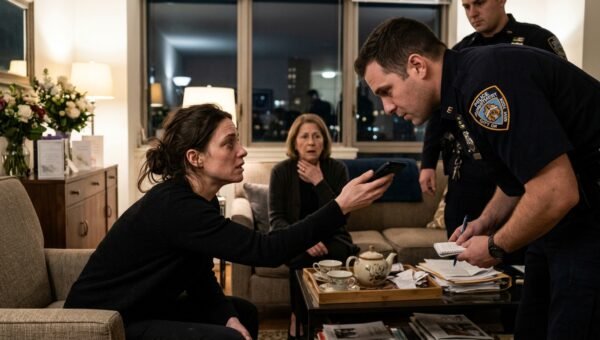
I took the photos to the county building the next morning. Gordon met me in a small interview room that smelled like burnt coffee. His hair had gone mostly white. He still had the same habit of pressing his thumb against the side of his index finger while he listened.
I laid out the pictures. He didn’t touch them at first. He leaned over the table and looked at each one, slow and careful.
When he reached the last photo, his hand stopped.
He turned it over. The address was written in black marker: 3127 180th Street.
Gordon’s face changed. Not a little. He actually looked like he’d taken a bad hit.
“This address belongs to Nolan Voss,” he said.
I knew the name. Nolan had been a deputy when June disappeared. He’d been to our house more than once. He fixed a loose kitchen step for my dad and checked in after June went missing. My parents trusted him because he wore a badge and knew our names.
“Why is his address on there?” I asked.
Gordon sat back. “I should’ve checked that address years ago.”
“What does that mean?”
He looked down at the photo again. “I knew Nolan. I trusted him. He said he’d been at your house that week.”
Gordon told me that Nolan had said he’d stopped by to ask June a few questions about a car seen near the house. Gordon wrote down Nolan’s address, then crossed it out after Nolan said he’d mixed up which week he’d been there. Gordon had never put that note in the official file.
“I let his word settle it,” he said. “I was wrong.”
I wanted him to say more. I wanted to hear that it was all his fault, because then I could be furious at him instead of turning the same question back on myself. But he didn’t make excuses. He sat there with his hands flat on the table.
I asked if he’d go to the address with me.
“No,” he said. “Not alone.”
That answer made me trust him more than any apology would have. He called Sheriff Marla Pruitt and told her about the photos and the crossed-out note. Marla said we weren’t going to Nolan’s house until she had deputies with us and a plan. I didn’t like waiting. I waited anyway.
By late afternoon, Marla, Gordon, and I were on the road to 3127 180th Street. The farm sat beyond a narrow gravel drive. I recognized the red shed from a picture in one of my parents’ albums. Nolan had lived there when he was a deputy. It was still his address.
Marla had two deputies with her. She told me to stay by the car.
I said, “I’m not staying here.”
Gordon glanced at me. “You stay behind us.”
Nolan answered the door after the second knock. He was old, but not so old he needed help walking. He looked at Gordon, then at me. When I held up the Polaroid, he stopped talking.
He didn’t ask what it was.
“That’s June,” I said.
Nolan looked at the photo for a long second. “She left on her own.”
Gordon stepped closer. “You told me that in 1999.”
“She was grown.”
“Then why did you keep these?”
Nolan’s mouth opened, then closed. His eyes went to the officers. He reached for the picture. Marla blocked him with her arm.
“Don’t touch it,” she said.
I was gripping the Polaroid so hard the corner bent. Nolan stared at the tiny brown flowers behind June.
“I was in the closet,” he said.
Nobody moved.
“What?” I asked.
“I took the pictures. I had a key. Your dad gave it to me after I fixed the back door.”
That was true. I remembered the old brass key on my father’s ring. Nolan had been around our house for years. I had never asked what he did while my parents were out, or why he knew the house so well.
Gordon’s voice went flat. “Gordon didn’t raise his voice. “You told me she left.”
Nolan lowered his eyes. He said June had found him in the closet and threatened to tell my parents. He took her out to the farm to scare her into keeping quiet. When she tried to get away, he hit her. She died there. He buried her on the property, then told Gordon she’d run off. The photos stayed hidden because he couldn’t bring himself to destroy them.
Nolan led the deputies to the spot. They found June’s remains, and the state confirmed who she was. The sheriff’s office reopened the case. Nolan was charged, and Gordon gave a statement about the note he’d left out of the file. I couldn’t forgive either man for the years we’d spent not knowing. I also didn’t have to keep pretending June had chosen to leave.
The mirror’s backing is empty now. I leaned it against the wall, and for once, it reflected only the room.