The Red Cross envelope had my name spelled right, but the camp number was wrong. I noticed that before I noticed the seal. For a few seconds, I thought the letter might belong to somebody else, and I could give it back without opening it. I was twenty-two years old. I had already learned how much a person can try to make one small thing mean what she needs it to mean.
I have kept this part to myself for a long time. When my children asked about the war, I told them about the letter, and about losing my family. I did not tell them that before the letter came, an American sergeant had put a bowl of grits on my tray and spoken to me as if I were still a person. I thought that part was too small to matter. I was wrong.
On April 16, 1945, I was one of twenty-three German women in a military truck near the Belgian border. I had been working as a civilian auxiliary, carrying papers and supplies. I was not a soldier, though by then I knew that did not protect me from being treated like one. The canvas flap lifted. I saw chain-link fences, watchtowers, and American guards watching us climb down.
I had heard what Americans would do to us. Some of it came from official talk.
Some came from people who repeated rumors until they sounded like facts. I expected shouting, hands on us, punishment for every answer we got wrong. My mouth was dry from the ride. I remember one woman gripping the strap of her little bag so hard her knuckles hurt. Nobody said much.
A guard pointed us toward a mess hall. The noise inside made me tense up again. Trays scraped, men called across the room, and I could smell coffee and something cooked with fat. I watched the soldiers’ hands more than their faces. I was waiting for someone to shove me or tell me I had no right to eat.
A Black sergeant stood behind the serving line. He had a neat uniform and a tired look, not an angry one. He set a scoop of pale, creamy food on my tin tray. I stared at it long enough that he paused.
“Grits,” he said. “Corn grits. It’s good. You’ll like it.”
I did not know the word. I looked at him, then at the tray. He was a Black American soldier serving German prisoners, and I had never been taught to picture that. The words I had heard about America did not leave room for the sight of him, calm and doing his job. I felt embarrassed by my own fear, then ashamed that I was embarrassed. I took the tray.
The grits were warm and soft. There was a faint taste I could not name, and a little salt. It was not a grand meal. I was hungry enough to scrape the tin with my spoon. Sergeant Thomas, I learned later, was the quartermaster sergeant assigned to the camp. That first day I knew only his last name from a short introduction and the way he waited for me to try the food.
“Is it all right?” he asked.
“Yes,” I said.
“Good.”
That was the whole conversation. I remember it because I had expected kindness to come with a price. I thought he might want a thank-you, or a promise, or some sign that I knew he had power over me. He just moved on to the next tray. I ate everything. I was not ready to call it trust, but I had chosen not to let fear keep me from eating.
The camp was not gentle in every way. There were rules, searches, long waits, and little information about what would happen to us. The other women and I learned where to line up and which guards had no patience for questions. Thomas could not change that. But when he was on duty near the mess hall, the portions were fair, and he did not let a woman be shoved aside because she was weak or slow.
Some of the American soldiers disliked him. I heard one man say, “You don’t need to fuss over them.” Thomas answered without raising his voice.
“Everybody gets fed.”
The soldier gave a short laugh. Thomas kept working. I had seen that kind of laugh before, though not from the same side of a fence. It was the sound of someone deciding another person was beneath notice. Thomas did not make a show of standing up to him. He simply kept serving the same amount.
That stayed with me. I had thought hatred was a thing people had to announce, with flags and speeches and loud words. Thomas showed me it could be quieter than that. It could be a hand withholding food, or a person acting as if your question did not deserve an answer. He also showed me that refusing to do that was a choice, even when the choice cost a person something.
By May, we knew Germany had surrendered. The news reached us in pieces, passed along by guards and women who had heard something from the next barracks. I remember the date as May 8, though I may have first heard it the day after. Some women cried with relief. Others sat on their bunks and said nothing. I felt no relief. Surrender meant the war was over, but it did not tell me where my family was.
My parents and younger brother lived in Berlin. I had last heard from them before the front moved so fast that letters stopped coming. I had a picture of my mother in my pocket, folded until the corners softened. I kept telling myself that the post was slow, that Berlin was still standing, that my family had found a cellar or a neighbor. I had no proof. I had only the need to keep asking.
One afternoon, I found Thomas near a stack of supply crates. I had been carrying a tin cup back from the wash area and saw him checking a list. I almost walked past. Then I asked the question I had been holding in my mouth for weeks.
“Why are you kind to us?”
He looked at me, then down at the paper in his hand.
“I’ve got a job to do,” he said.
“That isn’t all.”
“No,” he said. “It isn’t.”
He did not tell me his whole life. I did not ask him to. He said he had seen men use the war to excuse things they would not have done in front of their mothers. Then he said he had no interest in becoming that kind of man. His voice stayed level. I remember a loose thread on his cuff, because I looked at it while I tried to understand what he meant.
“You’re not afraid of us?” I asked.
“You’re prisoners,” he said. “That doesn’t make you less human.”
I did not know what to do with that sentence. It was not comfort exactly. He was not saying everything would be all right. He was saying something more basic, and somehow harder to argue with. I thanked him. He nodded and went back to his list.
The weeks went by. We heard talk of repatriation and checks on our papers, but no dates we could trust. I asked about mail until another woman told me to stop wearing out my voice. Still, whenever the camp clerk came through with a pouch, I watched his hands. I knew that hope could make a person look foolish. I kept hoping anyway.
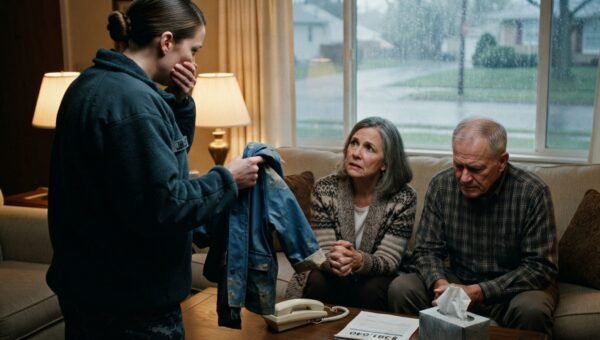
When the Red Cross mail finally arrived, the women crowded near the table. The clerk called names. I heard mine, stepped forward, and saw the envelope with the wrong camp number. I took it. My thumb rubbed at the paper seal. I told myself it might be a mistake. I told myself the letter could hold good news, though I had not received a good letter in months.
I opened it at the table. The paper inside was thin, with a few lines typed and a short message below. The Red Cross had found a report about my family’s house in Berlin. It had been destroyed in the air raids in April. My parents and my younger brother had been inside. The report said they had not survived.
I read it again. Then again. I was looking for a word that might change the sentence. There was none. My family was gone. I had spent weeks thinking the worst thing was not knowing. It was not. Knowing had a shape, and it fit inside a small sheet of paper.
I could not stay at the table. I went outside with the letter crushed in my hand and sat down beside the wall. I did not cry right away. I kept reading the same lines, as if I had been given an assignment and might be sent back to do it better. My fingers made a soft tearing sound against the paper. I had ruined the edge.
Thomas found me there. He did not ask what the letter said. He must have seen my face, or the way I was holding the page. He came over and sat on the ground beside me, leaving a little space between us.
“They’re gone,” I said.
He waited.
“My mother. My father. My brother.”
“I’m sorry, Hanna,” he said.
I wanted to say something that would make the loss smaller. I wanted to tell him he could not understand. But he did not claim that he understood. He did not tell me to be strong, or that I would be fine. He sat beside me. That was all. After a while, I let my shoulder rest against the wall instead of holding myself upright.
I had spent my life being told which people were worth trusting and which people were supposed to be enemies. The Red Cross letter had taken the last people I could call home. Thomas could not give them back. But he had never asked me to believe in him because he was American, or because he was a soldier. He had simply brought me food, treated the women fairly, and stayed when there was nothing he could fix.
I did not forgive the war. I did not forgive the people who fed us lies, including the parts I had repeated myself. I had been proud of things I should have questioned. I had looked at Thomas and first seen the enemy his uniform was supposed to be. I still regret that. But I learned that what I had been taught was not the only way to see a person.
When I was processed out of the camp, I had no family to return to in Berlin. I carried my papers and the photograph of my mother. Thomas was not there when I left. I did not get to say goodbye, and I had no address to write to. I sometimes wish I had asked more about his home. I was young and tired, and I thought there would be another chance.
For years, I told myself the letter was the thing that defined that spring. It was the worst news I had ever received, so I put it at the center of the memory. It took me a long time to admit the other part: my first clear act after reading it was to let someone sit beside me without pushing him away.
I have never called the grits a miracle. They were supper in a mess hall, and Thomas was a sergeant doing his duty. But the bowl came before I knew what I had lost. He had offered food without asking what I believed, and later he gave me company without asking me to be grateful. I carried that with me into a life that had to be made from almost nothing.
I could not keep the bowl. I did not keep the spoon. But when I think of that day now, I see the plain wooden table, the letter in my hand, and the little tin spoon resting where I had left it beside the empty tray. I had lost my family. I was still not entirely alone.