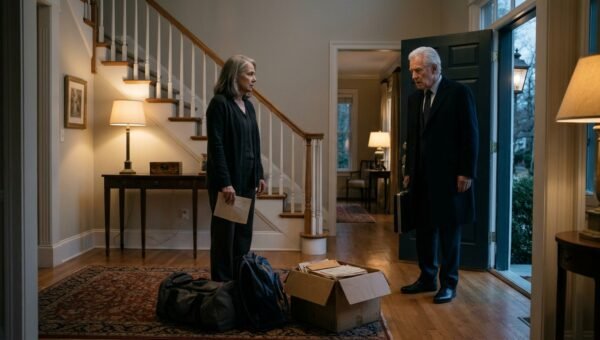
I got one thing wrong about Vanessa: I thought she took Toby because she wanted to be his mother. At eighteen, he stood crying on my porch and put an envelope in my hands, and I learned there was another reason.
I raised Toby from the time he was two until he was twelve. My son, Gary, had never wanted the job, and Vanessa left when Toby was little. I won’t pretend I was happy about how things started.
I was angry at both of them for a long time. But Toby was a baby, and he needed somebody steady, so I became that person.
My husband, Frank, helped me raise him. Frank died before Toby turned twelve, but he’d already made sure Toby had a future that didn’t depend on Gary or Vanessa. He set up a six-figure education trust. I knew the money was protected and meant for Toby. I didn’t know it would become the reason Vanessa came back.
For ten years, our life was plain and good. Toby left his shoes wherever he dropped them, and I’d find one under the kitchen table days later. He liked buttered noodles and the old brass desk lamp in his room. When Frank was alive, he’d sit with Toby at the table and help him with schoolwork, even when the homework was mostly coloring.
Then, when Toby was twelve, Vanessa showed up with a lawyer. She stood in my kitchen like she already owned the place.
I remember the smell of the chicken soup I’d been making, and the way Toby kept looking from her to me, waiting to see what I’d say.
“Thanks for your services! I will take it from here!”
I told her she couldn’t just walk in and take him. The lawyer explained that Vanessa was still his legal mother and had the right to take custody. Frank was gone. I had no legal claim that could beat hers.
I wanted to fight. I did. But Robert Vance, the family attorney who’d helped Frank set up the trust, told me the court could make things worse for Toby if I rushed into a case I couldn’t win. Vanessa had legal rights. I had years of loving a child, which wasn’t the same thing on paper.
So I let him go.
That’s the part I’ve carried like a bad order I followed because somebody said it was the only safe choice.
I wrote to Toby. Birthday cards, holiday cards, letters when I couldn’t think of anything clever to say. I mailed them to the address Vanessa gave me. I heard nothing back.
At first I told myself he was busy settling in. Then I thought maybe Vanessa wouldn’t let him call. After a while I started to wonder if he believed I’d stopped trying. I kept writing anyway. Six years is a long time to keep putting stamps on cards that never get answered.
Then he came back.
Toby looked older than eighteen, in the way a person looks older when they’ve been tired for a long time. His hair needed a cut. His backpack was hanging off one shoulder. He kept blinking like he was trying to stop himself from crying, but it wasn’t working.
I took the envelope from him. The papers inside were folded and refolded. The top page had his name on it, and Vanessa’s handwriting was across a sticky note.
“Where is your mom?” I asked.
“I left.”
“Are you hurt?”
“No. I’m just tired.”
That answer told me more than he meant it to. I stepped aside and let him in. He stood in the entryway, still holding the strap of his backpack, like he wasn’t sure he was allowed to put it down.
“You don’t have to explain anything right now,” I said.
“I need you to read this.”
The envelope held trust release forms. Vanessa had put herself down as the person who’d receive the money. There was also a power-of-attorney form that would let her move the trust funds into her business account. Toby was supposed to sign them.
I looked at him. “Did you sign?”
“No.”
“Good.”
“I almost did.”
He said it quietly. I didn’t tell him he shouldn’t have considered it. He was eighteen, scared, and had spent years hearing that his mother could cut him off whenever she wanted. I knew how easy it was to do the thing that might make the shouting stop.
Then I saw the cards.
They were tied together with an old ribbon. My handwriting showed on the envelopes, and every one had been opened. I knew the little red birthday stickers I used to put on Toby’s cards. I’d thought the mail had been lost, or returned, or thrown away. I hadn’t thought someone had kept every one.
“Where did you get these?”
“Her desk. I was packing.”
He rubbed his thumb over the edge of the top envelope. “I didn’t know you’d sent them.”
I sat down because my legs were not doing what I wanted. I tried to say something kind, something that would let him know he didn’t need to apologize. What came out was, “I sent every one.”
“I know now.”
That was all. I wanted to hug him, but I waited. He was carrying enough things he hadn’t chosen.
We sat at the kitchen table. I made him toast, which he ate in small bites, and he told me what the last six years had been like. Vanessa had moved him two states away. She said I’d abandoned him. She told him I had no interest in paying to raise him, and that I’d let her take him because I wanted to be rid of the trouble.
“She said you didn’t want me anymore,” he told me.
I felt my jaw tighten. “That wasn’t true.”
“I know. Now.”
He said she treated him like another bill to pay. He was expected to keep his head down, do what she asked, and not make things harder. She wasn’t always yelling. That might have been easier to name. Mostly she was cold, and she made sure he understood that food, clothes, and a place to sleep were things he owed her for.
I asked about Gary. Toby shrugged. “He never called.”
I had no good defense for my son. I’d hoped he’d grow into a father, but he hadn’t. I’d let myself believe there might be a reason he stayed away. There wasn’t one that made the hurt smaller.
The week of Toby’s eighteenth birthday, Vanessa gave him the forms. She told him the trust was for family and that she’d managed everything for him. She said she’d spent years supporting him and expected him to sign the money over.
“She said I could stay with her if I signed,” he said. “If I didn’t, she said I was on my own.”
That was when he found the cards. He’d been looking for his school records while packing. The stack was hidden in her desk. He found old letters, too, and the address on the envelopes was mine.
“I kept thinking you didn’t write,” he said.
I didn’t have a clean answer for the years he’d spent believing that. I’d mailed the cards. I’d also stopped pushing after the first few years because I didn’t want to make his life worse. That seemed careful at the time. Sitting there with those cards between us, it looked more like giving up too soon.
The next morning, I called Robert Vance. I’d known him for years, and I trusted him, but I was afraid of what he might confirm. Toby came with me to his office. I brought the forms and the cards, though I wasn’t sure what the cards proved besides the fact that I’d been trying.
Robert read the paperwork twice. Then he looked up.
“Vanessa has no right to direct the trust into her own account.”
“What about the filings?” I asked.
He opened the trust file. Vanessa had asked the court to let her take money from the account when Toby was fourteen, and again when he was sixteen. Both attempts had been denied.
“She was told no both times,” Robert said. “The money was protected for Toby’s education.”
I turned to Toby. He was staring at the table, rubbing the edge of one fingernail with his thumb.
“She knew about the trust before she took you,” I said.
Robert didn’t answer right away. He didn’t need to. Vanessa had learned that Frank had set aside the money, and she’d come back to claim custody before Toby was old enough to make his own decisions. She’d spent six years keeping him from me, then waited for his eighteenth birthday so she could pressure him to hand the money over.
I was so angry I could hardly get the next question out. “What can we do now?”
“Now Toby decides,” Robert said. “He’s an adult. The forms don’t become valid just because his mother wants them signed.”
Toby let out a short breath. “I don’t want her to get any of it.”
The phone rang before we could do the rest of the paperwork. Vanessa had called him six times since he left. He had one voicemail saved. Robert told him to put it on speaker so we could all hear it.
Vanessa’s voice filled the office.
“You need to come back and sign the papers.”
Then, “I paid for six years of your life.”
Toby’s face went still. He gripped the edge of the chair.
“Those cards were mine,” he said when the message ended. “She hid them.”
Robert explained that she could not charge Toby for years of ordinary parental care, and she had no right to demand the trust. Vanessa called again before we left. Toby answered, and I heard her start in before he put the call on speaker.
“You owe me six years of back living expenses.”
I picked up the phone. My hands were steady. That surprised me.
“You filed twice to take money from Frank’s trust,” I said. “Both requests were denied.”
“You have no idea what I’ve done for him.”
“I know what you asked him to sign.”
“He’s my son.”
“He’s eighteen, and he gets to decide what happens to his money.”
She said she’d sue. She said I’d turned him against her. She said I’d been waiting all these years to get him back.
I had to stop myself from answering every insult. There was no use arguing about the past with a person who had hidden six years of my letters.
“Robert has the filings and the forms,” I told her. “Do not contact Toby about the trust again. If you keep threatening him or trying to take his money, we’ll take the evidence to the authorities.”
“You can’t keep him from me.”
“I’m not keeping him from you. He’s choosing.”
I handed the phone to Toby. He looked at me once, then held it near his mouth.
“Goodbye, Mom.”
He ended the call and blocked her number. He didn’t look pleased. He looked like someone who’d set down a heavy box and wasn’t sure what to do with his hands.
Robert helped Toby sign a formal refusal of Vanessa’s power of attorney and all access to the trust. He arranged for the money to be held in a secure student account for tuition and living costs. Vanessa had no way to move it into her business account. Robert also sent her a cease-and-desist letter with the records of her failed filings and the forms she’d tried to get Toby to sign.
There was no big courtroom scene. No sudden apology. Just paperwork, signatures, and Robert telling us what could be done if she tried again. I’m glad it was that plain.
Toby came to live with me. We took his backpack to his old room, and he stood in the doorway for a while. I’d kept the room mostly as it was. The curtains were different, and I’d replaced the mattress, but the desk was still there.
“I thought you’d get rid of everything,” he said.
“I couldn’t.”
He didn’t answer, but he went inside and set his bag down. That was enough for that day.
We ate chicken soup that night. I’d made too much, as usual. Toby put a slice of bread beside his bowl and asked if he could use the desk lamp. I said it was still his. He didn’t turn it on yet.
Over the next few weeks, we went through school records and got him registered at the local community college. He chose classes that sounded practical, then changed his mind about one of them. I didn’t try to decide for him. I’d done enough deciding when he was little, and this part belonged to him.
He also agreed to try therapy. He said he wasn’t sure he wanted to talk about Vanessa with a stranger. I told him he didn’t have to know what to say before he went.
The first time he laughed at something on television, I looked over too fast and he noticed.
“What?”
“Nothing,” I said. “I just missed that sound.”
He shook his head, almost smiling. “You’re weird.”
“Probably.”
I didn’t ask him to forgive anyone. I didn’t ask him to call Vanessa. He gets to decide what family means now, and I won’t make that choice for him.
The night before orientation, I went into his room to leave his folder on the desk. Toby had taken the old brass lamp from the closet. He set it on the nightstand, then smoothed the worn birthday cards across the quilt beside his college orientation folder.