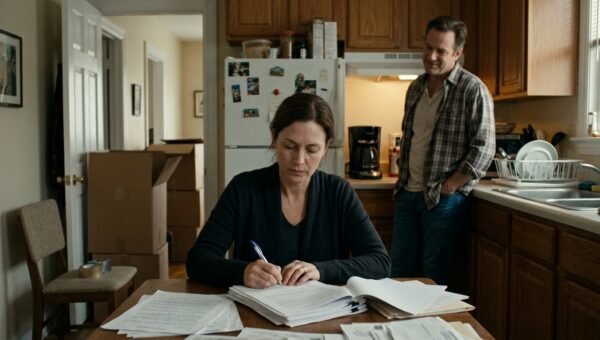
Why didn’t I call Grant at 9:17, when the bank alert showed $5,000,000 leaving our joint account? I’ve asked myself that for years. I was standing at the kitchen counter with a piece of toast in my hand. Grant was at the table, scrolling through his phone, acting like the morning was ordinary.
The alert said wire transfer, $5,000,000. The recipient was a company I didn’t recognize. I looked at Grant, then back at the screen.
He didn’t look up. I set the toast down and asked if he wanted more coffee. He said, “No, I’m good.” That was the first lie I let him tell me.
By noon, my wealth manager, Paul, had called me back. He’d confirmed the money went to a shell company that had just bought an estate in Coral Gables. The person listed as its beneficiary was Mia Sinclair. I knew the name. I’d seen it on a hotel charge Grant said was for a client meeting, and once in an email he’d closed too fast.
Paul asked if I wanted him to call Grant. I said no. I asked him to check the account rules and tell my lawyer. Then I went back to the kitchen and finished making lunch. I don’t know why I remember the smell of toast getting cold. I remember it better than what I ate.
The account wasn’t a casual joint checking account. It held capital from our family businesses, and the trust rules were clear: a transfer that size needed both of our approvals. We’d set that up years earlier, after Grant nearly bought into a bad deal without reading the papers. I’d been the one who insisted on the second signature. He called it “overkill” at the time.
I still wanted him to say it was a mistake. That’s the embarrassing part. I wanted a boring answer. A typo. A confused wire. Something that let me go back to the life I’d had at breakfast. Instead, Paul called again and said the deed was real, the company was real, and Mia was tied to it.
For three days, I said nothing to Grant. I kept my voice level. I asked what time he’d be home. I reminded him that his parents, Arthur and Helen, were coming for the weekend.
I even asked whether we needed to pick up Helen’s favorite tea. Grant said he’d handle it. He didn’t ask why I’d stopped wearing my wedding ring.
Arthur and Helen were traditional people, but not foolish ones. They saved receipts, paid their bills early, and treated a family name as something you were supposed to take care of. I’d always thought Grant got his confidence from Arthur. It took me a while to understand that Arthur’s confidence came with limits. Grant had never learned to respect them.
On the third day, my lawyer went over the account records with me. She confirmed Grant had bypassed the required sign-offs by moving the money through the shell company. The bank had placed a hold after the transfer was flagged. My lawyer filed for an emergency freeze on the property and started the process to claw back the funds. I read every line twice.
I wasn’t calm because I felt nothing. I was calm because I had a job to do.
The next morning, Arthur and Helen arrived with two bags and a tin of shortbread. Helen set it on my counter and said, “I brought the kind you like.” I thanked her. Then I made coffee and listened to Arthur tell me about a new real estate listing he’d been watching. It was close to Coral Gables, he said, and he wondered what the area was going for now.
That gave me the reason I needed. I told them I knew a property nearby that might be a useful comparison. Grant was upstairs, taking a call. I didn’t tell him where we were going. I said we’d be back before lunch, and he barely looked away from his phone.
I drove. Arthur sat in front, and Helen was behind me. We talked about traffic and the shortbread tin. My hands were steady on the wheel. At one point Helen asked if I was feeling all right. I said I was tired. That was true, though not the whole truth.
The estate came into view a few minutes later. I recognized Grant’s car in the drive. I’d seen it in the photo Paul sent with the property records, though I hadn’t asked for the photo. Some details are hard to put away once you’ve seen them.
Arthur noticed the car too. “Is Grant here?” he asked. I said I didn’t know. I parked and got out before either of them could ask another question. Helen came around the passenger side, then Arthur joined us. I didn’t explain. I couldn’t have explained without giving myself one more chance to back out.
The front door opened after I rang the bell. Mia stood there in a neat, expensive-looking blouse, one hand on the door. She looked at me first, then at Arthur and Helen. Her smile slipped when she saw Grant behind her. He was halfway down the hall, shirt sleeves rolled up, and he stopped when he saw us.
I looked at Mia and asked, “Is this the new maid for our estate?”
Nobody spoke. Mia’s hand left the door. Grant took one step toward me, then stopped, as if he’d only just noticed his parents were there. Arthur’s mouth tightened. Helen looked from the house to Grant, then to me. I had imagined saying that line, but not how small my voice would sound when it came out.
Mia said, “I’m not the maid.” It was the only thing she said. Grant tried to steer the moment away from her. “This isn’t what you think,” he said. His voice had that sharp edge he used when he expected people to make room for him. I’d heard it in meetings and at family dinners. It had worked more often than it should have.
Arthur looked at his son. “You bought this house with our money?”
Grant said it was a business arrangement. He said the property was an investment and that Mia was helping manage it. He didn’t say why our money had been sent through a company I’d never heard of. He didn’t say why he’d done it without my approval. He didn’t say the word affair.
I’d planned not to raise my voice. I didn’t. I opened my folder and held out the legal notice. “The transfer wasn’t approved,” I said. “The account is frozen. The property is under an emergency order, and the money is being recovered.”
Grant reached for the papers, but I kept hold of them for a second. He looked down at the bank confirmation, the court filing, and the transfer record with his name on it. I remember his thumb rubbing the edge of the page. He used to do that when he was trying to look patient.
“You can’t do this here,” he said.
“I can,” I told him. “And I did.”
Helen took a step back from him. Arthur didn’t. He looked more tired than angry, which landed harder. He said Grant had brought shame into their family and that he wasn’t going to cover for him. Grant started to speak, but Arthur raised one hand. That was all it took. Grant stopped.
I won’t pretend I felt sorry for Mia. I didn’t. But I also knew Grant had sold her a story about being the owner of that house. She stood in the doorway like she’d been told to welcome guests, and now the guests knew the truth. I didn’t need to punish her with another speech. I wanted the money back, and I wanted Grant to know he’d lost the right to tell me what was true.
The freeze held. The court process took months, not minutes, and the clawback was not as clean as the paperwork made it look. The property was sold, the shell company was dissolved, and the money was recovered through the legal process. Grant’s claim that it had all been a business investment didn’t survive the records. Our marriage ended soon after.
Arthur and Helen kept their distance from him. I didn’t ask them to choose me, and they didn’t ask me to forgive him. I know the family tie didn’t vanish in one day. But when I left the estate, neither of them turned back toward Grant. That was enough for the ride home.
I closed the passenger door, got behind the wheel, and drove away with Arthur and Helen in the back seat. Grant was still in the doorway beside Mia, holding the papers he’d tried to take from me.