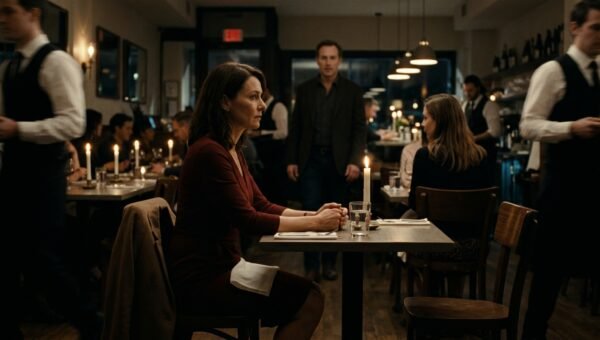
Eighteen Christmases, and the chair was still empty. I was sitting at my dining table with the local news on when Chloe’s face appeared beside a red ribbon and a sign for a safe house for runaway girls. I stopped with my hand around my tea mug. The reporter called her the founder. My daughter, who hadn’t spoken to me in years, was standing there with scissors in her hand.
I sat down hard enough to make the chair legs scrape. I knew her face, of course. I’d looked at it in old pictures so many times I could have picked it out anywhere. But the woman on television wasn’t the girl who’d left with a duffel bag and $300. I watched her thank the people who helped make the house possible, then I reached for the phone before I could talk myself out of it.
I’m not good at calling strangers. I used to be better at fixing things with my hands, back when I helped my brother mend fences on our parents’ place. A loose board, a bent hinge, something you could point to and say, “That’s the problem.” This was different. I called the station and asked for whoever handled the segment. When a woman answered, I said, “I’m Chloe’s mother. Could you pass along my number, if she’s willing to have it?”
The woman was kind. She didn’t ask for the whole story, and I didn’t offer it. I gave her my name and phone number, then asked her to make clear I wasn’t asking Chloe to call me. I just wanted her to have the choice. After I hung up, I put the phone on the table and kept my hands in my lap because I didn’t trust myself not to call back and make it worse.
The empty chair had been there long before that night. I’d started setting it out for Christmas after Chloe left, even though I knew she wasn’t coming. At first it was a habit. Later, it felt like I was admitting what had happened without saying it out loud. I never told anybody that. My sister thought I kept setting an extra place because I was hopeful. Maybe I was. Maybe I just didn’t know what else to do.
In 2007, Chloe was sixteen. She wrote in a journal that she planned to leave town with a man who was twenty-eight. I found the journal because I was looking for a phone number she’d written down. That’s the excuse I used then. The truth is, I kept reading after I saw his name, and I read enough to know she was serious.
I was scared. I still believe there was real danger in that relationship. But fear does not make every choice a good one, and I made mine fast. I called the man’s boss, told him what I’d found, then called the sheriff. I gave them the names and the details from the journal. The sheriff spoke with the man, and he left town within the week.
I didn’t tell Chloe before I made those calls. I told myself there wasn’t time. The moment she found out, she looked at me like I’d taken something from her that I had no right to touch.
We were in the kitchen, and I remember the little chip in the blue plate she was holding. She said, “You didn’t protect me. You humiliated me.”
I answered badly. I said she was sixteen, and I was her mother, and I’d do it again. I meant that I’d stop a grown man from taking advantage of my child. I didn’t understand that she heard something else: that her private thoughts belonged to me, that I could make decisions for her and then call it love. I can see that now. I couldn’t see it then.
For the next couple of years, our house got quiet in a way I couldn’t fix. Chloe wouldn’t tell me where she was going or who she was seeing. I checked the front window when she was late. I asked too many questions when she came home. She treated every question like a hand reaching for her sleeve. I treated every silence like proof that I had to reach harder.
On her eighteenth birthday, she packed a duffel bag. I had put $300 in an envelope on her dresser, thinking she might need it, though I didn’t tell her I’d done that. She found it and left it on the counter. I picked it up later and put it in the drawer with the birthday candles. I don’t know why I kept it. It just seemed wrong to spend it.
She didn’t leave a note. She moved out that day and stopped answering my calls. I sent cards at Christmas. I sent one at her birthday, too, most years, with a short message and no demand that she call. Sometimes I wrote “Love, Mom” and sometimes I wrote “I’m here.” I kept the words plain because every longer thing I tried to say sounded like an argument.
I don’t know which cards she got. I don’t know if she read any. For eighteen Christmases, I set the extra chair out and put one card near it. Then I’d take the card away before dinner because I felt foolish. My family stopped asking whether Chloe was coming. I didn’t blame them. I was tired of giving the same answer.
The news segment had ended by the time I called the station. I didn’t sleep much that night. I kept thinking of the girl who had once written down a plan to leave with a man she barely knew, and the woman who now opened a safe place for other girls. I was proud of her. I was also ashamed that part of me wanted credit for the fact that the man had left town. I had to tell myself those could both be true.
Three days later, my phone buzzed while I was putting clean sheets away. It was a text from an unknown number. “This is Chloe. The station gave me your number.” I sat on the bed and read it again. Another message came a minute later. “I’m not ready for a phone call. Would you meet me at the café by the old library?”
I wrote back, “Yes. You choose the time.” Then I deleted two more sentences before sending. I wanted to say I’d missed her every day. I wanted to ask if she was safe, if she was happy, if she remembered our old house. None of those things needed an answer right then. She had offered a meeting, not a way for me to unload eighteen years of questions.
We met the following Saturday. I got there early and picked a table where I could see the door. I kept touching the paper napkin, folding it in half and opening it again. When Chloe walked in, I almost stood up too fast. She gave me a small nod. I nodded back. We sat down, and the server brought coffee for her and tea for me.
For a while, we talked about ordinary things. The weather had turned cold. The road by the library was under repair. Chloe asked if my sister still lived nearby, and I said she did. It wasn’t much, but neither of us had to rush into the old hurt. I was grateful for that. I had imagined this meeting so many times, and in most versions I said everything right. In real life, I kept needing to stop and think.
Chloe told me about the safe house. It had rooms for girls who needed somewhere safe to stay, and staff who knew how to help without making them feel trapped. She’d started working with young people years ago, after she’d spent time trying to find help for herself. She didn’t tell the story like she was asking me to feel sorry for her. She told it like she wanted me to understand what the work was for.
“I was scared back then,” she said. “I didn’t know how to say that.” She looked down at her cup. “I also hated that you read my journal and called people before you talked to me.” I told her she was right. I said I’d been afraid and controlling, and I’d used being her mother as a reason not to listen. It wasn’t a long speech. I was trying not to turn my apology into another thing she had to take care of.
She let me finish. Then she said, “I know you thought you were keeping me safe.” I nodded. “I also know I nearly got myself into something bad.” She rubbed her thumb along the edge of the cup. “But you may have kept me from him. You didn’t keep me with you.”
I didn’t try to explain that away. I wanted to say I’d been lonely, that I’d worried, that I’d sent cards. But she already knew I had sent them. None of that changed what it had felt like to be sixteen and have her private words handed to her boss’s boss and the sheriff. I said, “I’m sorry I made you feel like you had no say.” It was the plainest thing I had, and it was true.
She didn’t forgive me right there. I didn’t ask her to. Before we left, she gave me the safe house’s public event schedule and said I could come to the next open-house afternoon if I wanted. “It’s not a family reunion,” she said. I told her I understood. She also said she’d text me when she got home. I thanked her, then wondered if I’d thanked her too much.
The next few months were careful. We texted about small things. Chloe sent me a picture of the first snow on the safe house steps. I asked whether she wanted help with the spring fundraiser, and she said she’d let me know. I didn’t show up uninvited. I didn’t ask her to come for Christmas. I had spent years believing love meant not letting go of the rope. I was trying to learn that a person could stay connected without pulling.
When she asked me to help sort donations one Saturday, I went. I folded towels and labeled boxes while the staff carried on with their work. Nobody made a big thing of me being there. Chloe came by twice to ask where I’d put the blankets. At the end, she said, “Thanks for coming.” That was all. It was enough for that day.
She came to my house for tea a few weeks later. I’d washed the dining table and put out the cups, then caught myself setting the chair across from mine too far away. I moved it closer, then worried that looked like I was making a point. When Chloe came in, she noticed the chair but didn’t say anything. She took off her coat, sat down, and asked if I still used the old tea tin.
I said I did. She remembered I liked a splash of milk and no sugar. I hadn’t told her that in years. She poured the tea herself and set the cup in front of me. It was a small thing. Maybe she remembered from when she was little. Maybe she’d just paid attention that day. I didn’t ask her to explain it.
Before she left, Chloe said she could come by again the following Sunday. I said I’d like that. I didn’t make her promise. I didn’t tell her I’d been saving the chair. After she went out, I brought the cups to the sink and left the extra chair pulled close to the table.
On Sunday, the tea was steaming beside the chair she’d pulled close.