Nora pushed the cornbread pan toward me and said, “Don’t let that burn, Mama.” She was sixteen, barefoot, and already halfway up the stairs before I answered. I found her journal under the couch when I went looking for the TV remote. I knew I had no business opening it. I opened it anyway.
I was forty when this happened, living outside Amarillo, and I told myself I was the kind of mother who knew what was going on.
Nora still ate dinner at my table most nights. She left her school papers on the counter and asked me to wash her favorite blue shirt. I mistook those ordinary things for proof that she’d tell me if anything was wrong.
I don’t remember the exact date I read the journal. It was 2006, before Nora turned seventeen. I remember the page, though. Her handwriting got smaller near the bottom, and she’d written that a twenty-eight-year-old man was going to help her leave town. She had a place in mind. She had a day picked out. I read the page twice, hoping I’d got it wrong.
That was the first clue I didn’t ignore. There had been others.
A few weeks earlier, Nora had asked what time the last bus out of town left. I said she wasn’t going anywhere without telling me. She shrugged and said she was asking for a friend.
I was busy folding towels, and I let myself accept that answer because it was easier than asking again.
Then she started keeping cash in the pocket of her backpack. I saw it once when I was picking up laundry. I asked why she had money tucked in there, and she said it was for lunch. I told her lunch didn’t cost that much. She shut the backpack and said, “Can you not go through my stuff?”
I got mad. I said, “Then don’t leave it all over the floor.” That was the whole conversation. I remember thinking she was getting secretive like most teenagers did. Bless it, I had a gift for picking the least useful explanation.
The man’s name was in the journal, but I won’t put it here. He was twenty-eight and she was sixteen. He’d told her he could get her out of town, and she believed him.
There wasn’t a detailed plan in those pages. Just enough to tell me she expected him to show up and take her away.
I put the journal back where I found it. Then I sat at the kitchen table and tried to decide what a sensible mother would do. The trouble was, I didn’t want to be sensible. I wanted to get in my car, find him, and make him look me in the eye. I wanted Nora to come downstairs and tell me it was all a misunderstanding.
She came down for the cornbread. I said, “Who’s this man?” I had the journal open on the table.
Nora stopped. Her cheeks got red, and she looked from me to the page. “You read my journal?”
“I’m asking who he is.”
“Give it back.”
“Not until you tell me what’s going on.”
She grabbed for it. I held it away from her, which was a stupid thing to do.
She said, “You had no right.” I said, “You’re sixteen.” Neither of us said anything useful after that.
I called his boss the next morning. I knew where he worked because Nora had mentioned the job before. I told the boss what I’d found and said this man was planning to take my underage daughter out of town. I didn’t ask Nora to come with me. I didn’t tell her I was making the call.
His boss said, “I’ll deal with it.” I asked what that meant. He said, “He won’t be working here.” That didn’t make me feel better. It only made me wonder what he’d do next.
So I called the sheriff’s office. I took the journal with me and talked to a deputy I knew by sight. I was shaking enough that my hands kept sliding on the paper. The deputy asked whether the man had threatened Nora. I said no, not in anything I’d read. He asked if I had proof of the plan. I handed him the journal.
He didn’t promise me an arrest or a big investigation. He said he’d make a record of it and speak to the man. I asked him not to tell Nora I’d brought the journal. He gave me a look I deserved. “She may find out,” he said. I told him I understood. I didn’t.
The man left town within the week. His boss let him go, and the deputy spoke to him. I don’t know what was said between them, and I never found out where he went. He was gone. I took that as the end of the danger.
Nora took it as the end of her trust in me.
She found out I’d called the boss and the sheriff. I can’t remember which person told her first. She came into the kitchen with the journal in her hand, and the pages were bent back where I’d read them. That little detail bothered me more than it should have. Like the bent pages were the offense, not the fact that I’d gone behind her back.
“You called the sheriff?” she said.
“I was trying to keep you safe.”
“You told people my business.”
“He was a grown man. You were a kid.”
“That’s not what I asked.”
I wish I’d stopped talking then. I wish I’d said I was scared. Instead, I started explaining why I’d done the right thing, as if the right thing made every part of how I did it right.
Nora looked at me and said, “You didn’t protect me. You humiliated me.”
I answered, “I’m your mother.” It was true, but it wasn’t an answer. She went upstairs and shut her door. I stood outside it for a while, then went back down because I couldn’t think of a better thing to do.
For the next year and a half, we lived in the same house but not the same way. I kept asking where she was going. She kept giving me the shortest answer she could. I watched for signs that the man had come back, though nobody said he had. I held on tighter, and Nora pulled away harder.
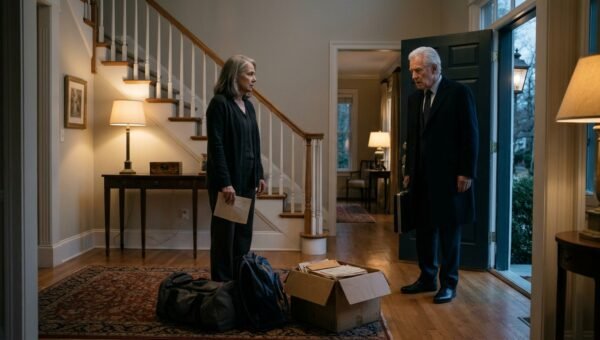
On the day she turned eighteen in 2007, she left with a duffel bag and $300. She didn’t tell me where she was going. I was at home when she came down the stairs, and I followed her to the door.
“Don’t do this,” I said.
“I’m eighteen.”
“You can stay here.”
“I know.”
She didn’t yell. That almost made it worse. She picked up her bag and walked out. I wanted to grab her arm. I didn’t. I told myself that was growth. If I’m honest, I was afraid she’d hate me more.
The chair at our table stayed empty that Christmas. It stayed empty the next one, too. I sent cards and letters, though I don’t know how many got to her. Sometimes I wrote too much. Sometimes I wrote nothing but her name and my own. I never got a reply.
Eighteen Christmases went by with that chair empty. I stopped setting a place for her because it felt like asking the whole family to take part in a hope she hadn’t agreed to. Still, I kept the chair. That’s the part I never explained to anyone.
I told myself I’d done what a mother had to do. The man was gone. Nora had lived. Those facts mattered. But some nights I’d picture her reading my face the way she had in the kitchen, waiting for me to hear what she was actually saying. I’d hear her words again: “You humiliated me.” I’d never answered that part.
Last night, the local news was on while I cleared my dinner plate. I wasn’t really watching until I heard them say “safe house for runaway girls.” The report showed a ribbon-cutting outside a plain brick building. The woman standing beside the ribbon had Nora’s dark hair, Nora’s way of keeping her mouth still when she was trying not to cry.
Then the reporter said her name.
I sat down hard. Nora was thirty-six. She stood in front of the building and talked about giving girls a safe place to go when home didn’t feel safe, and about how hard it was to ask for help when you thought every grown-up would take your choices away.
The segment showed the lobby and an office, then went back to Nora at the ribbon. The reporter said she’d spent years working with young people before starting the safe house. I watched her hands while she spoke. She had one thumb pressed against the side of her finger, the same nervous habit she had as a kid.
Nora said, “A girl shouldn’t have to choose between being unsafe and being alone.” I heard that sentence and looked at the empty chair across from me. I had spent eighteen years thinking I understood what she’d needed. I knew I’d been right about that man. I didn’t know if I’d ever understood what Nora needed from me.
The news ended. I sat there another minute, with the plate still in my hand. Then I picked up the phone and called the station.
A woman answered. I said, “My name is Carol. I’m Nora’s mother.” I almost hung up after that. Instead, I said, “I don’t want her private number. Would you please pass along a message?”
The woman asked what I wanted Nora to know. I stared at the chair and said, “I saw the story. I’m proud of what she built. I’m sorry I read her journal and made decisions without her. I’d like to talk if she wants to. If she doesn’t, I’ll leave her alone.”
The woman said she’d send the message to the station’s community outreach coordinator, who could pass it along. I thanked her, hung up, and felt ridiculous for being scared of a phone call. I had made one before. I’d made plenty. This was the first one in eighteen years where I wasn’t trying to control what happened next.
Nora called me that evening. She didn’t say hello at first. I heard a small click, like she was settling the phone against her ear.
“I got your message,” she said.
“Thank you for calling.”
“I don’t know what I’m supposed to say.”
“That’s okay.”
There was a pause. I started to fill it, then stopped. She asked, “You still think you did the right thing?”
“I think I was right to stop him. I was wrong to read your journal and make it all about what I thought you needed.”
Nora breathed out. “I was scared of him, too. I didn’t know how to admit that. I thought if I left with him, at least I’d be choosing something.”
I sat down at the kitchen table. “I wish I’d asked you that.”
“Yeah,” she said. “Me too.”
She didn’t forgive me on the phone. I didn’t ask her to. We talked for eleven minutes, maybe twelve. She told me the safe house had opened a few weeks earlier and that the news piece had been filmed that morning. I told her I’d watched it twice. She said, “You didn’t have to call the station.”
“I know. I didn’t know how else to reach you without taking something from you.”
That made her quiet for a moment. Then she said, “You can come see the place. If you want. I’ll be there Saturday.”
I drove over Saturday morning. I had to pass the turn twice before I made myself take it. At the door, I could hear a phone ringing inside, and I nearly went back to my car. I didn’t. Nora opened the door herself.
“Hi, Mama.”
“Hi, honey.”
She hugged me. It was brief, and I didn’t try to make it longer. She showed me the lobby, the office, and a small room with a couch and a shelf of books. She explained the house rules and how the staff made sure each girl had someone to talk to. I listened. I didn’t suggest a better way.
When we sat down, I said, “I saved your life, but I broke your heart.”
Nora looked at the brochures on the table. “You kept me alive long enough to learn how to save myself.”
She paused, then added, “And others.”
I nodded. I wanted to say I was glad the bad thing had made something good. I knew better than to put that on her. Her work belonged to her. So I asked what she needed help with.
“These brochures need folding,” she said.
That was how we started. I came back the next week, then again the week after. Some visits were easy. Some ended with Nora saying she needed to get back to work. I didn’t follow her down the hall or ask her to explain. I learned that showing up wasn’t the same as being invited into every part of her life.
Now there’s a wooden chair beside the sunny window in her office. Nora sits at the table across from me, folding brochures, and I sit in the chair with the old empty place finally filled.