At the Astoria bus depot, I watched my father come through the doors with one suitcase and a plastic grocery bag. Eight years had passed since we’d spoken. I’d brought a blanket in case the night got cold, and I’d spent the drive rehearsing what I would and wouldn’t offer him.
I know now he wasn’t there to ask me for a place to live. I didn’t know that then.
His call came just after eight. He said his car had broken down and he needed somewhere to sleep for one night. I almost told him no. I had a daughter upstairs, a job in the morning, and a father who had once made a habit of deciding that his pride mattered more than what I asked him to stop doing.
But he was still my father. So I said I’d get him.
The depot smelled like wet coats and diesel. Arthur had on the brown jacket I remembered from old pictures, though it hung looser than it used to. The grocery bag had a knot in the handles. He set it down to shift the suitcase, then looked past me toward the car.
“Clara still plays the violin?”
I said yes. Before he got in, I reached into his coat for something wrapped in a music program. I hadn’t planned to touch him.
I saw the folded paper sticking out near his inside pocket and, for reasons I can’t explain, thought it might be a bus ticket.
“Careful with that,” he said.
The program was from Clara’s middle-school concert, eight years earlier. I’d given him a copy that night. He’d kept it folded around a small, hard bundle. When I opened it in the car, I found a worn amber rosin block and a set of old strings tied together with thread.
I didn’t know what to say. The rosin had a crack through one side. It smelled faintly dusty and sweet, like the drawer where my grandmother kept her sewing things.
“Those were your mother’s,” Arthur said.
He didn’t add anything. He got into the car. I put the program on the seat between us and drove home.
The ride took twelve minutes. I asked if the bus had been on time.
He said it was close enough. I asked if he’d eaten. He said he had a sandwich earlier. Then we both sat there with the wipers knocking at the rain.
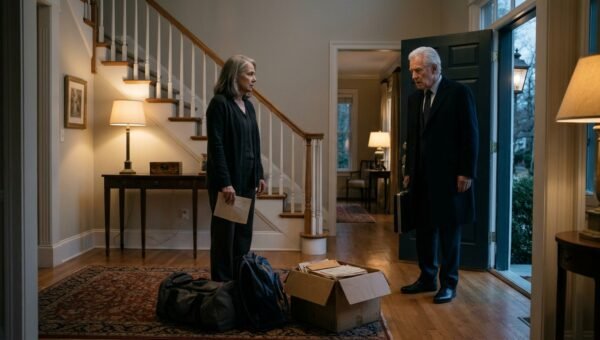
At the house, I showed him the spare room. Clara was asleep upstairs, her violin case leaned by the wall outside her bedroom. Arthur looked at it, but didn’t go closer.
“She’s got school,” I said. “I can give you tonight. Just tonight.”
“I understand.”
I wanted to believe him. I also wanted him to hear the boundary clearly. Eight years ago, he had not heard me clearly at all.
That argument had started over money. Arthur had been a mechanic most of his life, and he hated needing help from anyone, especially me. I’d offered to cover some overdue bills after he’d told me he was behind. He called it interference. I called it refusing to let him drown just to prove he could swim. We both said things we knew would stick.
When he left, he said he’d call when he was ready. He didn’t. I did not call either. I have told myself that was because I was respecting his choice. There was some truth in that. There was also anger, and a little punishment.
I brought a blanket to the spare room. He had already placed his suitcase by the bed and set the grocery bag in the hallway.
“Do you need anything else?”
“No. Thank you.”
That was all. I went downstairs and picked up the orchestra program. I was still holding it when I saw the grocery bag’s handles had fallen open.
I shouldn’t have looked inside. I did anyway.
There were a few prescription bottles, a toothbrush, and folded papers in a plain envelope. Not travel snacks. Not the things a person packs for a long stay. The suitcase was nearly empty too, just shirts, socks, and a pair of shoes with the soles worn down at the heels.
I could see clinic letters at the top of the envelope. Under them was a folder with Pine Ridge Senior Residence printed across the front. I pulled it out enough to read the appointment time: ten the next morning.
Arthur came back from washing his hands. He saw me holding the folder. I felt like a kid caught going through a drawer, except I was an adult and had every reason to want the truth.
“Why did you tell me the car broke down?”
He took the folder from my hand and set it on the table. He didn’t look mad. That almost made it harder.
“I sold it two months ago.”
I waited.
“I needed the money for the clinic bills,” he said. “I don’t have much use for a car now.”
He sat at the kitchen table. I stayed standing, still holding the orchestra program.
“You could’ve just told me.”
“I know.”
“Why didn’t you?”
He rubbed a thumb over the folder’s bent corner. “A tow sounded like something I could ask my daughter for. Saying I needed help sounded different.”
I knew what he meant. I didn’t like it, but I knew.
He told me the diagnosis had come six months earlier. The doctor had called it early-stage cognitive decline. He had small gaps, he said. Nothing that kept him from handling his daily life yet, but enough that he’d stopped driving and started making plans. He’d sold a few things, applied to Pine Ridge on his own, and taken regional buses when he needed to get around.
“I’m not moving into your house,” he said. “I’m not asking for money.”
I looked down at the program. The cracked rosin block pressed against the paper from inside.
“Then why come here?”
“To give you that. And to see if Clara still plays.”
He said he wanted the old supplies to go to someone who’d use them. His mother had kept the rosin and strings for years. He’d taken them when he left after our argument, though he didn’t say why he’d held onto them. I didn’t ask. I knew the answer might not be one he could put into words.
He’d hoped to hear Clara play, he said, but didn’t want to disrupt her life or make a claim on her. He had planned to check in at Pine Ridge in the morning. One night with me, then he’d be on his way.
My first thought was that he’d made all these decisions without telling me. My second was that he’d made them without asking me to carry them for him. I felt both things at once, and I hated how easily I wanted one to cancel out the other.
“I need to know what happens if things get worse,” I said.
“I’ll tell you.”
“You can’t promise that if your memory’s getting worse.”
He nodded. “Then you’ll have to ask me more than once.”
It wasn’t much of a plan. It was the first honest answer he’d given me in years.
I put the blanket on the couch instead of the spare bed. Then I took it back and put it on the bed. I don’t know why that mattered to me. I wanted him to understand he was staying one night, but I didn’t want him to feel like a guest I was trying to send back out into the rain.
He noticed me fixing the blanket.
“You don’t have to fuss.”
“I’m not fussing.”
He let it go.
In the morning, Clara came downstairs before school, her hair still damp at the ends. She looked at Arthur, then at me. She knew him mostly from photographs and a few stories I’d told when she was little. He’d praised her bow hold when she first started lessons. She couldn’t remember that, but I had told her.
“Grandpa?” she said.
Arthur stood up slowly. “You’ve grown.”
She looked at the violin case by the stairs. “I have practice before school.”
“I’d like to hear, if that’s okay.”
She glanced at me. I didn’t want to make the choice for her, so I just nodded.
She carried the violin out to the porch. Arthur followed and sat down on the step. The rain had stopped, though the boards were still damp. Clara played a short section of Bach. Maybe five minutes, not even a full piece.
Arthur kept his hands folded in his lap. He didn’t tell her how to hold the bow or how to fix the one rough note. He just listened. That was the part I remember most. He didn’t try to take up more room than she offered.
When Clara finished, she lowered the violin.
“Thanks for listening,” she said.
“Thank you for playing.”
She went back inside to get her school bag. Arthur stayed on the step for another few seconds. I stood in the doorway with the car keys in my hand.
“You don’t have to drive me,” he said.
“I know.”
I drove him anyway.
At Pine Ridge, a woman at the front desk had us fill out forms and check his medication list. Arthur had the papers in order, with his name and the appointment time written on a small card. He signed where they asked him to sign. I sat beside him, not across from him, and kept my questions to myself unless he asked.
The room they showed him was small, with a bed, a dresser, and a window box outside. He looked at the window, then at the form in his hand.
“This is what you want?”
“It’s what I arranged.”
I heard the difference. He wasn’t asking permission. He wasn’t asking me to approve of him. He had made the choice while he still could.
The intake worker asked if I was his emergency contact. Arthur looked at me. I told her yes, then asked to add my phone number and Clara’s school hours. I did not promise to be there every day. He did not ask me to.
On the way out, I said I could come by Sundays.
“Every Sunday?” he asked.
“Let’s start with Sundays.”
He nodded. We both knew a schedule was more useful than a grand promise.
At home, I took the rosin and strings out of the old program. Clara had already left for school, so I put the rosin on her music stand near the window. It looked smaller there than it had in my hand, worn down from years of use and split along one side.
The morning light caught the amber block. I watched it from the doorway with my car keys in my hand, still unsure what we were to each other, and knowing I’d be back on Sunday.