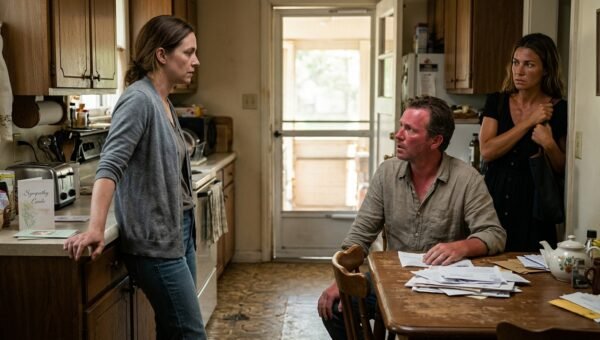
The old USMC crate is empty now. I left it beside Clara’s porch swing, where the afternoon sun had warmed the boards, and watched her hold her father’s dog tags against her chest.
I knew that would be the last image I carried home. I didn’t know, when I first saw the crate after Uncle Artie’s funeral, how I’d get it to her, or what I’d say when I did.
I only knew that a man who had been silent about the war for more than seventy years had left me one last thing to do.
Artie Vance was ninety-six when he died. He’d come back from the Pacific in 1945, a proud Marine, and lived outside Huntsville, Alabama, most of the rest of his life. He never talked about the war. Not at family gatherings, not around Thanksgiving, not even when his hands started to shake and he knew he didn’t have many years left.
The crate was beside his favorite armchair. Dark wood, worn edges, faded USMC lettering. For as long as I could remember, that crate had been his footrest. As kids, we sat on it and played cards until Artie told us to get down before we broke our necks. We thought it was just an old box. We weren’t wrong about it being old.
I was clearing the house with my cousin, who had to leave before lunch.
The rooms were quiet in that ordinary, uncomfortable way a house gets after a funeral. I kept picking up things, deciding they were trash, then setting them back down. I wasn’t ready to make choices about Artie’s life just because he wasn’t there to make them himself.
The armchair had a dent in the cushion where he sat every evening. I noticed it because I’d sat there during the last week of his life, handing him water and pretending he was going to get better. On the crate, there was a ring of dust where his heels had rested. I brushed at it with my sleeve, then tried to lift the lid.
It didn’t move.
I turned the crate over. Recessed brass screws held the bottom in place, their heads dark with age but still neat in a row. This wasn’t a box someone had forgotten to open. Someone had shut it on purpose.
I fetched a screwdriver from the kitchen drawer. My cousin had said to leave the heavy things for the estate company, and for a minute I almost did. Then I thought of Artie’s feet on that box every night, and how nobody in the family had ever asked him what it was. I didn’t want a stranger to haul it away without knowing.
The screws came out slowly. I had to press hard and turn the screwdriver with both hands. When the last one loosened, I lifted the bottom panel and smelled old paper, canvas, and the sharp, oily smell of something kept safe for a very long time.
There was a bundle wrapped in oilcloth. I set it on the floor and opened it carefully, because the cloth cracked at the folds. Inside were dog tags stamped T. Miller, a canvas pouch, and a pocket watch with a dent in its brass rim.
The hands had stopped. I couldn’t tell if they’d stopped during the war or years later.
There were letters, too. Several, folded and handled enough that the creases were soft. They were dated May 1945 and addressed to Mrs. Evelyn Miller. One was still in its envelope. Another had no envelope at all, just a note in a young man’s hand that began, “My darling.”
Under the letters was a Western Union telegram. I didn’t need to read the whole thing to understand it. It told Mrs. Miller that her husband had been killed in action.
I sat down on the floor. My cousin had already gone, and the house seemed even quieter than before. I remember the little dry sound the oilcloth made when I touched it. I kept thinking that I’d spent years putting my feet on this same crate when I visited Artie. I’d laughed when he told us to use coasters on the coffee table but never asked why he kept the box.
There was one more thing inside: a legal envelope with Artie’s handwriting on the front. Clara Miller Hensley. An address outside Foley, Alabama. The envelope had been sealed, and I could tell from the date he’d written it months before he died.
I read it standing at the kitchen counter. I had to start over once because my eyes kept jumping ahead.
Artie had written that he’d located Clara, Thomas Miller’s daughter. He’d also written that he had meant to find her much sooner. He explained that her father, Corporal Thomas Miller, had been in his squad on Okinawa. They were both young. Tommy had been killed in June 1945 while covering Artie’s retreat to a trench line.
Artie said the blast had been meant for him.
He wrote that Tommy had given him the letters and his personal things to bring home to his pregnant wife. Artie came back to Huntsville that fall and couldn’t make himself go to her door. He thought seeing him would make her look at the man who had survived while her husband hadn’t. He thought his survival was an insult he had no right to explain.
So he put Tommy’s things in the crate and screwed it shut.
I stopped reading for a while. I got myself a glass of water and left it untouched on the counter. Artie hadn’t hidden the box in an attic or locked it in a shed. He’d kept it beside his chair. Every evening, he put his feet on it.
He said the pressure of his boots on the wood helped keep him in the room when his mind went back to Okinawa. He could feel the floor under him. He could stay put. He also said he knew it wasn’t enough, that a box couldn’t bring Tommy home, but it was what he could manage.
The words that stayed with me were simple. “I couldn’t face her.”
He didn’t claim that made it right. He said he was sorry. He said he should have sent the letters, told Evelyn what happened, and made sure Tommy’s daughter knew her father wasn’t just a name in a record. He wrote that he believed speaking about his own war took attention away from the men who never came home. I’d mistaken that silence for distance. It wasn’t distance. It was a man trying to carry a debt he couldn’t pay.
At the end, he asked his family to deliver everything to Clara. He included the letters, the dog tags, the pocket watch, and Thomas’s Purple Heart citation. He’d added his own written account of what happened and an apology for taking so long to tell her.
I could have mailed the envelope. I thought about it. But after reading what Artie had written, dropping the package at a post office felt like one more way to keep my hands out of it. I called the number I found for Clara and stood in the hall while it rang.
When she answered, I told her I was Artie’s niece or nephew, then corrected myself and said I was the one clearing out his house. I explained that I’d found something of her father’s. I didn’t say everything on the phone. It felt wrong to turn the whole story into a surprise she had to absorb while holding a receiver.
She was quiet for a moment, then said she’d never met her father. She’d been born only weeks before he died. Her mother had raised her with a few details and the military papers, but no letters from him. Clara had always known he served. She’d never known what he’d said before he left, or what he’d done at the end.
I asked if I could bring the things down. She said yes, then told me she’d need to sit down before I got there. I said I understood. I didn’t, not really, but I knew she deserved time.
I packed the contents back into the oilcloth and carried the crate to my car. It was heavier than I expected. I wrapped it in a blanket so it wouldn’t slide around, then drove south toward Foley.
I kept thinking about Artie at the wheel of his old life, coming home in 1945 with Tommy’s things and no idea how to put them down. He’d made a choice, and then he’d lived inside that choice. I can understand why he did it. I can’t make the years disappear for Clara, and I can’t make it fair.
I had the crate on the passenger seat. Every so often I checked that it was still there, which was silly, but I did it anyway.
Clara met me on her porch. She was a small woman with careful hands and the kind of voice that made me slow down when I answered. I set the crate down by the swing, then told her Artie had kept her father’s things safe all these years.
She touched the faded letters on the oilcloth before she opened them. I didn’t rush her. When she saw the tags, she picked them up with both hands and read her father’s name. Then she pressed them to her chest.
I told her what Artie had written about Okinawa. I said he’d described Thomas covering his retreat and saving his life. I told her the detail Artie had repeated in his letter: Tommy had been thinking about his wife and the baby she was carrying. He’d trusted Artie to bring his things home.
Clara lowered her head. She held the tags there for a while. Then she asked me to read the letter aloud.
It was the letter Artie had written to her, not one of her father’s. His handwriting was steady in most places and shaky at the bottom. He told her he was sorry he had waited. He said her father had been brave, but he didn’t want her to think bravery meant he wasn’t afraid. He wrote that Tommy had talked about her mother, and that he’d been proud of the child who was coming.
At the end, Artie said he hoped Clara could forgive him for keeping the story to himself.
She listened without interrupting. When I finished, she asked me to read her father’s letters next. I read the first few lines, then passed them over so she could read the rest in her own time. Her fingers paused on the words “My darling.” She read them again, more slowly.
I sat beside her. The porch swing moved a little when she shifted. For a while, neither of us tried to fill the space with talk. She asked how Artie had been near the end. I told her he’d been tired, but still himself, still stubborn about accepting help. I left out the times he’d called me by his sister’s name. Those weren’t mine to lay on top of everything else.
She said she was glad he’d written. Then she said she wished he’d done it sooner. I told her I understood. I didn’t try to defend him. I loved Artie, but loving him didn’t give me the right to make his delay sound harmless.
Clara asked if I would leave the crate. I said it belonged with the things it had protected. She shook her head and said she wanted the letters and tags, but not the box. It had done its job. She wanted to keep the watch and the citation, too, and have the letters copied so her children could read them without handling the old paper.
So we left the crate empty beside the swing. I helped her lay the letters flat inside her house, away from the sun, and made a list of what we’d brought. Nothing was lost. Nothing went to a yard sale or an estate company. Clara had her father’s words, and she knew what he’d done.
Before I left, I saw her back on the swing, holding the dog tags against her chest. The old crate sat beside her, its worn lid open. I had known Artie as a quiet man who kept his boots on a box. I left knowing what he’d been trying to keep close, and what he’d finally let go home.