The $6.84 receipt was folded in my purse when I drove to Amanda and David’s house that Friday. I’d kept it, though I couldn’t have said why. It was just a thin strip of paper, soft at the creases from being carried around. By Sunday night, it would be sitting on their kitchen counter beside every receipt from the weekend.
I’m 71. My monthly income is $1,486, and that has to cover rent, utilities, food, and the rest of living.
I drive 42 miles each way to see my grandchildren, Leo, who’s eight, and Maya, who’s five. For months, I’d gone every Friday to help out. I didn’t ask to be paid. They’re my grandkids. I brought little things, too. A puzzle for Leo, stickers Maya liked, sometimes the kind of cookies they asked for.
I know how that sounds. I wanted to be useful. I also wanted Amanda to feel I was welcome there. Those aren’t always the same thing, I guess.
The $6.84 happened the Friday before the trip. I’d used their bathroom, washed my hands, and left a small strip of toilet paper caught under my shoe. Amanda noticed it later. She was standing by the hall closet when she told me I needed to pay for the rolls I used.
“This isn’t a free hotel,” she snapped.
I looked at David. He was 39, my son, and he was looking down at his shoes.
I wanted him to say, “Come on, Amanda.” Just that. He didn’t.
The kids were in the next room, so I didn’t want a scene. I took out my wallet and handed Amanda $6.84. She put it on the counter without saying thanks. I went home telling myself she was stressed, or maybe I’d used more than I realized. I can make excuses quickly when I want to keep the peace.
The next Friday, Amanda and David were leaving early for a three-day anniversary trip. They’d asked me to watch the kids. I said yes. I’d already promised Leo I’d help him finish a model airplane, and I wasn’t about to leave the children in the middle of their parents’ plans.
Their car was packed when I got there. Amanda had a travel mug in one hand and her phone in the other. David was moving a suitcase toward the trunk.
“Everything’s all set,” Amanda said.
I didn’t know what she meant by that until they drove away and I opened the refrigerator. It was almost empty. There were a few expired condiments and an unopened bag of carrots. I opened the pantry. A box of crackers, some cereal, and not much else.
I checked my phone, thinking maybe I’d missed a message about food. Nothing. I was standing there with the refrigerator door open when Leo came in and asked if I’d brought anything for lunch.
“Your mom said you’d get whatever you wanted,” he told me. “She told Dad not to buy groceries because Grandma will buy them anyway.”
He said it in the plain voice kids use for facts. He didn’t know it could hurt.
I closed the refrigerator. Then I asked Leo to show me the airplane. He did, and Maya came along with a stuffed rabbit tucked under her arm.
I kept my voice normal. I wasn’t going to make them feel there was a problem they had caused.
I took them to the grocery store. They helped pick apples and cereal. I got milk, eggs, bread, chicken, fruit, things for school lunches, and a few snacks. I let them choose pizza for Saturday night. Maya asked for the little yogurt cups with the fruit at the bottom, so I put those in the cart, too.
At the register, I watched the amount climb. I moved one item off the belt, then put it back because Leo said it was for his lunches. The total was $327.18. I paid with my debit card and got the receipt.
It was nearly a quarter of my monthly income. I knew that before I put the receipt in my purse. I knew it again when my bank alert came through later and showed my balance had dropped into the double digits.
Still, the children ate well. We made pancakes Saturday morning, and I let Maya stir even though flour got on the counter and her socks. Leo and I worked on the airplane at the kitchen table. It didn’t fly straight, but he was proud of it. He asked if I could come back the next Friday.
“Let’s see,” I said.
That was the first time I hadn’t said yes right away.
The weekend went by in small tasks. I washed dishes, kept track of the kids’ things, and tried to make the house feel normal. I didn’t want them thinking of themselves as a burden. They weren’t. But every time I pulled something from the grocery bag, I thought of the $6.84. It was a strange thing to carry around in my head, such a small amount. Then again, the amount wasn’t the point.
Sunday afternoon, the kids were tired from playing and sat on the couch watching a movie. I used the quiet to check my bank account. The balance was still there on my phone, in black numbers, with no care for how far the next deposit was.
I sat at the kitchen island and added up what I’d spent. Groceries, $327.18. The gas for 84 miles, $18.50. I wrote down 72 hours of childcare at the local rate I found online, $20 an hour, which came to $1,440. Then I subtracted the $6.84 Amanda had charged me.
The total was $1,778.84.
I wasn’t planning to demand that amount. I wasn’t even sure what I wanted when I started writing. I only knew I couldn’t keep pretending the work and money disappeared because I loved the kids.
For years, I’d treated my time like an endless supply. I drove the miles. I bought the little gifts. I watched the children. I told myself being family meant not counting. But Amanda had counted. She’d counted toilet paper down to the cent.
So I counted, too.
I lined the receipts up in order on the counter. The grocery receipt was the longest. The $6.84 one was small enough to miss, so I placed it on top. I wrote the note carefully. My hand shook once, and I waited until it stopped before I finished.
“Groceries: $327.18. Gas for 84 miles: $18.50. Childcare for 72 hours at $20 per hour: $1,440.00. Less toilet paper charge: $6.84. Total value: $1,778.84.”
Then I wrote the part I meant them to read.
“Since this isn’t a free hotel, it isn’t a free daycare either. Going forward, visits will take place at my home, or not at all.”
I added that I wasn’t asking them to pay me for 72 hours of childcare. I wanted the math there because they had acted like my help cost nothing. I did want the $327.18 back. I’d spent it on food their children needed, and I couldn’t spare it.
I had planned to leave after the kids were asleep. But when I checked the time, I knew I couldn’t stay until David and Amanda got home. I didn’t trust myself not to get drawn into an argument in their kitchen, and the children shouldn’t have to listen to one.
I called David’s niece, who lived nearby and had watched the kids before. She came over and stayed with them. I told Leo and Maya I had to go home, hugged them, and tucked them in. Maya had already fallen asleep with her rabbit against her cheek. Leo asked if I’d finished the airplane.
“Not quite,” I said. “We’ll do it at my place next time.”
I left the house keys on top of my note. Then I drove home.
David called late that night. I let it ring out because I was too tired to talk without crying, and I didn’t want him to mistake tears for a change of mind. He left a message. His voice sounded tight.
“Mom, we need to talk about that note.”
Monday morning, he called again. This time I answered.
“Amanda says you’re charging us almost eighteen hundred dollars,” he said.
“I’m showing you what the weekend cost.”
“You know we didn’t ask you to spend that much.”
“The refrigerator was empty, David.”
There was a pause.
“I thought you’d bring food,” he said. “Amanda thought you’d figure it out.”
I held my phone against my ear. “So you knew?”
He didn’t answer right away. I heard a cabinet close on his end.
“I knew she hadn’t gone shopping,” he said. “I thought it would be fine. I didn’t want to start something before our trip.”
That was the part that hurt. He hadn’t forgotten to speak up. He’d decided it was easier not to.
I reminded him that I’d spent the money from a fixed income, not some extra account. I told him the money I saved for him as a boy was not there for him to spend again through my groceries and my time. I didn’t yell. I was surprised by that. I’d expected to be angrier.
“I can pay you back for the food,” he said.
“That’s what I’m asking for.”
“What about the rest?”
“The rest is there so you can see what it costs. I’m not your household help, David.”
He started to explain that Amanda had been under pressure, that they hadn’t meant for it to come across that way. I listened. Then I told him I wasn’t coming over every Friday anymore.
“If you want time with me, bring the kids here,” I said. “I’ll have them, and I’ll feed them. But I’m not driving over to be treated like a bill you can keep adding to.”
He said he understood. I didn’t believe him yet.
A few days later, David came to my apartment alone. He had an envelope in his hand. He looked tired, and for once he didn’t start by telling me what Amanda thought.
“I’m sorry,” he said. “I saw the way she talked to you. I kept looking away.”
I took the envelope. It held $327.18. I counted it at the kitchen table, because I needed it to be exactly right. It was.
“I should’ve said something then,” he said.
“Yes,” I told him. “You should have.”
He didn’t argue. That mattered, but it didn’t erase anything. I told him I loved him, and I meant it. I also told him I wasn’t going back to the old arrangement. We agreed the kids could come to my apartment on Saturdays. Amanda could bring them or David could. The first visit was the next weekend.
It’s been different since then. Not perfect. I’m not going to pretend one envelope fixed years of little things. But the kids come to my place now, and I don’t have to spend half a tank of gas to prove I love them. David has started speaking up when Amanda makes a dig. He should have done it long ago. I’m glad he’s trying now.
The grocery money is back in my account. The $6.84 receipt is still in the drawer, though I don’t keep it in my purse anymore. On Saturday mornings, I make tea and set out fruit before Leo and Maya arrive. Their picture is in a frame beside the kitchen window.
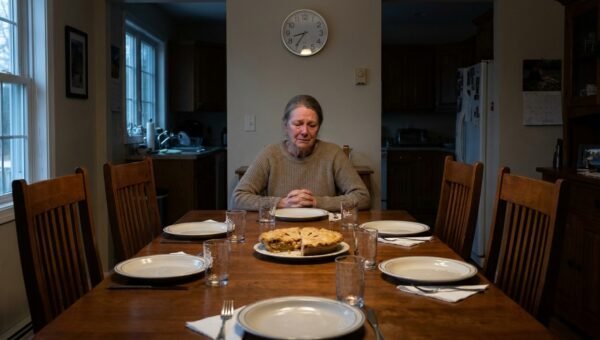
I sit at my own table, with my front door locked, and wait for the kids to knock.