I almost let my dad’s first words keep me away when he was trying to ask me for help. The funeral program was still on my kitchen table, folded in half, with a pencil note on the back I hadn’t read yet. When Dad called, I thought he was telling me not to come.
“Hello?”
“Ryan? It’s your dad.”
“Hey, Dad. Everything okay?”
“I’m a bit under the weather. The doctor says I should be alone for a few days.”
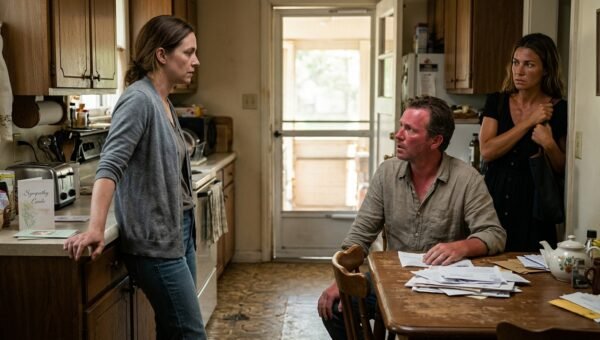
I remember looking at the program while he said that. I’d brought it home from Mama’s service because I couldn’t bring myself to leave it behind. Her picture was on the front, the one where she’d squinted at the sun and laughed because I took too long to get the camera ready.
“Can’t Uncle Mike help out?” I asked.
There was a pause. Then Dad said, “Look, son, I wouldn’t ask if I had another option. It’s just for few days.”
It didn’t sound like him. He’d never been good at asking for help, but he was usually plain about what he wanted. This sounded like he was trying to fit two different messages into one call.
“Why now?”
“Look, there’s only one reason.”
Then he stopped. I heard a soft clink, like a spoon against a mug, and a man’s voice too low to make out.
Dad said, “I have to go.”
The call ended. I sat there with the phone still at my ear for a second, feeling foolish.
Mama had been buried only a few days. I was tired, and grief can make a person hear things that aren’t there. But I knew Dad’s voice when he was worried. I also knew he wouldn’t tell me the doctor wanted him alone and then ask me to come unless something was wrong.
I turned the program over. Near the bottom, in Mama’s small pencil writing, was: “If Douse, open Psalm 27 in my red Bible and look for the, ”
The rest of the line was cut off at the edge of the paper. Maybe she’d started another word and run out of room. I don’t know why I hadn’t noticed it at the funeral. I’d been staring at the front of the program and trying not to cry when people said they were sorry.
Mama had called Uncle Mike “the Douser” for years. I used to think it was one of her little jokes, though she never laughed when she said it.
If something was going well, Mike found a way to put it out. A good business month, a new plan, a family dinner that wasn’t about him. He’d say he was only being practical.
I went to the bookshelf and took down Mama’s red Bible. She kept it near the end of the shelf, behind two recipe books. The leather cover had gone soft at the corners. When I was a kid, I’d watched her read from it after dinner, moving her finger under each line while Dad washed dishes.
I opened to Psalm 27. A ribbon was tucked inside, right around the verse she liked. The page didn’t look different until I felt something flat between the paper and the back cover. There was a small envelope, a safety deposit key taped to it, and a stack of folded papers.
I didn’t sit down. I read standing there.
The first paper was a deed to the house. It transferred the home to me while giving Dad the right to live there for the rest of his life.
It was signed and notarized. Under it was a dated affidavit in Mama’s handwriting, with a lawyer’s signature and seal. She’d written that Dad was not to lose control of his home or money because of pressure from his brother.
There was also a folded page covered in names, dates, and amounts. Mama had kept track of money Mike had taken or talked Dad into lending him through the years. The list went back more than a decade. It wasn’t only about a few bad loans. There were business checks Dad had covered after Mike said he’d pay them back, and money that never came back.
I’d known Mike borrowed from Dad. I hadn’t known Mama had kept every date.
At the bottom of the page, she’d written, “Mike douses the fire, then says he came to help. If he’s there when Arthur is sick, don’t wait.”
I read that line twice. The phone call changed shape in my head. Dad hadn’t been trying to send me away. He’d been choosing words carefully because Mike was close enough to hear.
I called the law office listed in the margin of the affidavit. I got a receptionist first, then Mr. Levin, the attorney who’d helped Mama with the house papers.
“Did Mike call your office today?” I asked.
“He did,” Mr. Levin said. “He asked about an emergency conservatorship packet.”
“What does that mean?”
“He said your father couldn’t manage his affairs. I told him we’d need to speak with Arthur directly and review the facts.”
I gripped the edge of the counter. “Dad’s sick. Mike’s at the house now.”
There was a short pause. “I’m glad you called. Mike also booked a mobile notary for this afternoon. He said it was for estate management.”
I looked at the deed again. The papers were real. Mama had planned for this. But I could still be too late to stop Mike from putting Dad under pressure, or from making a mess Dad would have to live with later.
“Can you come?” I asked.
“I can’t get there in time,” Mr. Levin said. “Take the originals. Don’t let your father sign anything. I’ll call the notary and explain there’s a dispute.”
I wanted to ask how Mike had managed to arrange all this so quickly. I wanted to ask why Dad had let him in. But those questions could wait. I put the papers in a folder, grabbed the Bible, and went out to my car.
The drive took twenty-six minutes. I know because I watched the clock at the lights. I kept hearing Mama’s line in my head, and I was mad at myself for thinking she was just being sharp about Mike all these years.
I was also mad at Dad. Not for being sick. For trying to carry everything alone until it turned into a crisis. I’d done the same thing with him, though. We could go months without saying much beyond practical things. After Mama died, I’d told myself I was giving him space. Maybe I’d also been waiting for him to make the first move.
Mike’s truck was in the driveway. The front door was open a few inches. I knocked once, but nobody answered, so I went in.
Dad was in his armchair in the living room, wearing his old gray sweater. He looked feverish and tired, and there was a glass of water on the table that he hadn’t touched. Mike stood beside him with papers on the coffee table. A man I didn’t know had a notary stamp and a small case open near his chair.
Mike looked at the folder in my hand. “What are you doing here?”
“Dad called me.”
“He said he was sick and wanted quiet.”
Dad tried to sit up straighter. “Ryan, I, ”
Mike cut him off. “He’s not feeling well. We’re handling it.”
The notary looked from Mike to me. The pen was already in Dad’s hand. That was the part I can still see clearly: Dad holding it without writing, his fingers shaking a little, while Mike leaned over the table and pointed to a line.
I stepped between them and set the red Bible down on the table.
“Put the pen down, Dad,” I said.
Mike gave a short laugh. “This is family business.”
“It is. That’s why I’m here.”
I opened the folder and laid out Mama’s deed and affidavit. The notary picked them up and read the first page. Mike reached for the papers, but I put my hand over them.
“This house is already protected,” I said. “Mama transferred it to me, and Dad has the right to live here for the rest of his life.”
Mike looked at the affidavit. “That’s not what she meant.”
“She wrote it down. It’s signed and notarized.”
The notary read the page again, then closed the folder of papers he’d brought. “I can’t notarize this with a dispute like this in front of me.”
Mike’s face tightened. “You don’t know what’s been going on here.”
“I know you asked for a conservatorship packet this morning,” I said. “I know you arranged this signing while Dad’s sick. And I know Mama kept records of the money Dad covered for you.”
I put her handwritten list on the table. Mike glanced at it and didn’t touch it.
“That was between your mother and me,” he said.
“It was between you and Dad, too.”
He started to say something else, but Dad spoke first. His voice was thin, but it carried.
“Mike, go.”
Mike looked at him as if he expected him to take it back. Dad’s hand was still on the pen. Then he set it down.
Mike gathered his jacket. He said I was making a family matter ugly and that Dad would regret shutting him out. I didn’t answer. I was scared I’d say something I couldn’t take back, and honestly, I didn’t want Dad to have to hear more arguing.
The notary left with the unsigned papers. Mike went after him. I locked the front door when they were both outside, then stood there with my hand on the knob until I heard Mike’s truck pull away.
Dad looked at the Bible on the table. “Your mother told you?”
“She left a note in the program.”
“She told me not to worry.” He rubbed at his forehead. “I thought she was just worried about Mike again.”
“She knew what he might try.”
Dad swallowed. “I didn’t want to make you come running.”
I wanted to say that was ridiculous. I wanted to tell him I’d been his son the whole time, even when I was too busy to call. Instead I moved the water closer to him and asked if he wanted me to call the doctor.
He nodded.
While we waited for the doctor to call back, I made tea. I’ve never made it the way Mama did. I always use too much water, and I never remember how long she let the bag sit. Dad drank half the cup anyway.
We called Mr. Levin together. He explained that the deed protected Dad’s right to remain in the house and that the affidavit would help show Mama’s intent. He also said we needed to handle Dad’s care and finances properly, not make a rushed decision in response to Mike.
So we did it properly. In the days that followed, Dad and I met with the attorney and filled out a healthcare proxy. We set up joint oversight on his accounts, with Dad’s approval, so any large change would be clear to both of us. Mike was removed from anything that gave him access or authority.
It wasn’t easy. Dad hated the paperwork, and I hated seeing him look at me like he was becoming a burden. I’d always thought the hard part of being a son was showing up for the big things. I hadn’t understood how many small calls and visits I’d let slide because I figured Dad would ask if he needed me.
When his fever started to come down, I stayed overnight. He slept in his own room. I slept on the couch, where I could hear him if he needed help. The next morning, he said he was sorry he’d made the call so strange.
“I heard Mike beside me,” he said. “I couldn’t say what I wanted.”
“I know,” I told him.
He looked at the red Bible on the nightstand. “Your mother was ready for everything.”
“She was ready for Mike.”
Dad gave a tired little laugh, then his face got serious again. “I’m sorry I made you think I didn’t want you there.”
I sat on the edge of the bed. “I’m sorry I needed a reason.”
He didn’t say anything for a while. Neither did I. Some things between us had been quiet so long that I couldn’t fix them in one conversation. I could stay, though. So I did.
Dad recovered at home. Mike stayed away after Mr. Levin sent him a formal notice that he had no authority over Dad’s home or finances. I didn’t feel like I’d won anything. I was relieved that Dad could sleep without worrying about a pen being put in his hand again.
That night, I set Mama’s red Bible on Dad’s nightstand and opened it to Psalm 27. The ribbon rested across the verse she’d marked years ago: “Wait on the Lord: be of good courage, and he shall strengthen thine heart.”
Dad had fallen asleep before I left the room. The Bible stayed open beside him, right where Mama had put it for us.