PART 1
My father called on a Tuesday evening after eight years of absolute silence.
He did not ask how I was doing. He did not ask about my marriage, or about the house my husband Tom and I had spent six years fixing up on the north side of town. He cleared his throat twice, the exact gravelly sound he used to make before announcing bad news at the dinner table, and told me his car had broken down somewhere past Altoona.
He was sitting on a metal bench inside the Greyhound station on 11th Avenue, and he needed a place to sleep for one night.
“Just the couch, Sarah,” he said, his voice flat and thin through the receiver. “One night. I can catch the morning connection.”
I stood by the kitchen counter with the phone pressed hard against my ear. Eight years earlier, he had sold the family hardware store out from under my brother and me, taken every dime of the equity, and driven out toward Ohio with a woman none of us had ever met. He never came to my daughter Chloe’s eighth birthday party. He missed her middle school graduation. He never answered three separate letters I sent when my mother’s estate finally cleared probate.
I told Tom I had to go get him. Tom looked up from the kitchen table, his reading glasses halfway down his nose, and told me I did not owe that man a gallon of gas.
“I know,” I said. “I just need to see him with my own eyes. I’ll drop him at the guest room, and he’ll be gone at seven.”
I took a spare fleece blanket from the linen closet, threw it into the backseat of my sedan, and drove into downtown Altoona. The whole drive, I practiced what I was going to say. I rehearsed the rules. No talking about the hardware store. No drinking in the house. No asking for cash. One night, one shower, and a ride back to the terminal before Tom left for work.
The downtown bus depot smelled like burnt diesel and wet floor wax. My father was sitting on a green plastic chair near the baggage lockers. He looked smaller than I remembered, his shoulders curved inward beneath an old brown twill work jacket with grease stains on the cuffs. At his feet sat one scuffed brown leather suitcase and a white plastic grocery bag tied tight at the handles.
He stood up when he saw me walk through the glass doors. He did not reach out to hug me, and I was grateful for that.
“Sarah,” he said.
“Dad. Car’s parked in the loading zone. Let’s go.”
I carried the plastic bag because it looked light, while he dragged the heavy suitcase across the linoleum. When we reached the curb, he stopped with his hand resting on the passenger door handle. He did not pull it open right away. He turned his head and looked at me sideways, squinting into the cold streetlights.
“Chloe,” he said, his voice rough against the damp wind. “She still play that violin?”
A knot tightened in my throat. Chloe was sixteen now. She practiced in her bedroom every afternoon until the floorboards vibrated, working through Bach partitas while Tom cooked dinner.
“Yes,” I said, keeping my hands jammed into my coat pockets. “She does. Why?”
Instead of answering, my father reached inside his heavy twill jacket. His fingers fumbled around the inner breast pocket for several seconds. When his hand came back out, he was holding a thick piece of glossy paper, folded twice down the middle.
It was an orchestral concert program. Across the top, printed in bold navy ink, were the words: *All-State Youth Philharmonic Invitational, Columbus.*
The date on the cover was from three years ago. Right below the date, circled in black ballpoint ink with three heavy lines, was Chloe’s full name.
PART 2
I stared at the program in his rough hand. The paper was creased and soft at the corners, the way paper gets when someone has carried it around in a pocket for months.
“Where did you get this?” I asked.
“The high school lobby,” he said. He didn’t look at me. He opened the passenger door and set his suitcase down in the footwell before easing himself into the seat. “Columbus wasn’t that far from where I was living. I saw the announcement in the county paper.”
I walked around to the driver’s side, got in, and shut the door. The smell of cold air and old tobacco followed him into the car. I placed both hands on the steering wheel, my knuckles pale against the black vinyl.
“You were there?” I said. “Three years ago? You sat in that auditorium and didn’t come down to say hello?”
“I bought a ticket at the side table,” he muttered. He pulled the seatbelt across his chest, his hands shaking just enough to make the metal buckle click three times against the receiver before it caught. “Row W. Up against the back wall. She played second chair. First piece was that piece with the loud brass section at the start.”
“It was the Dvořák,” I said. My voice was tighter than I wanted it to be.
“I don’t know the names of them,” he said. “I just know she sat on the left side of the stage. She had her hair pulled back in one of those silver clips your mother used to keep on the dresser.”
I put the car in reverse and backed out of the space. My throat felt raw. I remembered that concert clearly. Tom and I had driven four hours in a sleet storm to sit in the fourth row. We bought Chloe flowers afterward at a grocery store down the street, and she cried because she had missed one entrance in the third movement. My father had been sitting twenty rows behind us in the dark.
“Why didn’t you come down?” I asked, turning onto 10th Street. “If you drove all that way, why sneak out like a thief?”
“Because you wouldn’t have wanted me down there,” he said simply. “You would have had to explain me to Tom, and you would have had to tell Chloe who the old man was. It wasn’t my night to ruin.”
I didn’t answer him. We drove the rest of the way in total silence.
When we pulled into my driveway, the porch light was on. Tom came to the front door, wearing his slippers. He didn’t say much, just nodded once toward my father and helped him carry the heavy suitcase into the spare bedroom off the laundry area.
“There’s clean towels on the dresser, Mr. Miller,” Tom said, his voice polite but distant. “Bathroom is right through that door.”
“Thank you, Tom,” my father said.
I set the white plastic grocery bag on the kitchen counter while my father closed the guest room door. Tom stood by the sink, crossing his arms.
“How is he?” Tom whispered.
“Old,” I said. “He was at Chloe’s Columbus concert three years ago. He had the program.”
Tom frowned, taking off his glasses to rub the bridge of his nose. “Why would he keep that a secret?”
“I don’t know,” I said.
I looked down at the plastic grocery bag on the counter. It was knotted tight, but the thin plastic was stretched taut against something hard and rectangular inside. I reached out and untied the first knot, my fingers working the thin handles loose.
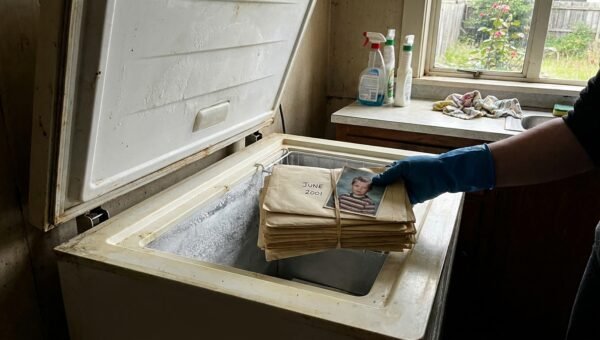
Inside the bag was a faded green metal strongbox. On the lid, scratched into the green paint with the tip of a nail or a pocketknife, were the initials *H.M.* Harold Miller. My grandfather’s initials. It was the cash lockbox my father had kept bolted beneath the service counter of Miller Hardware for thirty-five years.
PART 3
I lifted the box out of the plastic bag. It was surprisingly heavy.
“What is that?” Tom asked, stepping closer.
“It’s the register box from the store,” I whispered. “He took it the day he left.”
The guest room door clicked open behind us. My father walked into the kitchen wearing a clean flannel shirt, his socks sliding slightly on the linoleum. He saw the green box sitting on the counter between Tom and me. He stopped three feet away and put his hands into his pockets.
“You don’t need to pry the latch,” my father said. “It isn’t locked.”
I kept my hand on the cold metal lid. “You told me your car broke down, Dad. You said you were passing through.”
“The car did break down,” he said quietly. “Transmission blew out on the bypass near Duncansville. Tow truck driver took forty dollars to drop me at the station because I couldn’t pay the yard fee to store it. I walked away from the car.”
“Where were you going?” I asked.
“Here,” he said.
He stepped to the counter, reached past my arm, and flipped the two brass latches. The hinges gave a sharp squeak as the lid came up.
There was no cash inside. The metal coin trays were gone.
Sitting in the bottom of the box was a neat stack of cream-colored envelopes, bound together with thick rubber bands that had dried out and cracked with age. On top of the stack lay a folded legal deed, stamped with a county recorder’s seal, and a small blue passbook from a savings bank in Canton, Ohio.
“Look at the ledger,” my father said.
I picked up the blue passbook. The first entry was dated nine days after he sold the hardware store eight years ago. There was an initial deposit of $42,000. Beneath it, in tight, penciled rows written in his cramped handwriting, were monthly deposits. Small ones. $150. $200. $75. Every single entry was matched with an employer note: *Lumber yard night shift.* *Dispatch.* *Seasonal warehouse.*
The final balance, stamped by a teller machine six weeks ago, was $71,400.
“The woman you left with,” I said, my voice barely audible. “Brenda.”
“Brenda took half the buyout cash the second month we were in Akron,” he said. He pulled out a kitchen chair and sat down slowly, resting his forearms on the table. “She was gone by Christmas that first year. I could have come back, but I was too proud. I sold your grandfather’s shop because the property taxes were three years behind and the suppliers were going to put a lien on the house. I thought I could invest the rest and give you kids a clean payout.”
He shook his head once, his eyes fixed on the salt shaker.
“I lost the shop’s share in a bad warehouse lease,” he continued. “I had twenty-four hundred dollars left to my name by spring. So I got a room over a dry cleaner’s and I took whatever work they gave me at the depot.”
“Why did you save this?” I asked, holding the blue book. “Why didn’t you spend it on yourself?”
“Because that wasn’t my money to keep,” he said. His voice didn’t rise. It stayed low and tired. “Half the equity from that building belonged to you and your brother David. David won’t take my calls. He changed his number five years ago. But you’re still in the phone book.”
He tapped the legal paper resting in the green box.
“That’s a transfer deed for your mother’s five acres out in Bedford County,” he said. “The taxes are paid up through December. The savings account is held in trust for Chloe’s college tuition. It’s signed over. All you have to do is take it to the branch downtown with my death certificate when the time comes.”
“What are you talking about?” I said.
He pulled a folded slip of white paper from his pocket and laid it next to the ledger. It was a referral slip from an oncology clinic in Steubenville, dated two months prior. Stage IV small cell lung carcinoma. The appointment box for a follow-up consultation was stamped in red: *PATIENT DECLINED TREATMENT.*
Tom stood completely still behind me. The only sound in the kitchen was the hum of the refrigerator.
“I didn’t come here to ask you for a room, Sarah,” my father said, looking up at me. “I came because I couldn’t carry that box around any longer, and I didn’t want the state to take the account when I dropped.”
ENDING
We did not go to bed that night.
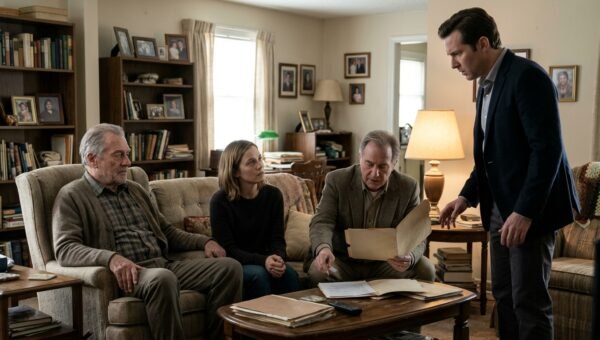
Tom brewed a fresh pot of coffee at midnight, and the three of us sat around the kitchen table until the sky outside the window turned from black to slate gray. My father drank his coffee black, using both hands to steady the mug.
We did not fix eight years of damage in five hours. There were moments when the old anger flared up in my chest, especially when he talked about the day he packed his truck without telling me, leaving me to face the hardware store’s creditors alone in an empty showroom. I told him how humiliating that winter had been. I told him about the letters I had written that he never answered. He didn’t defend himself. He just listened, staring down at the wood grain of the table, nodding every time I paused to catch my breath.
“I was a coward, Sarah,” he said around three in the morning. “There isn’t an excuse for it.”
At six-thirty, the hallway door opened, and Chloe walked into the kitchen wearing her school sweatshirt and flannel pajama pants. She stopped when she saw the older man sitting in Tom’s usual chair.
“Mom?” she asked.
My father started to stand up, his joints popping, but he caught himself and stayed where he was, resting one hand against the edge of the table.
“Chloe,” I said, stepping between them for just a second before stepping back. “This is your grandfather.