PART 1
Every Sunday morning by six o’clock, my kitchen smelled like browned butter, sage, and roasted beef. For four years, my husband David’s family came through our back door at noon sharp.
There were eight of them: his mother Evelyn, his sister Brenda with her husband and three teenagers, and his brother Keith. They did not ring the bell. They walked in, kicked their boots into the corner by the mudroom bench, dropped coats on my clean chairs, and asked what time we were eating.
I cooked three courses from scratch. I made yeast rolls, mashed potatoes, fresh green beans, and braised roasts. I poured iced tea until the pitchers ran dry. Then, while David and his brother watched football in the living room and Brenda helped their mother into the front parlor, I cleared eight grease-stained plates, washed the roasting pan by hand, and scrubbed the gravy off the stovetop. Not once in four years did anyone offer to dry a spoon.
Last Tuesday night, my wrists were swollen from peeling two bushels of apples for the freezer, and David walked in with a two-pound block of cheddar cheese and dropped it on the island.
“Brenda wants the baked macaroni with the sharp cheddar this week,” he told me, opening the refrigerator for a beer. “Make a double pan. Keith said the kids didn’t get enough last time.”
I stood holding the kitchen towel, looking at the grey water in the sink. “David, I can’t do it this Sunday.
I’m exhausted. My feet hurt by two o’clock every weekend, and I spend all of Monday putting the kitchen back together. Why can’t we go out? Or Brenda can host.”
David didn’t even look up from his phone. “Brenda has three kids in sports, Sarah. She doesn’t have the time.”
“I work forty hours a week at the clinic,” I said. My voice wasn’t loud, but it was shaking. “I have chores too. I haven’t sat down for a quiet Sunday morning in four years. I’ve had enough.”
David set his beer bottle down on the quartz counter with a hard click. His jaw tightened.
“They got us this house,” he said, staring right at me. “My family is the only reason we’re living in this neighborhood. Is this your thank you?”
I stared at him. The kitchen got very quiet except for the hum of the refrigerator.
We moved into this three-bedroom ranch in Maplewood six years ago. When we bought it, David told me his mother had given us a massive family gift to secure the winning bid over three other buyers.
He handled the closing while I was covering twelve-hour shifts at the county clinic during the fall flu surge. Whenever I asked about refinancing or taking out an equity line to replace the leaking porch roof, he brushed it off. He always said, “Leave the deed alone, Sarah. Mom handled the paperwork with her family lawyer to protect the family stake. You don’t mess with a gift.”
For six years, I carried that debt in my chest. Every time Evelyn complained that the roast was too salty, I bit my tongue because I believed she bought the roof over my head. Every time Keith tracked dried mud across my living room rug, I swallowed my anger because David said Keith had put up half of his personal savings to make sure his brother got a home.
“Is that what you really think?” I asked David quietly. “That I owe them my life because of a down payment?”
“I think you’re ungrateful,” he said, turning toward the hallway. “They built our life here. The least you can do is cook lunch.”
He walked upstairs and shut our bedroom door.
I didn’t argue. I didn’t yell. Instead, after David fell asleep, I went down to the basement where we keep the metal filing cabinets behind the furnace.
I pulled out the heavy green folder labeled “House Purchase – 2020.” It was thin. There was a copy of the home inspection, an old property survey, and our homeowner’s insurance policy. The closing statement was missing. The deed was missing. The title insurance document wasn’t there.
The next morning, I took an early lunch break from the clinic and drove to the county clerk’s office on Court Street. I paid four dollars for a public records search on our parcel number.
The clerk handed me the recorded deed and the mortgage history on plain white paper.
I sat in my car in the county parking lot with the engine idling and read the papers three times.
There was no gift deed. There was no family trust. Evelyn’s name did not appear anywhere on the county registry. Keith’s name was not on a single line. The deed had two names on it: David Miller and Sarah Miller, as joint tenants with right of survivorship.
And below that was the financing breakdown. The purchase price had been $310,000. The down payment was exactly $62,000.
Every single penny of that $62,000 came from the proceeds of the small townhouse I had bought on my own before I met David, which we sold three weeks before closing.
His family had not contributed one cent.
I sat behind the steering wheel and felt the heat rise up into my ears. David hadn’t just exaggerated a gift; he had turned my own money into a lie to keep me in an apron every Sunday of my life.
I folded the clerk’s stamped papers, put them in my purse, and drove to the grocery store.
By Saturday evening, I had prepped Evelyn’s favorite dish: a standing rib roast with rosemary potatoes, glazed carrots, and two pans of homemade rolls. When David came into the kitchen and saw the roasting pan sitting on the counter, he smiled and kissed my cheek.
“See?” he said. “I knew you’d come around. You just needed to think about what they did for us.”
“I thought about it all week,” I said.
Sunday morning, when the front door swung open at noon and eight people walked in expecting lunch, I was all smiles.
PART 2
Evelyn was the first one through the door, wearing her Sunday church coat with the fur collar. She set her purse on the counter right next to my clean cutting board and sniffed the air.
“Garlic,” she said, giving me a dry peck on the cheek. “You know garlic doesn’t agree with my gallbladder, Sarah. Did you use the garlic powder or the real cloves?”
“Real cloves, Evelyn,” I said, smiling warmly. “Just the way David likes it.”
Behind her came Brenda, shouting at her boys to wipe their sneakers, though none of them did. Keith headed straight for the refrigerator, opened the door without asking, and pulled out a bottle of dark beer.
“We’re starving, Sarah,” Keith called out over his shoulder. “Smells like beef. Tell me you made the crusty rolls.”
“Everything is ready,” I said. “Every single thing.”
David came down the stairs wearing a clean button-down shirt. He looked around the crowded kitchen, saw the serving bowls lined up on the counter, and gave me a smug, approving nod. It was the look he always gave when he thought he had successfully handled me.
“Go on into the dining room,” David announced, clapping his hands together. “Sarah outdid herself today. Take your seats, everyone.”
The dining room table has eight chairs. I had brought in two wooden folding chairs from the hall closet to make room for ten people.
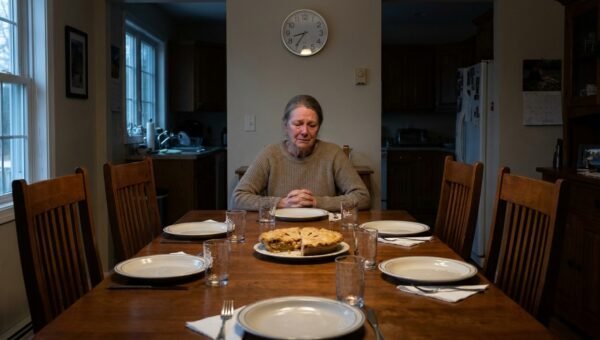
The table looked lovely. I had laid out my mother’s white linen cloth, the good cloth napkins, the heavy silver forks, and the water glasses filled with ice. But there were no plates in front of the chairs.
Instead, in the center of each woven placemat, sat a clean white legal envelope, face down, with each person’s name written across the front in black ink.
Evelyn sat down at the head of the table where she always sat. She picked up her envelope, turning it over with her arthritic fingers. “What is this? A thank-you card?”
“Something like that,” I said.
I stood by the doorway connecting the kitchen and the dining room. I had taken off my apron and hung it on the pantry hook. Underneath, I was wearing my dark trousers and the wool sweater my sister gave me last Christmas.
David frowned, looking down at his envelope. “Sarah, where are the plates? The roast is going to get cold on the counter.”
“Before we eat, we need to take care of the house business,” I said evenly. My voice was steady. It was the calmest I had felt since Tuesday night. “David told me something very important earlier this week. He reminded me that this house is only ours because of his family’s generosity. He told me that every Sunday dinner was my way of saying thank you for the roof over our heads.”
Brenda let out a small, nervous laugh. “Well, family takes care of family, Sarah. You don’t have to make a whole production out of it.”
“I think I do,” I said. “Because for four years, I believed him. I believed that Evelyn put up the cash. I believed Keith emptied his savings. So I went down to the county records office on Court Street on Wednesday, because I wanted to see the exact numbers. I wanted to know the exact dollar amount of the debt I was paying off every Sunday.”
David’s face lost all its color. He didn’t open his envelope. His hand clamped down on top of it, his fingers pressing so hard the paper creased.
“Sarah,” David said, his voice dropping into a harsh, tight whisper. “Stop this right now. We can talk in the kitchen.”
“Open your envelopes,” I told the table.
Keith was the first to tear the paper flap open. He pulled out the three sheets inside. The top sheet was a certified copy of the county deed. The second sheet was the closing settlement statement from October 14, 2020.
The third sheet was an invoice I had typed up myself on my work computer.
PART 3
“What the hell is this?” Keith asked, staring at the invoice.
“Read it out loud, Keith,” I said.
Keith looked over at David, then down at the paper. “It says… four years of Sunday dinners. Fifty-two weeks a year. Eight guests per week. Groceries, prep time, service, and deep cleaning. Billed at twenty-five dollars per head. Total: $41,600.”
Brenda gasped. “Are you charging us for eating lunch with our own brother?”
“No, Brenda,” I replied, looking directly at her. “I’m showing you what labor costs. But keep reading. Look at the title document underneath.”
Evelyn put on her reading glasses, her hands trembling slightly as she unfolded the county paperwork. “David… what is your sister’s name doing off this deed? You told me you and Keith were on the deed together.”
I turned my eyes to Evelyn. “Is that what he told you?”
The table went dead silent. The only sound was the refrigerator compressor kicking on in the other room and the hum of the dining room chandelier.
“David told me that he and Keith bought this place as an investment,” Evelyn said, her voice thin and cracked. She looked up at her son, her brow furrowed in genuine confusion. “He told me that Sarah’s credit was too poor to be on a mortgage, so Keith signed as the co-guarantor. He told me Keith owned twenty percent of the equity.”
Keith stood up so fast his wooden chair scraped across the hardwood floor. “Wait a minute. You told Mom I was on the deed? David, you asked me for five thousand dollars three years ago to pay the county property taxes because you said the town was putting a lien on the house! You told me it was protecting my share!”
David sat completely still. His face was blotchy, red and white in patches. He stared down at the table, refusing to look at his brother or his mother.
“Nobody has a share except David and me,” I said. I pulled my own copy from my cardigan pocket. “The purchase price was $310,000. The down payment was $62,000. That money came entirely from the sale of my townhouse on Elm Street, which I owned five years before I ever went on a blind date with your brother. David didn’t put in a dime of equity. Neither did Keith. Neither did Evelyn.”
I looked at David. “You lied to them to get Keith’s cash. And you lied to me to keep me cooking and cleaning for your family every single week so you could play the big provider.”
“Sarah, please,” David muttered, his teeth clenched. “Not here. Not in front of the kids.”
“You had no problem telling me I owed them a thank-you right in our kitchen,” I said. “You told me I was ungrateful. Well, the records are public. You took five thousand dollars from your brother under false pretenses. You told your mother I was a charity case living in a house she helped secure. And you let me scrub your family’s grease off the stove for two hundred Sundays because you were too cowardly to admit that my money bought this life.”
Brenda pushed her chair back, her face twisted in disgust as she looked at her brother. “David, is that true? You took five grand from Keith while his transmission was slipping?”
“I was going to pay him back,” David choked out. “We had expenses. The roof needed work.”
“The roof didn’t get fixed,” I said. “I paid the contractor two thousand dollars out of our joint checking account last spring to patch the flashing. Where did Keith’s five thousand go, David?”
David didn’t answer. He couldn’t.
Keith grabbed his jacket off the back of the folding chair. He looked at David like he was looking at a stranger he had caught trying his doorknob. “You’re a real piece of work, Dave. Mom, get your coat.”
“Keith, wait,” David pleaded, standing up and reaching for his brother’s arm.
Keith pulled his arm back so hard he knocked over his water glass. The ice water spread across the white linen tablecloth, soaking into the paper invoices and turning the ink blue. “Don’t touch me. You used Mom’s name to steal from me. We’re done.”
ENDING
Evelyn didn’t look at David when Keith helped her out of her chair. She walked past him slowly, leaning heavily on her cane, her eyes fixed on the floor. Brenda gathered her three teenagers, her face bright red with embarrassment, and ushered them out the front door without another word.
The door clicked shut. The house was suddenly louder in the silence than it had been with eight people talking.
David stood by the soaked tablecloth. “Are you happy now? You just blew up my entire family.”
“You blew it up six years ago when you forged an entire reality to manipulate us all,” I told him. “I just turned on the lights.”
I didn’t pack a bag, and I didn’t leave. It was my house.
I told David he had twenty-four hours to move his clothes into the spare bedroom over the garage. The next morning, I called a family law attorney named Martha Higgins, whose office is two blocks from the county courthouse.
We filed for legal separation three weeks later.
Because the $62,000 down payment was proven to be separate pre-marital property through the Elm Street sale records, David had no leverage. He was forced to agree to a buyout. To keep the house, I took over the remaining mortgage entirely in my own name, and David’s share of the post-marriage equity was reduced to cover the money he had secretly siphoned from our joint savings.
As part of the settlement, David had to sign a formal promissory note to Keith for the five thousand dollars he took, plus interest. Keith didn’t speak to David for nine months, though Keith called me once in November just to apologize for tracking mud into my foyer all those years. I told him he didn’t need to apologize for being lied to.
Yesterday was the first Sunday of October.
The air outside was crisp, smelling like damp oak leaves and woodsmoke. For the first time in six years, there was no beef roasting in the oven at six in the morning. There were no dirty pots piled in the double sink.
I sat at my dining room table with a cup of black coffee and a warm cinnamon scone I bought from the bakery around the corner. The white linen tablecloth was gone, replaced by a simple vase of yellow marigolds from the garden bed David never let me plant because he said his mother liked an open lawn.
The house was completely quiet. The clock on the wall ticked softly. I took a slow sip of my coffee, looked out the bay window at the yard I owned, and didn’t hurry at all.