PART 1
The cough started on a Tuesday night. By Thursday, our little girl Maya was running a fever that wouldn’t break, and the pediatrician’s office told us to head straight for the children’s hospital. I called Arthur twice while I was strapping her car seat into the back. He didn’t pick up. When he finally texted back an hour later, he said he was trapped across town at a client dinner and couldn’t leave.
I spent the next four days sleeping upright in a stiff vinyl chair in room 412, holding a cool washcloth against Maya’s forehead while an IV line hummed beside her bed. Arthur didn’t show up. He sent a brief text each morning asking if her temperature had dropped, then stopped replying altogether by Saturday afternoon. When I finally carried Maya back through our front door on Monday morning, exhausted and running on three hours of sleep, Arthur wasn’t there. His closet was half empty. On the kitchen island sat a single sheet of hotel stationery with three sentences scrawled in his rushed handwriting, telling me he needed space, that he had gone to Paris for a fresh start, and that he had already transferred the remainder of our joint savings to cover his initial expenses.
Our bank account balance was forty-two dollars. Maya was still coughing every time she lay flat, needing a fresh dose of liquid antibiotic every six hours.
I didn’t cry. There was no time for it. I put Maya down in her crib, called my sister Sarah to ask if she could watch her for a single afternoon, and drove straight to the bank to figure out how a man could legally drain every cent we owned while our toddler was hooked up to an intravenous drip.
The manager at the branch was sympathetic, but corporate rules meant I couldn’t touch the credit lines Arthur had tied up or freeze the remaining empty accounts without his signature or a formal separation filing. I sat in my sedan in the bank parking lot for twenty minutes, watching the rain streak across the windshield, feeling that heavy, steady anger settle into my bones. I didn’t break down. I drove to the grocery store, bought milk and a bag of plain flour, and drove home to make soup for my daughter.
Three weeks passed in that quiet, exhausting rhythm of single-parent isolation, punctuated only by occasional texts from Arthur that I left unread on my screen.
PART 2
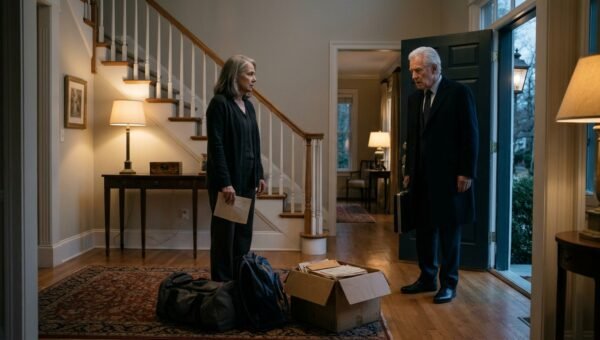
The house felt too quiet after Maya finally went down for her nap. I was sitting at the kitchen table with a stack of past-due utility notices when a taxi pulled up outside our curb. I watched through the blinds as Arthur stepped out onto the driveway. He looked entirely different from the man who had vanished three weeks ago. He rolled an expensive leather suitcase through the front door like nothing had happened. His shirt was crisp and pressed. His hair was freshly cut, parted cleanly on the side. He even wore the heavy sandalwood cologne I had bought him for our anniversary years ago.
He didn’t look tired. He didn’t look guilty. He smiled that easy, practiced smile he used whenever he wanted to smooth over an argument.
Then he looked right at me and said the words I never expected to hear.
“I’m ready to be your husband again.”
I stared at him from across the laminate table. My hands stayed flat against the bills. Upstairs, Maya stirred slightly in her crib, a soft rustle against the silence of the afternoon. Our three-year-old daughter was still recovering from the severe bronchitis that Arthur had abandoned us with while he flew across the Atlantic. And yet Arthur stood there in the entryway, smelling like duty-free cologne, expecting me to smile, take his coat, and welcome him back into the kitchen like a stray dog returning to the porch.
I almost laughed out loud. It was a dark, dry sound trapped in the back of my throat. Because he had no idea who was sitting in the back room, waiting for me to finish checking the household ledger. He thought he was stepping back into a house of quiet obedience where he could pick up his life right where he dropped it.
“You’ve been gone twenty-two days, Arthur,” I said, my voice lower and steadier than I even expected it to be.
He walked further into the kitchen, tossing his car keys onto the counter with a familiar clatter. “Paris was a mistake, Clara. It was a fog. A temporary lapse in judgment. I realized over there that everything I actually care about is right here. We can fix this. I’m back for good.”
“That is interesting,” I replied, not moving an inch from my chair. “Because when you left, you forgot something very important on the printer tray in the den.”
Arthur’s smile flickered for a fraction of a second, the first real crack in his polished surface. “What are you talking about?”
“Before you left, you printed out your itinerary and your hotel reservations,” I said. “And you also left the confirmation page for a joint bank account in Zurich that you opened under a corporate LLC three months ago. I didn’t understand it at first. But I had three weeks alone in this house to make a few phone calls, talk to a family attorney who specializes in asset recovery, and find out exactly how much money you moved out of our retirement before you caught that flight.”
Arthur took a step forward, his expression hardening. “Clara, you’re making things up. You don’t know anything about business accounts.”
“I know that forty-two dollars is what was left in our grocery account while Maya was on oxygen,” I said, standing up from the table so I was looking him straight in the eye. “And I know that the person sitting in my living room right now isn’t me. It’s the process server I hired yesterday morning, who has been quietly reviewing your paperwork for the last twenty minutes while you were outside rehearsing your entrance.”
PART 3
The process server, a tall man named Miller who wore a worn tweed jacket and carried a thick manila folder, stepped out from the living room archway and walked into the kitchen. He didn’t look at Arthur with anger or drama. He simply looked like a man doing a routine job on a Tuesday afternoon.
Arthur froze. The color drained completely out of his face, leaving his skin a sickly, gray tone that ruined his fresh haircut. He looked from Miller back to me, his mouth opening slightly before he managed to speak. “You can’t do this. We’re married. Whatever I earned is—”
“File number four-hundred and twelve,” Miller said evenly, pulling a heavy set of legal documents from his folder and laying them right on top of Arthur’s car keys. “Emergency asset freeze, temporary injunction on all personal and corporate holdings, and notice of divorce filing with full accounting of dissipated marital funds. You’ve been served, Mr. Hayes.”
Arthur stared down at the papers as if they were venomous snakes. All the practiced charm, the fresh cologne, and the careful posture collapsed instantly. He reached out a trembling hand toward the edge of the counter, looking for something to steady himself. “Clara, wait. We can talk about this. We don’t need lawyers. We can sit down and work this out like adults. Paris… Paris didn’t mean anything. It was just a trip.”
“It wasn’t a trip, Arthur,” I said, walking past him to grab his expensive leather suitcase by the handle. I dragged it across the linoleum and shoved it straight toward the front door, leaving it open to the cool autumn air. “A trip has a return date. You didn’t plan on coming back until the money ran out or until you got bored. But you came back to the wrong house.”
Arthur looked at the open door, then back at me, finally realizing that the life he thought he owned was entirely gone. “You’re throwing me out?”
“I’m not throwing you out,” I said quietly. “You left three weeks ago. You just forgot to finish packing.”
ENDING
Arthur stood by the kitchen counter for a long moment, his chest rising and falling in shallow, ragged breaths. He looked around our kitchen as if he were seeing it for the very first time, noticing the stack of unpaid utility bills, the half-empty cup of coffee I had abandoned hours ago, and the quiet hallway leading back toward Maya’s room. He didn’t say another word. He picked up his car keys from beneath the legal papers, grabbed the handle of his suitcase, and walked out the front door without looking back.
I watched from the window as he climbed back into his car and drove away down the street, his brake lights flashing once before he turned the corner.
Upstairs, I heard the faint, soft sound of Maya shifting in her crib, calling out a sleepy, familiar word for water. I wiped down the laminate table with a damp cloth, tossed Arthur’s abandoned hotel stationery into the trash can, and walked down the hall to check on my daughter.