PART 1
I raised Leo from the time he was two years old. My son Mark never wanted him, and Leo’s mother simply packed two suitcases one afternoon and walked out the front door, leaving us behind with no forwarding address and no phone number. Mark moved three states away within six months and started a new life, completely abandoning any pretense of fatherhood. I did not care about Mark at that point.
My whole world narrowed down to a toddler who woke up crying for a mother who was never coming back.
I turned my life upside down to give Leo a stable home. I worked part-time at the community college bookstore while keeping up the small house my husband left me when he passed. I bought shoes, paid for dental checkups, helped with homework at the kitchen table, and sat in tiny plastic chairs at parent-teacher conferences year after year. When other women my age were traveling or enjoying quiet retirement mornings with coffee, I was driving to soccer practice and packing lunch boxes. I never regretted a single minute of it. Leo was my boy, and I loved him fiercely.
Ten years passed in a blur of routine and quiet stability. Leo grew into a polite, quiet boy who played clarinet in the school band and helped me weed the tomato patch on Saturday mornings.
He called me Grandma, but in every way that mattered, I was his mother.
Then the blue sedan pulled into my gravel driveway on a crisp Tuesday in October.
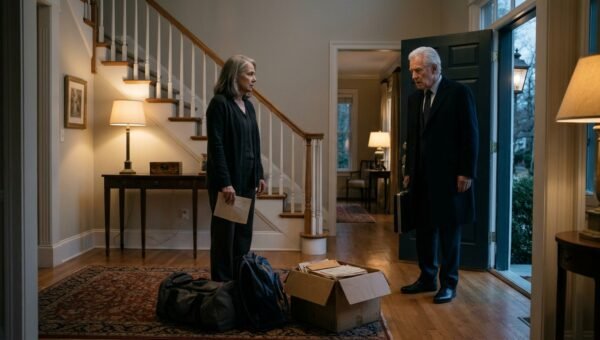
A woman stepped out of the passenger side before the engine even stopped. It was Brenda, Leo’s mother, looking older and sharper than she had ten years ago, wearing a sharp camel-colored wool coat and carrying a thick leather portfolio. Behind her came a tall man in a dark gray suit carrying a leather briefcase. I recognized Brenda instantly, even though I had not seen her face in a decade. My chest tightened so hard I could barely draw breath.
Brenda walked straight up my porch steps without knocking and pushed the screen door open. She did not ask to come in. She stood in my front hallway, looking around my living room as if appraising the furniture for a yard sale, while the man in the gray suit stood respectfully behind her on the welcome mat.
Leo was sitting at the dining room table finishing an algebra worksheet. When he heard the front door, he looked up, his pencil frozen over the paper.
Brenda walked past him without looking at his face and stopped right in front of me. She gave me a small, practiced smile that did not reach her eyes.
“Hello, Margaret,” she said, her voice smooth and entirely devoid of warmth. “It has been a long time.”
I gripped the edge of the hall table so hard my knuckles turned white. “What are you doing here, Brenda? How did you even find this house?”
“People always find a way when they have a proper legal reason,” she replied smoothly. She turned to the man in the gray suit, who stepped forward and opened his leather briefcase. He pulled out a stapled set of heavy cream-colored paper and handed it to Brenda, who offered it to me like a hostess presenting a menu.
“I am here on official business,” Brenda said, her voice dropping into a professional register. “Thanks for your services over the years. Truly. You kept him fed and clothed while I got my life sorted out and established a proper corporate career in Chicago. But I am his birth mother. My parental rights were never legally terminated by a court of law. I am fully capable of providing a stable home now, and my lawyers have verified that custody defaults back to the biological parent under these circumstances.”
She smiled again, that cold, empty smile. “I will take it from here.”
Before I could process the words, before I could scream or demand they leave my house, two local sheriff deputies walked up my front steps. Brenda had brought them as an escort. One of them, a deputy named Miller whom I had known for years, looked at me with deep, genuine pity in his eyes. He tipped his hat and told me quietly, “I am sorry, Mrs. Davis. She has the paperwork signed by a family court judge in the county seat. We have to make sure the transition goes peacefully.”
Leo stood up from the dining room table, his face completely pale. He looked back and forth between Brenda and me, his lower lip trembling. He did not run to me. He did not shout. He looked shell-shocked, frozen in place by the sudden invasion.
“Get your jacket, Leo,” Brenda said, her tone hardening into an absolute command. “We are going to the hotel now, and tomorrow we fly to Chicago.”
I tried to step around her to reach my boy, but the deputy gently blocked my path with his forearm. “Don’t make it harder than it has to be, Margaret,” he murmured.
I watched, paralyzed by sheer disbelief, as Brenda grabbed Leo by the forearm and led him out my front door. He looked back at me once from the porch, his eyes wide and terrified, before the screen door slammed shut.
The house went dead silent. The front door remained open an inch, letting in the cold October wind. I stood alone in the hallway, staring at the empty coat rack where Leo’s blue hoodie still hung, realizing with sickening horror that I had no legal standing, no voice, and no child.
PART 2
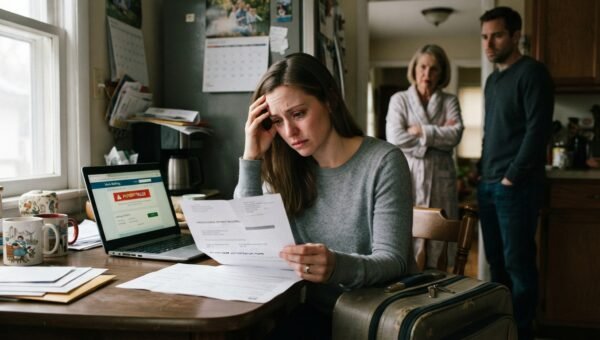
The days that followed blurred together into a grey, suffocating numbness. I tried calling every family lawyer within a fifty-mile radius, but the answer was always the same discouraging refrain. Because I had never formally petitioned for legal guardianship or adoption while Leo was a minor, and because Brenda had never officially surrendered her parental rights through the state system, she remained his legal guardian on paper. The lawyers told me that fighting her in court would cost tens of thousands of dollars, take years, and had very slim odds of success against a biological parent with a stable income and a Chicago address.
I sat at my kitchen table for days, staring at the spot where Leo’s algebra worksheet still lay unfinished. The blue hoodie hung on the coat rack until I finally took it down and folded it, pressing it into the bottom of my cedar chest so I wouldn’t have to look at it every time I walked past the door.
My son Mark was no help. When I finally tracked down his phone number and called him, furious and weeping, he simply sighed into the receiver and told me I was making a big deal out of nothing.
“She is his mother, Mom,” Mark had said, his voice entirely detached, as if he were discussing a business merger. “Let her deal with him. You did your time. Enjoy your retirement.”
I hung up the phone and blocked his number. I realized then that I was entirely on my own. Brenda had won. She had taken my boy back to Chicago, and my daily life was reduced to a crushing, hollow silence. I stopped cooking hot meals. I stopped gardening. I spent hours sitting in the worn armchair by the living room window, watching cars pass by on the county road, waiting for something that would never happen again.
Six years passed.
They were the longest, loneliest years of my life. I received two Christmas cards during that time, both containing brief, stilted notes from Leo saying he was doing fine in school and playing in the high school jazz band. There were no return addresses. When I tried to reply through the return address of the law firm that had accompanied Brenda on that terrible day, my letters were returned unopened, stamped with a formal legal rejection notice stating that minor contact was at the discretion of the legal guardian.
I grew older faster during those six years. My hair turned completely white, and the lines around my eyes deepened into permanent creases of grief. I learned to live without purpose, moving through the house like a ghost.
Then came a rainy evening in late November.
I was sitting in the kitchen with a cup of lukewarm tea when a sharp knock sounded at the front door. It was well past eight o’clock, long after dark. My heart gave a painful lurch. People did not visit out here in the country after dark unless something was wrong.
I walked slowly to the door, turned the deadbolt, and pulled it open.
A young man stood on the porch, drenched in the cold autumn rain. He was tall, broad-shouldered, and wearing a soaked canvas jacket. Water dripped from his dark hair down into his eyes. But beneath the water and the six years of growth, I recognized the shape of his jaw and the quiet set of his mouth.
It was Leo.
He was eighteen now, an adult by law, standing on my porch with his canvas duffel bag slung over one shoulder.
My breath caught in my throat. I didn’t say a word. I simply reached out, grabbed the lapels of his wet jacket, and pulled him hard across the threshold into the warm light of the hallway. I buried my face against his chest, wrapping my arms around him as hot, sudden tears broke free after six years of being locked inside.
Leo wrapped his arms around me just as tightly, his shoulders shaking. “I’m sorry, Grandma,” he whispered into my hair. “I am so, so sorry it took me this long to come back.”
PART 3
We sat at the kitchen table for hours while the rain drummed a steady rhythm against the kitchen window. I made him a pot of hot tomato soup and grilled cheese sandwiches, the exact meal he used to love when he came home from elementary school with skinned knees. He ate ravenously, as if he hadn’t had a proper home-cooked meal in months, while I sat across from him and just watched the way his hands moved, marveling at how much he had grown into a man while I was locked out of his life.
“Why did you leave like that, Leo?” I asked softly, my voice trembling slightly as I pushed the warm mug closer to his hands. “Did she treat you badly?”
Leo put his mug down and looked away, staring out the dark kitchen window at the reflection of our overhead light. “She didn’t beat me or lock me in a room, if that’s what you mean,” he said, his voice tight and bitter. “She bought me nice things. She put me in a private school in the suburbs. But I was never her son. I was a project. A trophy she used to prove to her new husband and her high-society friends that she had her act together. Whenever they threw dinner parties, I was introduced like a piece of antique furniture she had successfully recovered from storage.”
He reached down to the floor, picked up his soaked canvas duffel bag, and unzipped the main compartment.
“She thought she owned me,” Leo said, his eyes locking onto mine with a fierce, cold resolve. “She thought she could buy compliance just by throwing money at private tutors and brand-new cars. But she made one fatal mistake. She kept her private file cabinet unlocked in her home office.”
He pulled out a thick manila folder, bulging with legal documents, bank statements, and certified copies, and slid it across the kitchen table toward me.
“What is this?” I asked, my fingers brushing the heavy cardboard tab.
“That is why I waited until I turned eighteen,” Leo said quietly. “That is the paper trail of how Brenda got this house, how she took me away, and where the money came from that paid for her fancy life in Chicago.”
I opened the folder. The first page was a certified copy of a property deed transfer from twelve years ago, bearing my late husband’s signature—or rather, a very clumsy forgery of it—along with a notary stamp from a shady agency downtown. The second page was a bank ledger showing a lump sum withdrawal of eighty-four thousand six hundred fifty dollars transferred from a hidden savings account my husband had left me into an unknown corporate account controlled entirely by Brenda and my estranged son Mark.
I froze, staring at the exact figures on the page.
“Mark was in on it?” I whispered, the words feeling like dry ash in my mouth.
“He signed off on the initial fraudulent asset claim,” Leo said, leaning forward across the table. “They needed quick capital to start her business in Chicago, and they knew you wouldn’t give them a dime if they asked honestly. So they conspired with a corrupt paralegal to forge your signature on the property transfer and asset release forms. Brenda used the threat of the legal custody battle to keep you quiet and off-balance. She knew you wouldn’t fight back if you were terrified of losing me permanently.”
He tapped his finger against the bottom bank statement. “She didn’t just steal me back, Grandma. She and Mark stole your retirement savings to fund her entire life. And I copied every single document out of her office safe before I packed my bags and walked out her front door for good.”
I stared at the papers, the pieces clicking into place with a clarity that made my head spin. It wasn’t just a bitter custody dispute. It was an orchestrated financial betrayal executed by my own son and the woman who abandoned him, using my grandson as both a weapon and a shield.
“What do we do with this, Leo?” I asked, looking up into his young, determined eyes.
Leo smiled—a small, fierce smile that looked remarkably like the one I used to give him when he stood up to a bully on the playground.
“We take it to the district attorney downtown,” Leo said, tapping the folder with his knuckles. “I’m eighteen now. I can testify as a primary witness to everything she said in that house. And I have the signed bank ledgers right here. They thought they won. But the game just changed.”
ENDING
We didn’t call the police that night, and we didn’t call Mark. We left the folder sitting right in the center of the kitchen table, squarely beneath the warm glow of the yellow pendant lamp.
The rain stopped around midnight, leaving the night air clean and sharp with the smell of wet earth and pine. Leo walked over to the coat rack by the front door, reached into the bottom of the cedar chest where I had folded it six years ago, and pulled out his old blue hoodie. He slipped it over his shoulders. It was a little tight across his broad shoulders now, but he zipped it all the way up anyway.
He walked back into the kitchen, picked up his empty soup bowl, and carried it over to the sink.
“I’m sleeping in my old room tonight, right?” he asked, looking over his shoulder at me with a soft, familiar grin.
“The bed is made,” I said, my voice steady and clear for the first time in six years. “It’s been made every single night since you left.”