PART 1
My daughter-in-law, Brenda, gave me a two-dollar scratch-off ticket for my seventy-third birthday and chuckled while I scratched it. I smiled, thanked her, and told absolutely no one what I saw under the silver coating.
That little piece of cardboard had been sitting in a bowl on their kitchen counter next to the mail for three days before she handed it to me. Brenda had a habit of buying those cheap tickets at the gas station when she picked up her diet soda, usually tossing the losers into the cup holder of her minivan.
When she handed this one over with a roll of her eyes, she made sure everyone at the kitchen table knew it cost practically nothing.
My son, David, didn’t look up from his phone. He just mumbled a half-hearted happy birthday and reached for a slice of store-bought cake. I didn’t mind the lack of fanfare. At seventy-three, you learn not to measure love by the wrapping paper or the price tag. I had lived in my small house across town for forty years, paid off the mortgage back when interest rates were breaking records, and kept to myself mostly. I watched my grandson on Tuesdays, tended my tomatoes, and stayed out of their way.
I took the nickel Brenda offered me from the counter and scraped the grey film away row by row. Most of those tickets show three matching amounts or little symbols that mean nothing. This one was different.
When the numbers cleared under the third square, my heart did a strange little flutter against my ribs, but I kept my face entirely still. I had spent thirty-two years working the front desk at the county records office before I retired. I knew how to look at official text, and I knew how to look at print.
Underneath the latex coating was a prize code and a payout figure that made my fingers tighten around the nickel. It wasn’t a fifty-dollar winner or a free ticket for next time. It was a top-tier regional lottery win for fifty thousand dollars.
Brenda laughed a dry, sharp sound and reached out to tap the cardboard with a manicured fingernail. “Don’t spend it all on hard candy, Martha,” she said, turning back toward the sink to rinse a coffee mug.
I looked up at her back, then across at David, who was scrolling through some video on his screen with the volume turned down low.
I didn’t gasp. I didn’t drop the ticket. I simply slid the little green rectangle across the formica tabletop, tucked it carefully into the small leather coin purse I kept inside my knitting bag, and thanked Brenda again for the thought.
Ten months later, my son handed me a glossy brochure for the senior care facility he and his wife had already picked out for me. I simply said, “That looks fine.”
PART 2
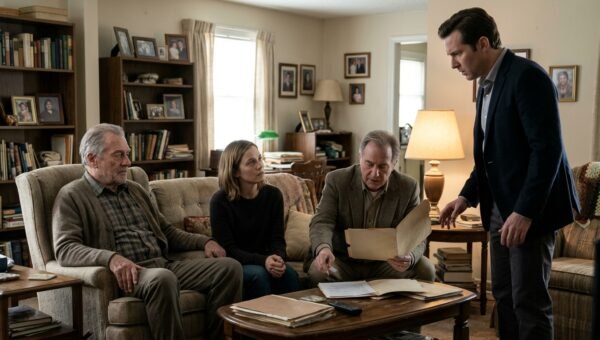
The brochure had thick, heavy pages filled with pictures of smiling seniors playing bingo and sitting in bright, sunlit solariums with potted ferns. David laid it out on my kitchen table right where I usually kept my crossword puzzles. He didn’t ask how my arthritis was holding up or if I was having trouble managing the house. He just patted my hand with that practiced, gentle touch people use when they have already made up their minds about your future.
“It’s time, Mom,” David said, looking around my living room as if he were already measuring the walls for someone else’s furniture. “The upkeep here is getting to be too much for you. Brenda and I were talking. If we sell the house now, we can cover the deposit for the Maple Ridge facility and have enough left over to help pay down some of our truck loan. It just makes sense.”
I set my teacup down on the saucer without making a sound. The porcelain didn’t even click.
“Is that so,” I said.
“We’ve already run the numbers,” David added, leaning back against my floral armchair. “Your roof is twenty years old anyway. You don’t want a sudden repair bill wiping out whatever savings you have left.”
I didn’t mention my savings. I didn’t mention that the roof had been inspected the previous autumn and given a clean bill of health by a roofer I had known since high school. I just nodded slowly, letting him talk himself into a corner where he felt completely secure. For ten months, they had treated me like an aging fixture in their lives, someone whose opinions could be bypassed with a pat on the head and a brochure. They assumed I was fading, that my memory was slipping, and that I would fold the moment they suggested packing up forty years of memories into cardboard boxes.
“Let me think about it over the weekend,” I told him, keeping my voice mild and compliant.
David smiled, clearly relieved that there was no argument. He kissed the top of my head, grabbed his car keys off the counter, and told me Brenda would call me on Monday to talk about moving dates.
As soon as his taillights disappeared down the street, I went to the small lockbox hidden in the back of my bedroom closet. Inside, wrapped in a clean linen handkerchief, was the validated lottery receipt and the claim paperwork bearing my signature and the state lottery commission seal from ten months prior. The fifty thousand dollars hadn’t gone toward David’s truck loan or a down payment on a Maple Ridge apartment. It sat in a separate account at the credit union across town, untouched and growing small bits of interest.
I sat down at my kitchen table, pulled out a sheet of lined writing paper, and began to write a letter to the state lottery claims division and a second letter to the lawyer who had handled my late husband’s estate. If David and Brenda were so eager to manage my housing arrangements, I figured it was only fair to let them see how thoroughly I could manage my own affairs.
PART 3
The following morning, a certified letter arrived at their house. By the time my son finished reading it, he was staring at me like he had never really known his own mother.
I had asked the process server to drop the documents off at David’s home address during breakfast hours, right when Brenda was usually sitting down with her first cup of coffee. It wasn’t a lawsuit for a crime or a dramatic police summons. It was an official notification from the state property and asset registry, accompanied by a formal legal inquiry regarding the transfer of my primary residence and a complete accounting of the scratch-off ticket winnings that Brenda had so casually handed me on my birthday.
My phone started ringing at nine o’clock. I let it ring three times before I picked up the receiver.
“Mom?” David’s voice was tight, high-pitched, and shaking with an anger he was trying desperately to control. “What is this? What did you send to the house?”
“Good morning, David,” I said, keeping my tone as calm as the kitchen air.
“There’s a paper here from a lawyer,” he said, his breathing heavy over the line. “It says something about an asset audit and a disputed property claim on your house. And it mentions fifty grand from a lottery ticket. Brenda is losing her mind. She’s saying you’re accusing us of something.”
“I’m not accusing anyone of anything,” I replied, sitting down at the kitchen table with my teacup. “I’m just clarifying ownership. When Brenda gave me that ticket on my birthday, she signed away any claim to what was printed underneath. But more importantly, the state wanted to make sure that my home deeds weren’t being signed over under duress while discussing senior care facilities.”
There was a long, heavy silence on the other end of the line. I could hear Brenda in the background, her voice sharp and frantic, asking him what I was saying.
“You planned this,” David whispered, the realization finally breaking through his arrogance. “You knew about the ticket all along.”
“I knew how to read numbers, David,” I said. “And I know the difference between a gift and a trap. If you and Brenda want to talk about my living arrangements, you can do it across a conference table with my attorney present. Otherwise, stay out of my house.”
I didn’t wait for him to answer. I pressed the disconnect button, set the phone back on its cradle, and walked over to the window to check on my tomatoes.
ENDING
By the end of the week, the Maple Ridge brochure had gone straight into the recycling bin, tucked neatly beneath the junk mail and old grocery flyers. David didn’t call back for nearly a month, and when he did, his voice was small, stripped of all the casual authority he used to wear like an expensive jacket. He asked if he could drop by alone to pick up some old childhood photo albums he had left in my attic years ago.
I told him he could come on Tuesday afternoon while I was baking bread. He sat at the kitchen table for twenty minutes, ate a warm slice with butter, and didn’t mention my house, my savings, or my future once.
When he stood up to leave, he looked around the room as if he were seeing the walls and the floorboards for the very first time. I walked him to the front door, watched him get into his truck, and locked the deadbolt behind him with a solid, satisfying click.