PART 1
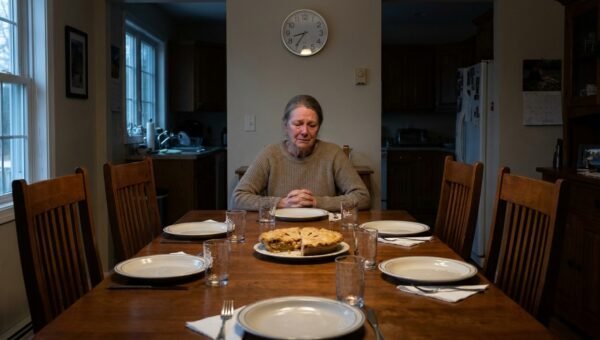
The glass pie plate was still warm on the passenger seat when I pulled into Gary’s gravel driveway at eight in the morning. I had spent three hours the night before baking Meyer lemon bars, the exact kind my mother used to make every June before the ovarian cancer took her four years ago.
Gary married my mother when I was fifteen. My biological father had walked out when I was seven, leaving behind three unpaid utility bills and an empty checking account.
For years, it had just been Mom and me against the world. When Gary came along, tall and quiet with calloused carpenter hands and paint-stained flannel shirts, I didn’t welcome him with open arms. I was a stubborn, guarded teenager. But Gary never pushed. He just fixed the broken latch on the back screen door. He made sourdough pancakes from scratch every Sunday morning, flipping them onto chipped yellow plates without demanding praise. When I ran track in high school, he stood near the fence at every single meet, rain or shine, holding an umbrella over Mom.
I never called him Dad. Not once in twenty years. Even when I got married at twenty-eight and he paid for the caterer without a word, I introduced him to people as “Gary, my mom’s husband.” Sometimes, late at night or during quiet holiday afternoons, the word sat right behind my teeth, but my pride kept it locked away.
After Mom died, our visits thinned out. We stayed in touch with monthly phone calls that lasted about ten minutes each. He would ask about my garden, and I would ask about his back and the siding on the house. I told myself we were still family. But deep down, I worried that without Mom as the bridge, we were just two polite strangers tethered by an old address.
That was why I drove two hours north on Father’s Day. Tucked inside my purse was an envelope containing a card where I had finally written down what I should have said two decades ago: “Thank you for showing up. You’ve been my dad all along.”
The sun was just breaking through the pine trees when I stepped out of the car. Gary’s truck was parked by the shed, but the front yard was dead quiet. I walked up the flagstone path toward the side porch, holding the lemon bars covered in aluminum foil.
The side casement window next to the kitchen was propped open with an old wooden block to catch the morning air.
I was about to knock on the screen door when I heard Gary’s voice from inside.
He wasn’t alone. Another voice answered, rough and familiar. It was his younger brother, Wayne.
“You don’t owe her a dime, Gary,” Wayne was saying, his voice sharp and impatient. “Not after how she treated you. She kept you at arm’s length for twenty years. She barely visits once a quarter.”
I stopped right on the second step. The aluminum foil crinkled slightly under my thumbs, and I held my breath.
“It’s not about that, Wayne,” Gary answered. His voice sounded older, heavier than I remembered. “Martha wanted this. We agreed on it before she went into hospice.”
“Martha isn’t here anymore,” Wayne snapped. “You’re sixty-eight. The roof needs ten grand, your knees are shot, and you’re sitting on a property worth four hundred thousand dollars that you paid off with your own sweat.
If you sign that quitclaim over to her today like you promised, you’re tying your own hands. Has she even called you yet this morning?”
“She will,” Gary said quietly. “She’s busy with her own life. But she’s Martha’s girl. That makes her mine.”
“She doesn’t think of you as her father,” Wayne said, the words hitting like a slap through the screen. “Look at the legal paperwork. If she finds out what Martha actually set up in that original trust, she’s going to hate you anyway.”
PART 2
The screen door felt ten miles away. I stood on the porch with the pie dish burning into my palms, listening to the two men argue over my mother’s name.
“She doesn’t know about the trust,” Gary said. His voice had dropped to a low, gravelly rasp. “And she doesn’t need to know. I took care of it.”
“You didn’t take care of it, you buried it,” Wayne replied, the sound of a coffee mug hitting the laminate table echoing outside. “Martha left this house to her in the 2012 will. You know it, and I know it. When Martha got sick, you had her sign that amendment putting the title in joint tenancy with right of survivorship so the house became entirely yours when she died. If your stepdaughter ever pulls the county records, she’s going to see you took her mother’s house right out from under her.”
My chest tightened so hard I could barely pull air into my lungs.
The house had belonged to my grandparents. My mother inherited it in 1998, long before Gary ever entered our lives. It was the house where I had measured my height against the pantry doorframe, where Mom had planted the hydrangeas along the driveway, where we had lived when we had nothing else. I had assumed Gary stayed there after Mom passed because of a standard life estate. It had never crossed my mind that the deed had been altered before she died.
“You make it sound like theft,” Gary said, his tone turning hard. “Martha was terrified of the medical bills. You remember what the treatments cost? The chemo wasn’t fully covered. The specialized home care was costing four thousand dollars a month out of pocket. The hospital was already putting liens on people’s properties in town. If the house had stayed in Martha’s name alone, the estate recovery would have taken every single brick to pay off the medical debt after she passed.”
“So you took the debt onto yourself?” Wayne asked, scoffing.
“I took the mortgage,” Gary said. “I took a seventy-five thousand dollar home equity loan in my name to pay off the oncology clinics so Martha could die in her own bed without bill collectors calling the landline every afternoon. The only way the bank would issue that loan was if I was on the deed as sole survivor. I told Martha I would hold the house safe and sign it back to Jenny when the lien was cleared. Well, last month I made the final payment.”
I stood frozen against the cedar siding.
The lemon bars were cooling in my hands. All those years I had convinced myself that Gary was just a practical man who married a woman with a comfortable home. When Mom was sick, I had been living three states away, struggling through a divorce, sending three hundred dollars a month when I could scrape it together and thinking I was carrying a heavy burden. I had never asked how the final hospital bills had been settled. I had never asked how the private nurses had been paid.
“You’re an idiot, Gary,” Wayne muttered. “You spent five years living on instant oatmeal and doing side carpentry jobs with bad knees just to pay off seventy-five grand on a house that isn’t even blood-tied to you. And now you’re going to hand the deed over to a woman who calls you by your first name?”
“Her name is Jenny,” Gary said, his voice rising with a rare, quiet fury. “And she doesn’t call me Gary because she’s cruel. She calls me Gary because she was loyal to a father who didn’t deserve it, and I respected her enough not to force the issue. Now put the pen down on that table and leave the deed alone.”
PART 3
I stepped back from the window, my shoes crunching softly on the gravel. I walked down the two porch steps, took a long breath, and walked heavily back up, making sure my footsteps sounded clearly on the wooden boards.
I knocked on the wooden frame of the screen door.
Inside, the kitchen went dead silent. A chair scraped back across the linoleum. Gary appeared at the door, wearing his faded blue work shirt, his thinning gray hair uncombed. When he saw me through the mesh screen, his face loosened into an expression that looked almost like relief, though his shoulders remained stiff.
“Jenny,” he said, opening the door. “You’re early.”
“Traffic was light on the interstate,” I said, holding out the dish. “I brought the lemon bars. Mom’s recipe.”
Behind him, Wayne sat at the kitchen table, a manila folder open in front of him alongside two coffee mugs. Wayne gave me a tight, uncomfortable nod and closed the folder with one flat palm.
“Morning, Jenny,” Wayne said, standing up and grabbing his truck keys from the counter. “I was just leaving. Gary and I were just… going over some paperwork.”
“You don’t have to run off, Wayne,” I said, stepping into the kitchen. The room smelled of dark roast coffee and old wood polish, exactly as it had when I was sixteen.
“No, I’ve got chores,” Wayne said quickly. He looked at Gary, shook his head once, and walked out the door, letting the screen slam shut behind him.
Gary stood by the counter, his hands awkwardly tucked into his front pockets. He looked at the pie dish on the table, then at me.
“I can put some fresh coffee on,” he offered.
“Gary,” I said. “I heard you through the window.”
The silence that followed was heavy and real. Gary didn’t argue. He didn’t offer a quick excuse or try to spin the truth. He simply lowered his head, his shoulders dropping two inches as if a brace had been knocked out from under him.
“You weren’t supposed to hear that,” he said quietly. He walked over to the kitchen table, pulled out the chair across from Wayne’s empty cup, and sat down. He tapped the manila folder with his rough forefinger. “I didn’t steal your mother’s house, Jenny. I swear to you on her grave, I didn’t.”
“I heard the whole thing,” I said, sitting down across from him. “I heard about the loan. I heard about the oncology bills.”
“Your mom was in pain,” he said, staring at the wood grain between us. “The last three months, she was so worried about you having nothing left. She kept talking about her parents, how hard they worked to build this place. The clinic was threatening legal action over seventy-five thousand dollars in experimental treatments that insurance kicked back. I had good credit from thirty years in the trade. So I told the bank to put it against the house in my name, and I told Martha I would protect it. But the bank required the deed in joint tenancy first.”
He slid the manila folder across the table toward me.
Inside was an official quitclaim deed, freshly drafted and notarized two days prior, transferring the entire four-acre property and the three-bedroom house into my legal name. Attached to the back was a paid-in-full receipt from the county credit union, stamped May 14th.
“I was going to give it to you today,” Gary whispered. “Wayne wanted me to keep it as an asset for an assisted living facility down the road. But this was Martha’s. It belongs to you.”
ENDING
I looked at the deed, then down at the paid-in-full receipt. Seventy-five thousand dollars. For four years, while I had been living in my suburban apartment complaining about gas prices and rent increases, this man had been waking up at five in the morning to do framing work on bad joints just to clear the title on a house he never intended to keep.
I reached into my purse. I pulled out the Father’s Day card, the envelope slightly bent from the drive, and set it on top of the legal papers.
“I brought you this,” I said.
Gary looked down at the envelope. His hands trembled slightly as he picked it up. He used a butter knife from the counter to open the seal, pulled out the card, and read the handwritten lines inside. He didn’t speak for a long time. He just pressed his thumb hard against the paper, his jaw working as he fought to keep his composure.
“You don’t have to say that, Jenny,” he said, his voice cracking. “I just did what any man who loved your mother would have done.”
“No,” I told him, taking the pen Wayne had left on the table. “A husband takes care of his wife. A father protects the child, even when that child is too proud to admit what she has.”
I picked up the quitclaim deed. I didn’t sign it. Instead, I slid the paper back into the folder.
“We’re going to the county courthouse on Monday,” I said, my voice steady. “And we’re putting this deed into a joint trust with both of our names on it. You aren’t leaving this house, and you aren’t going to any assisted living facility alone. This is your home as long as you’re breathing.”
Gary wiped his eyes with the back of his rough sleeve, looking at me with a mixture of disbelief and quiet shock.
“You’re sure about that?” he asked.
“I’m sure,” I said.
I stood up, walked to the cabinet, and pulled down two of Mom’s old chipped yellow plates. I sliced a big square of lemon bar for him and one for myself, set them on the table, and pulled my chair in close.
“Eat your breakfast, Dad,” I said. “We’ve got work to do.”