PART 1
The coffee was fresh out of the drip pot, black and steaming, when Greg flung it straight across the kitchen table.
It caught me across the left cheek, down the side of my neck, and soaked the collar of my linen work blouse. The heat took a second to register as a burn, but when it did, it felt like someone had pressed a hot iron to my skin.
I gasped, knocking my chair back against the sideboard as I stumbled toward the sink.
“Look at me when I am talking to you!” Greg yelled. His voice was hoarse, shaking with a kind of wild, ugly rage I had never heard in twenty-four years of marriage. “Hand over the card or get the hell out of my house!”
I had cold tap water running over my trembling fingers, splashing it against my face, trying to stop the fire eating into my skin. The ceramic mug he had thrown hit the hardwood floor near the pantry and cracked into three pieces, pooling dark liquid around the rug.
The fight had started over eight hundred dollars. His sister, Brenda, was behind on her car note again. For three years, Brenda’s emergencies had been our emergencies. Her skipped insurance payments, her dental work, her past-due rent. Greg had already emptied our joint savings six months earlier to clear her credit line, promising me every dime would be repaid once Brenda settled her divorce. Not a single cent had come back.
Ten minutes before the mug flew, Greg had stood over me while I ate toast, demanding my personal business credit card. I run an independent medical transcription service from our spare bedroom. That card was linked to my operating expenses and software licenses. It was in my name alone.
“Brenda needs five thousand by noon or they repo the sedan,” he had said, tossing an overdue notice onto my plate. “Give me your business card. You can write it off anyway.”
“No,” I told him. My voice had been steady, tired, but firm. “I cannot write off personal loans to your family, Greg. And I am done paying Brenda’s way. We have nothing left in reserve.”
That was all it took. He had snapped.
“You selfish bitch,” he snarled now, standing in the kitchen doorway with his fists clenched. “Everything in this house belongs to both of us. Hand over your stuff or get out.
I mean it, Martha. Get out before I throw the rest of the pot.”
The burn was blistering along my jawline. My shirt was plastered wet against my collarbone. I did not argue. I did not cry. Something hard and completely quiet snapped shut inside my chest.
I walked past him without looking at his eyes. I grabbed my purse from the hall table, took my car keys off the hook, and walked out the front door into the brisk morning air.
I drove six miles to the Memorial Hospital emergency room with the window rolled down, letting the cool wind hit my throbbing face. In the triage bay, the intake nurse took one look at my blistering skin and moved me immediately to a room.
The attending doctor applied silver sulfadiazine cream, dressed the second-degree burn on my neck, and called the social worker. A quiet woman named Karen came in with a clipboard, looked at the blistered line running from my earlobe to my clavicle, and asked, “Was this intentional?”
“My husband threw a mug of coffee at me,” I said.
Karen took clear photographs with a hospital camera. She asked, “Do you want to file a police report, Mrs. Miller?”
“Yes,” I said. “I want an officer here right now.”
Two county deputies arrived forty minutes later. Deputy Hayes took my statement while Deputy Vargas logged the photos from the medical staff. When I finished explaining what happened, I looked at Hayes.
“He told me to get out,” I said. “All my business records, my computer, my mother’s silver, and my clothes are in that house. I need to go back and get them, but I will not go alone.”
“We will escort you,” Deputy Hayes said. “We can provide a civil standby while you secure your essentials.”
By 6:40 that morning, two patrol cruisers followed my sedan back into our suburban subdivision. Greg’s truck was parked in the driveway. The living room blinds were drawn shut.
My hands shook against the steering wheel for three seconds. Then I put the car in park, stepped out, and led the two armed deputies up the front steps of the house I had spent two decades paying for.
PART 2
The front door was unlocked. When Deputy Hayes knocked and announced our presence, Greg walked out of the kitchen holding a roll of paper towels.
The smug, irritable scowl on his face vanished the second he saw two uniform officers standing on either side of me. He stopped dead in the hallway.
“What is this?” Greg asked, his voice suddenly small. “Martha, what did you do?”
“Mrs. Miller is here to retrieve her personal belongings and vital documents,” Deputy Hayes said, keeping his hand resting near his duty belt. “We are here to maintain the peace. Step into the living room, sir, and keep your hands visible.”
“She is exaggerating,” Greg stammered, stepping backward. “It was an accident. The mug slipped out of my hand while we were arguing. We were having breakfast.”
“The hospital documented second-degree burns across her jaw and neck, Mr. Miller,” Deputy Vargas said plainly. “Have a seat on the couch.”
I did not waste a single second. I went straight to the spare bedroom that served as my office. I pulled heavy cardboard bankers boxes from the closet. Into the first box went my laptop, external hard drives, tax folders, client files, and transcription pedals. Without those, my livelihood was dead.
Next, I went into our master bedroom. I pulled three suitcases from under the bed. I packed my clothes, my winter coats, and my work shoes. From the dresser drawer, I took my passport, my birth certificate, and the velvet chest containing my late mother’s sterling silver service and her wedding ring.
While I packed, Greg sat on the living room sofa under the watchful eye of Deputy Hayes. Every few minutes, his voice carried down the hall.
“Martha, be reasonable! You’re making a scene! What are the neighbors going to think?”
I ignored him completely. My cheek burned beneath the sterile white dressing, a steady, pulsing reminder of exactly who I was dealing with.
On my fourth trip down the hallway carrying my desktop tower, I noticed our fireproof home safe sitting wide open beside Greg’s nightstand.
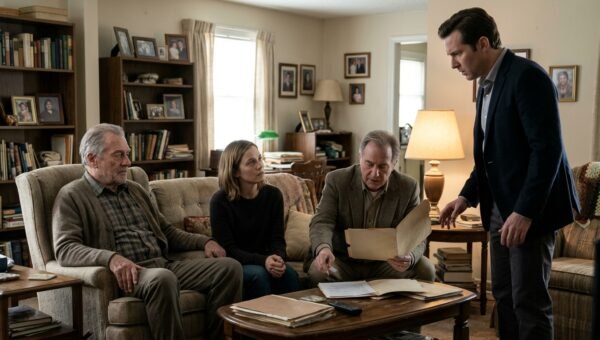
Greg had always handled the home paperwork because he worked in regional logistics and claimed he had better filing systems. But sitting on top of the safe was a thick manila folder labeled in his handwriting: Miller Holdings.
We didn’t own any holdings. We owned this three-bedroom split-level and two aging cars.
I set the computer down on the bed and opened the folder.
Inside was a loan application dated three weeks earlier. It was an equity line request for $48,000 against our paid-off house. Attached to the back was a copy of our house deed and a notarized quitclaim draft.
My name was on the signature line of the application. It was a neat, fluid signature, but it wasn’t mine. It was Greg’s shaky attempt at my handwriting.
Pinned beneath the forgery was a cashier’s check stub from our local credit union for $12,500, made out directly to Brenda’s bankruptcy trustee. And under that was a letter from a collection agency representing an auto lender, demanding the surrender of a luxury crossover registered under Greg’s name.
Not Brenda’s car. Greg’s name was on the title as the primary borrower. Brenda was only the co-signer.
Greg hadn’t just been bailing out his sister. He had secretly financed a $42,000 vehicle under his own credit eight months ago, failed to make the payments when Brenda stopped pitching in, and was now trying to mortgage our home out from under me to keep the bank from seizing his credit score.
My hands went entirely still. The coffee hadn’t been an explosion of sudden temper over a breakfast dispute. It had been the desperate, cornered violence of a man whose financial house of cards was falling down around his ears.
I slid the entire folder into my personal briefcase.
By 7:20, the patrol cruisers were idling in the driveway. The trunk and back seat of my car were completely full with my clothes, work gear, records, and family keepsakes.
I stood by the kitchen island one last time while Deputy Vargas waited by the open front door.
I twisted the gold band off my left ring finger. The skin underneath was pale, marked by twenty-four years of compromise. I set the ring directly on top of the yellow carbon copy of the domestic incident report Deputy Hayes had filled out on the counter.
Greg was sitting on the sofa, head in his hands.
“I’m giving you until Friday to find a lawyer, Greg,” I said quietly.
He looked up, his eyes bloodshot and full of venom. “You walk out that door, you don’t get a nickel from this house. You hear me? It’s my name on the mortgage!”
“The mortgage was paid off four years ago with my father’s life insurance,” I replied. “And you might want to look inside your safe. I have the loan folder.”
His mouth fell open. The anger drained out of his expression, replaced by a gray, hollow panic.
I turned around, walked down the porch steps, and got into my car.
PART 3
I spent the next three days in a quiet extended-stay suite near the interstate. The burns required daily dressing changes, but the physical pain was manageable compared to the work I had to do.
On Thursday morning, I met with Eleanor Vance, a family attorney recommended by the hospital social worker. I laid the manila folder on her desk along with the medical records, the police incident report, and our previous five years of tax returns.
Eleanor read through the forged equity application without changing her expression.
“This isn’t just grounds for an immediate temporary restraining order,” Eleanor said, looking over her reading glasses. “This is felony fraud and financial forgery. Did this loan fund?”
“The bank rejected the equity pull two weeks ago because the county records required my in-person notarization,” I said. “That is why he tried to get my business credit card that morning. The collection agency was threatening legal attachment on Monday.”
“We file for an emergency order of protection today,” Eleanor said. “We also file the petition for dissolution of marriage, freeze all joint assets, and request exclusive possession of the marital residence based on domestic violence.”
The judge signed the protective order that afternoon. Greg was served at his distribution center office on Friday morning. The order gave him two hours, accompanied by a sheriff’s deputy, to remove his personal clothing and tools from the house, after which he was barred from coming within five hundred feet of the property or my workplace.
On Saturday, Brenda called me six times from three different numbers. When I finally answered, her voice was shrill.
“You’re ruining my brother’s life!” she screamed into the receiver. “He was only trying to help me keep my car so I could get to work! You’ve always been cold to this family, Martha! You have no heart!”
“Brenda,” I said, keeping my tone dead level. “Your brother threw a pot of boiling coffee into my face. I have second-degree burns on my neck. If you call my number again, I will hand your phone records to the prosecutor along with the forged bank application he signed for your car.”
She hung up without another word. The phone never rang from her again.
Two weeks later, Greg requested a settlement conference through his attorney. He had been staying in a rented room near the rail yard, his wages were being garnished for the car debt, and the county prosecutor had officially opened an investigation into the assault.
We met in a conference room on the fourth floor of the county courthouse. Greg sat across the oak table in an ill-fitting suit. He wouldn’t look at my face, where the red burn mark was still visible along my jawline, healing slowly under a layer of medicinal ointment.
His attorney, an exhausted-looking public defender turned private counsel, pushed a handwritten proposal across the table.
“Mr. Miller is willing to stipulate to an uncontested divorce,” the attorney said. “He will surrender his equity claim on the marital residence in exchange for Mrs. Miller requesting leniency with the county prosecutor regarding the criminal charges, and an agreement that she absorbs the remaining eight thousand on the joint credit line.”
Eleanor didn’t even pick up the paper.
“No,” Eleanor said. “Here is what happens. Mr. Miller surrenders all legal claim and deed interest to the residence immediately via a clean quitclaim. He assumes sole and total liability for the vehicle repossession deficit and the joint credit balance, which we have proven was used exclusively for his sister’s personal benefit. In return, Mrs. Miller will not pursue civil damages for the battery, though the criminal case remains entirely in the hands of the state.”
Greg leaned forward, his hands flat on the table. For a second, a flash of the old kitchen rage flared in his eyes.
“That house is half mine, Martha! We lived there twenty-four years!”
“You tried to forge my name to steal the equity,” I said, looking him dead in the eyes. “You threw scalding water at my head because I wouldn’t hand you my business card. You gave up your right to that house the second you threw that mug.”
His lawyer tapped him on the forearm, whispering sharply in his ear. Greg slumped back into his chair. The fight went out of him completely.
He picked up the pen and signed the deed transfer.
ENDING
The criminal court sentenced Greg to eighteen months of supervised probation, mandatory anger management, and three hundred hours of community service after he entered a guilty plea to domestic assault. The judge made the restraining order permanent for five years.
I moved back into the house three days after the papers were recorded at the county clerk’s office.
The first thing I did was hire a local contractor to replace the kitchen flooring. I couldn’t bear to look at the stained hardwood near the pantry where the coffee had seeped into the grain. We put down clean, light ceramic tile that caught the morning sun.
I had the locks changed twice. I installed a security camera above the driveway and another over the back patio.
The red mark on my neck took nearly nine months to fade. On cold mornings, the skin still pulls a little tight, a pale patch just below my ear that serves as a quiet reminder of what I endured.
Last Tuesday, my sister drove down from Ohio to spend the weekend. We sat at the small breakfast table near the window, the morning sun warming our hands over ceramic mugs of black tea.
The kitchen was completely still. No shouting. No hidden debts waiting in the mailbox. No demands for money that wasn’t his to spend.
I reached out, set my tea down on the clean tile table, and listened to the steady tick of the wall clock in the hallway. For the first time in twenty-four years, the air in my home belonged entirely to me.