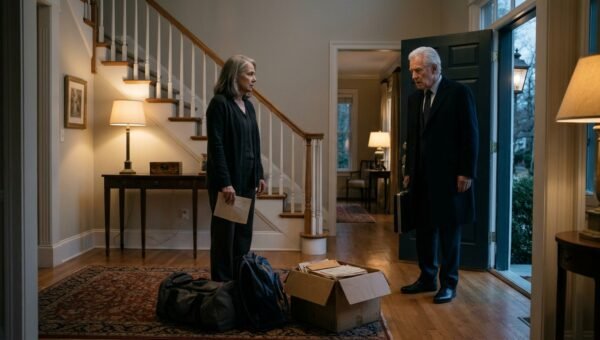
My kitchen table is where Arthur Pendelton set down the papers that made Clara Vance more than the old woman across the street.
He said she’d left me twenty million dollars. I thought I’d heard him wrong. I’d gone over now and then to clean her floors, pick up groceries, and help her find clothes that fit. I figured she wanted to thank me. Then Arthur looked at the papers and said, “You’re…”
He stopped there. I remember the little dry click of his pen. I remember it because I was trying to act normal, and there wasn’t a normal thing to do with twenty million dollars sitting in your kitchen.
“Sorry,” I said. “What am I?”
Arthur asked me to sit down. I was already sitting. Lord, help me, I was so rattled I laughed at that.
He didn’t laugh. He opened his briefcase and took out a locked brass box, old photographs, and a thick folder. He said he could explain, but I had to be willing to look at some family records. I said yes before I knew what I was agreeing to.
That was the first choice I made that day. It wasn’t the last.
Clara moved into the small house across from mine about eight years ago. I don’t know if I ever saw a moving truck. Maybe I did and forgot.
She was already old then, with white hair she pinned up and a careful way of walking, like every step needed to be considered first.
I hardly saw anyone visit her. I never saw a car in her driveway except hers, and she didn’t come outside much. People on our block called her private. I suppose I did too. It was easier than wondering if she was lonely.
The first time she asked me for help, I was carrying in a bag of groceries. She had come to her front door in a gray sweater with one sleeve hanging past her hand.
“Would you mind helping me with the house?” she asked. “I can pay you.”
“You don’t have to pay me,” I said. I was embarrassed later that I said it like I deserved a medal. I didn’t. I had time, and Clara was kind to me.
She shook her head. “I’d rather pay.”
We worked out a small amount for cleaning, but I wouldn’t take money for the errands.
She started asking me to pick up milk, tea, and whatever else she’d written on the back of an envelope. I bought her two sweaters at the thrift store one afternoon. She told me the green one was “a bit much,” then wore it the next time I came over.
We talked while I cleaned. Not about anything huge. She liked old radio shows and complained that people made soup too fancy now. Sometimes she told me a little about growing up, but she’d stop if I asked a question that came too close to family.
Once I said my mother, Ruth, used to tell me about her own mother, who’d left when she was young.
Clara put down her tea. “Families can make a mess of things.”
Then she changed the subject.
I let her. Honestly, I was glad to have someone who didn’t ask me to explain my own family.
My mother and I weren’t estranged, but we had long stretches where we spoke about grocery prices and the weather because anything underneath that was harder.
Last month, Clara passed away peacefully. I found out from a neighbor who’d seen the ambulance. I went to her house afterward, but the door was locked and there was nothing I could do. I felt bad in a plain, useless way. I kept thinking I should have checked on her the night before.
So when Arthur came to my house that afternoon, I assumed this was about her bills or her belongings. I expected to help with a few practical things. I had no idea what he meant by the estate.
“I’m her attorney,” he said. “Ms. Vance asked me to come to you after her death.”
“Why me?”
He glanced at the brass box. “That’s part of what I need to explain.”
I told him I couldn’t take twenty million dollars just because I’d vacuumed her living room. It came out sharper than I meant it to. He didn’t get mad.
“I understand,” he said. “This isn’t a payment for chores.”
That made it worse. I wanted it to be simple. A thank-you. A mistake. Something I could put back in the envelope and hand over.
Arthur opened the folder. He showed me the will, the estate records, and several documents with names and dates I didn’t know. There were accounts, property, and investments. He explained that the estate was real and that the legal steps would take time. I heard most of it, I think. But my eyes kept going to the box.
“Can we open it?” I asked.
“Clara gave me the key with instructions to let you open it yourself.”
He set a small key in my palm. It was warm from his hand, and I rubbed my thumb over the little notch in it. I’d spent years helping Clara with small locked jars and stuck drawers. Somehow I still thought I might be about to find old receipts.
The box opened with a stiff little scrape. Inside were photographs, birth records, legal papers, and a folded letter in Clara’s handwriting.
The first picture showed Clara as a young woman standing beside a girl with a dark bob. I knew the girl’s face. It was my mother’s face, younger than I’d ever seen it.
I touched the edge of the photograph. “That’s Ruth.”
“Yes,” Arthur said.
I looked at the next picture. Clara was holding a toddler. The toddler had my mother’s eyes, and Clara’s hand was wrapped around her like she was afraid she might lose her.
I was trying to do the math, but my head kept circling the same thing. Clara knew my mother. Clara had been in our family. I wanted to ask why she’d never said anything. I also wanted to put the photographs back and pretend I hadn’t seen them.
Arthur waited. He didn’t hurry me, which was kind of him. I had been short with him twice by then, and he still sat there like I wasn’t making his day harder.
The birth records showed Clara’s maiden name, Sterling. There were legal documents tied to her estrangement from my mother, and the dates matched. I read them slowly. I’m not going to pretend I understood every legal phrase. I understood enough to see that Clara and Ruth had stopped being in each other’s lives decades ago.
My mother had told me that her own mother left when she was young. She never told me Clara’s name. I’d never asked. That part is on me too.
“Did my mom know Clara was here?” I asked.
“Clara told me she didn’t believe so,” Arthur said. “She asked me not to make contact before her death.”
I didn’t like hearing that. I wanted to say Clara had no right to watch from across the street and keep quiet. But I had no idea what had happened between her and my mother. I knew what a family argument could do. My own mother could go quiet for a month over something neither of us could remember starting.
Arthur slid the letter toward me. The paper was folded in half, and Clara had written my name on the front. I recognized the handwriting from her grocery lists. I could even see a faint blue smudge near the bottom where her pen had skipped. I don’t know why I remember that.
I read the first part silently. Clara wrote that she had recognized me years ago, when I was a little girl walking beside Ruth. She’d moved into the neighborhood because it was near enough to see us, but not near enough to force her way back into our lives.
I stopped there.
“Why didn’t she tell me?” I said.
Arthur looked down at the papers. “She thought she’d cause more pain than she could repair.”
That answer didn’t make me feel better. It made me think of Clara sitting at her window while I walked to school, then coming over to ask me to buy her a sweater years later. I had been looking at her as a neighbor. She’d known who I was.
The letter continued. Clara wrote that she’d watched me grow up, though she hadn’t followed my life closely or tried to interfere. She said the years passed, and she kept telling herself there would be a right time to speak. Then she became afraid that any reason she gave would sound like an excuse.
She had seen me help other people on the block, she wrote. When she finally asked me for help, she wanted to know whether I’d treat her kindly without knowing her name or her money. I hated that part at first. It sounded like a test.
I read it again. The housework had been real. So had her need for help. But underneath it, she had been trying to answer a question she couldn’t ask out loud.
The letter ended with one sentence Arthur had asked me to read with him there.
He drew a breath. “Clara wanted me to tell you this exactly.”
Then he finished what he’d started at my door.
“You’re my only living grandchild, and the only person who loved me without wanting my money.”
There it was. The answer to why she’d left everything to me. Not because I’d cleaned her house. Because, as far as she knew, I’d seen an old woman who needed help and helped her.
I read the letter again, but I couldn’t take in the words. My hands kept smoothing the same crease. I kept thinking about that green sweater, the one she called a bit much. I’d thought she was teasing me.
I called my mother from the kitchen. She answered on the fifth ring.
“Mom, Clara Vance was your mother.”
There was a long pause. I could hear a television in the background.
“Who told you that?” she asked.
“Her lawyer. She left me a letter.”
My mother didn’t deny it. She said Clara had gone after a terrible fight when Ruth was young. The details came out unevenly. There had been hurt on both sides, and a legal separation that made the break harder to undo. My mother had been a child. By the time she was grown, she’d decided Clara didn’t want her.
“I thought she was gone,” my mother said. “I didn’t know she lived near you.”
I wanted to be mad at my mother for not telling me. I was, a little. But hearing her say she’d thought her mother was gone made my anger feel cheap. I told her I was sorry. She said, “Me too.”
We didn’t fix a lifetime in one phone call. We did stay on the phone for forty minutes. That was more than we’d done in a while.
The next week I went to Clara’s house with Arthur to sort through what needed to be handled. I’d been there dozens of times, but the rooms felt different when I knew she’d watched my family from her window. There were no secret rooms or stacks of strange keepsakes. Just the same table, the same tea tin, and the chair she always sat in.
I looked out the front window. My own house was across the street. I tried to picture Clara seeing me carry groceries, shovel snow, go to work, come home. I couldn’t tell which parts she’d seen. I couldn’t tell how often she’d wanted to come over and didn’t.
On the windowsill was a ceramic teacup. It had a thin brown line around the rim and a tiny chip near the handle. I remembered that cup from her kitchen table. She’d held it in both hands while she told me her soup needed more salt.
I asked Arthur if I could keep it. He said yes.
The estate work took months. Arthur helped me set up the inheritance properly, and I hired a financial adviser who explained what I didn’t understand. I’m not suddenly an expert on money. I still check the bank app twice when a bill goes through.
I also made sure the estate wouldn’t turn Clara into a story people told only because she had money. With Arthur’s help, I set up a community care fund in her name for older people who need rides, groceries, help with small repairs, and somebody to sit with them for a while. Nothing grand. The kinds of things that let a person stay in their own home.
My mother and I started talking more. It’s still careful. Sometimes we run out of things to say. But now there’s a name we can say without either of us changing the subject.
I don’t know if Clara was right to keep quiet. I wish she’d told me. I wish she’d had the chance to tell my mother, too. I’m grateful for what she left, and I’m sad she spent so many years looking at us from across the street.
The teacup is on my windowsill now. In the afternoon, the light lands inside it, right on the little chip near the handle.