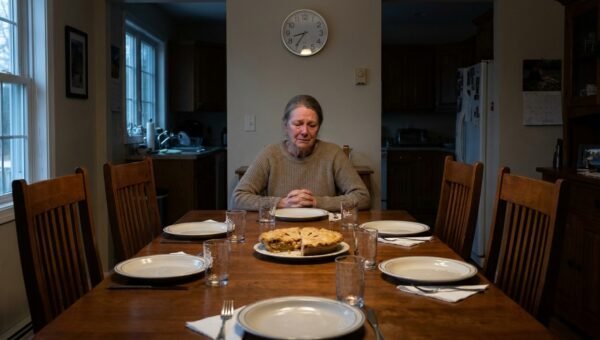
I got the family part wrong. I thought if I kept showing up for Mom, my three brothers would eventually understand what it cost me. At the Sunday dinner where she announced her will, I had a folder under my chair and a roast cooling on the counter. I was still hoping I wouldn’t need to open it.
My father, Earl, had asked me to take care of Mom while he was dying.
He said it plainly, as if he were asking me to pick up his prescription. “Take care of your mother.” I promised. I loved him, and I loved her, so at the time it didn’t feel like a burden. It felt like one thing I could do for him.
After the funeral, I started paying Mom’s rent and groceries. At first it was a few hundred dollars here, a utility bill there. I worked hospital billing, so I was used to looking at a stack of charges and sorting out what couldn’t wait. I told myself I could manage it. My brothers, Alan, Ben, and Cody, said they had their own bills. I didn’t argue. I was the one nearby, and I kept thinking the situation was temporary.
It wasn’t. Over the years, the payments added up to $156,000. I have the spreadsheet still. Rent, groceries, repairs, and those little cash transfers I labeled “Mom” because I assumed I’d remember what each one was for. I did remember. Mostly.
Alan lived a few hours away and called on birthdays. Ben was good at saying he’d help when work settled down. Cody, the youngest, was the one who’d call Mom and make her laugh, then leave me to handle the pharmacy run. Mom liked having them around in that way. She’d say, “Your brothers have a lot going on.” I didn’t say I did too.
The first time I felt resentful, I was standing in the grocery store with a gallon of milk warming against my leg while Mom called to add three things to the list. I remember the register was beeping and the floor had a wet spot by the freezer. I could have told her no. I could have asked the boys to take a turn. Instead I paid, put the milk in the back seat, and drove over.
I’m not proud of that. I wanted to be the reliable one.
I liked hearing that Dad would have been proud of me. It let me feel useful, and it also made it hard to stop.
Then Mom got sick in 2018. The hospital stay, surgery, and rehab came one after another. The bills landed in a pile on her kitchen counter, and there were also notices about the house. She was behind on payments and could lose it. I could cover the medical costs, but not without putting my own future on the line. I told her I wouldn’t borrow against my house or empty my savings on a handshake.
She cried. I felt awful. Then I asked the estate attorney who had handled Dad’s papers to come by and explain the options.
Mom was clear-headed that day. She asked questions. She understood the paperwork. The attorney drew up a promissory note for $200,000 and a deed of trust using Mom’s house as collateral.
It wasn’t a napkin promise. Mom signed the note, the notary witnessed it, and the deed of trust was filed with the county recorder. The amount covered the money I’d advanced and the medical debt I paid, with a little of my own contribution left out. I wanted the house protected, and I wanted some protection too.
Mom squeezed my hand after the papers were signed. “When I’m back on my feet, we’ll sort it out,” she said. I believed her. I also wanted to believe it was only a temporary measure, not the thing that would one day sit between us.
She recovered. I kept helping. The later years were quieter, mostly groceries, bills, and rides. I didn’t send her invoices. I didn’t ask my brothers for repayment. I thought the note was enough to keep everything fair if it ever came to that.
Cody started talking about the will after Mom got stronger. He called me one evening and said it would be best if we all sat down and “got the estate settled.” Mom wasn’t dying. She was fine enough to complain about the rehab food and ask me to bring her a certain kind of tea. But Cody said it was better to be clear now.
I remember the tea because I’d just set it on her counter when he brought it up again. He’d been visiting more, which I thought was a good sign. For a while, I even felt relieved. Maybe he’d finally come around. Maybe the brothers would start taking some of the weight.
Instead, he arranged the dinner and told me Mom planned to explain her will. I brought the roast because I still couldn’t seem to show up empty-handed. I brought the folder because I had started to understand that being quiet had not made anybody more generous.
Mom sat at the head of the table. Alan and Ben were there, too. Cody sat near her, close enough to look like he was in charge of the conversation. The house smelled like the pepper I’d put on the roast. I noticed because I’d forgotten to eat lunch.
Mom said she wanted everything divided equally. The house, the savings, whatever was left. Four shares, 25% each.
I asked if she was counting the money I’d put into her care. She said the house belonged to all of us in a way, and that my brothers were her children too. Then she said, “But your brothers are family too.”
I said I’d spent $200,000 taking care of her. Cody gave a small smirk and said, “Fair is fair.”
That was when I stood up and pulled out the folder.
I didn’t throw it. I set it on the table, harder than I meant to. There were canceled checks, bank transfers, itemized medical receipts, and my spreadsheet. On top was the promissory note. I opened the cover so they could see the notary stamp and the county recorder’s filing mark.
Mom looked at the note, then at me. “Where did you get that?”
“You signed it after your surgery,” I said. “You promised to pay me back.”
Cody reached for the paper. I slid it back toward myself. He said it was probably just something Mom had signed while she was sick, that nobody could take a house over a piece of paper. He kept talking until he saw the county stamp. Then his voice changed.
The note was valid. The attorney who prepared it confirmed that Mom had been clear, understood what she was signing, and had asked for the house to secure the debt. The deed of trust was recorded against the title. No one had to take my word for it. It was there in the county record.
Cody said I’d set Mom up. I was mad enough to answer too fast. I told him he hadn’t been in that hospital room, hadn’t paid the bills, and hadn’t been there when the house was at risk. That was true, but I also knew I’d been waiting years to say it in front of all of them.
Mom started crying and asked how I could treat my own mother like a debtor. I looked at the stack of papers between us. I said I hadn’t treated her like a debtor when I paid for groceries or drove her to rehab. I’d treated her like my mother. The note was what we agreed to when she asked me to put my own money at risk.
She said, “Family comes first.”
I didn’t answer right away. That line had worked on me for years. I’d heard it when she needed rent, when she needed a ride, when my brothers couldn’t help. I’d used it on myself, too, like it meant I wasn’t allowed to have a limit.
Alan picked up the ledger and turned a few pages. Ben asked Cody if he knew about the note. Cody said he didn’t, then said it didn’t matter because Mom could still change her will. Alan asked why Cody had been pushing for a meeting if he thought the house had no debt. They started arguing with each other. Mom was still crying, but she wasn’t asking me to fix it anymore.
The attorney explained the numbers to all of us the next morning. The estate had little net equity beyond the $200,000 secured by the house. If the house was sold or the estate settled, the debt had to be paid first. The lien stayed on the title. There wouldn’t be four equal checks waiting for my brothers. They would get nothing from the house until the note was satisfied, and there might be nothing left for them after that.
Cody said I was betraying the family. I told him I wasn’t taking anything he’d earned. I was enforcing the agreement Mom had made with me. I also told them I would no longer be Mom’s unpaid caretaker and personal bank. If she needed help, the four of us could make a plan. I would not be the automatic answer anymore.
Mom asked me to stay after the others left. She said she hadn’t meant for me to feel used. Then she said she’d hoped the boys would come around if she gave them the same share. She wanted them to visit. She wanted them to like her. I understood that. I did. But she’d tried to buy their attention with the part of my life I had spent keeping her house afloat.
I told her I loved her, but I wasn’t apologizing for having a written agreement. She looked down at her hands. She didn’t say the note was unfair again.
The next week, I checked the county filing myself. The deed of trust was still attached to the property record, exactly where the attorney said it would be. I printed the page and put it in the folder. I didn’t want another family meeting where somebody could pretend the paper had vanished.
I went back to Mom’s house one last time to pick up my copy of the records. I carried the thick folder out to my car and sat with it on my lap for a minute. Through the windshield, I could see the kitchen window where I’d left grocery bags so many times I stopped counting.
I closed the folder, turned the key, and drove away without looking in the rearview mirror.