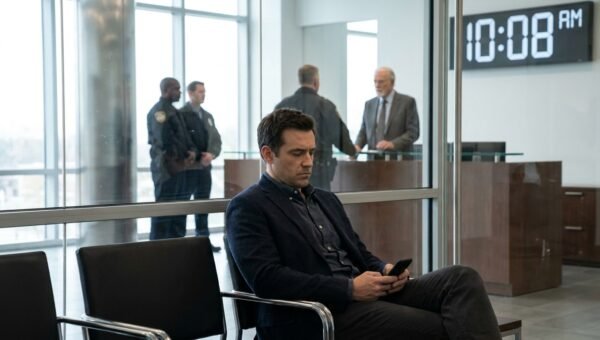
The first thing I noticed was the soft slap of leather on the control room floor. The machinery was shaking the coffee in my mug, but Julian Vance Jr.’s loafers made almost no sound. Italian, no socks. I remember that because I’d spent twenty-seven years telling people what was safe to wear on that floor.
He was thirty-two, the new CEO, and he came in with a folder tucked under one arm like we were a group project he could fix before lunch.
“Where’s the old equipment list?” he asked.
I pointed to the binder beside my station. I was still holding my coffee.
I’m Earl. I’d been at the plant long enough that people stopped asking how I knew which valve was running hot. I knew because I checked them. I kept the pressure records, certified the safety valves, and sent the state the reports our maintenance budget never quite covered. Some years the budget was short by a little. Some years it was short by a lot.
The old CEO, Julian’s father, gave me authority to sign off on that work. He didn’t call it a favor. He knew the plant needed a qualified person whose name and certification were on every required filing. I had my own professional license, and the plant’s operating permit listed me as the responsible operator. That detail was never on a chart in the corporate office.
It should’ve been.
The plant was legal because I kept it legal. I don’t say that to brag. I say it because there was a difference between a machine running and a machine being safe to run.
The difference was in the records, the inspections, and whether those pressure relief valves would open when they were supposed to.
Julian looked at the binder, then at me.
“We’re cutting the fat,” he said.
He told us he’d studied the numbers, reviewed productivity, and found places where we could move faster. He used “streamline” a few times. I remember thinking that a person could say streamline while standing beside a pipe that had been vibrating hard enough to rattle a wrench off a cart.
I should’ve asked him whether he knew what the valve report was. I didn’t. I thought I could show him the records and let the facts do their work.
That was my first mistake.
I opened the binder and showed him the current pressure readings, the inspection dates, and the list of valves waiting on replacement parts. The plant was old, but old didn’t mean reckless.
I’d spent years getting the most important work done first. One valve had been checked twice in a month because the reading wandered. Another was scheduled for a pressure test before the next production run.
He glanced at the sheets without sitting down.
“These look like duplicates,” he said.
“They’re not,” I told him. “One’s the inspection record. One’s the test certification.”
He smiled like I’d said something cute.
Bless his heart, I thought. Then I was mad at myself for thinking it. Julian hadn’t built the habits that kept that place safe, but I also hadn’t made a point of telling him how much of the place depended on my signature. I’d been proud of being the person who could fix things quietly. Quiet work has a way of disappearing.
I reached for the valve report. It was the one with the current certification and the overdue repair notes in the same packet.
If it went missing, the state would see an incomplete record, not a clever cost-saving move.
Julian took it from me.
I said, “That’s an active compliance report.”
He looked at the shredder by the copier, fed the pages into it, and watched them curl down through the slot. Then he patted my shoulder.
“Evolve or go extinct.”
The floor kept trembling under my boots. The shredding noise stopped. I could see the thin paper strips in the bin, mixed up with a coffee sleeve and a jammed staple.
He’d just destroyed the document that showed what had been checked, what still needed repair, and whose certification covered the work. It was a careless act, not some big plan. That didn’t make it less serious. In a plant, a careless act can do the same harm as a bad one.
I stepped away from him.
I didn’t yell. I didn’t tell him his father had trusted me more than him. I didn’t even bring up the twenty-seven years. I went back to my station and looked at the portal where I filed my operating commission. My hand shook once when I clicked the resignation box. Just once. I had the backup logs on an encrypted drive because I’d learned years ago not to trust one copy of anything important.
Then I called Marcus Cole at the state environmental and industrial safety office.
Marcus had inspected our plant for years. He knew my record. He also knew I didn’t call him to settle a workplace argument.
“Earl, is the plant running right now?” he asked.
“Yes.”
“Do you still stand behind the certification?”
“No.”
I heard him set something down on his end.
“Send me the records. Don’t change a thing.”
That was the point where I understood I was burning the bridge back to my job. The logs belonged to the company, but I had a legal duty to preserve them and a duty to tell the state when I couldn’t certify the operation. I sent the backed-up files through the board’s secure channel. I included the report numbers and the date Julian destroyed the paper copy.
I didn’t include a note about his shoes.
The control room went quiet in a way that felt odd, though the equipment never stopped. One of the shift leads, Darnell, came over and asked whether the line was going to stop.
“I don’t know yet,” I said.
He looked at the screen, then at me. “Can we run?”
“Not on my certification.”
That got around faster than I expected. The crew had seen me deal with breakdowns, missed shipments, and managers who wanted a restart before the checks were done. Most of them knew I wasn’t the one to ask if they wanted a comforting answer.
Julian was still in the building. He came back to the control room and asked why people were standing around.
“They’re waiting for direction,” I said.
“Then direct them.”
“I resigned my commission.”
He laughed first. Not a big laugh. More like he thought I was trying to make a point.
“You can’t just walk away from your responsibilities.”
“I didn’t walk away. I filed the resignation and reported the condition.”
His face changed then, not into fear exactly. He looked annoyed that a thing he’d treated like paperwork was now making demands on him.
He asked me to withdraw it. I told him I couldn’t. My name was on the permit. My certification was on the filings. I wasn’t going to put it back just because he disliked the result.
The next day, Marcus arrived with two state inspectors and an emergency inspection order. They went through the records at the control room station, then compared my copies with the filings in the state database. The current certifications were missing. The report Julian had shredded was one of the documents the plant needed to show the required checks had been completed.
The equipment didn’t have to explode for the state to stop it. They didn’t have a valid basis to let it keep running.
Marcus said, “Production stops until the records and the pressure systems are brought into compliance.”
Julian stood across from me, hands pressed flat on the console.
“You’re shutting down a whole plant over a report?” he said.
Marcus didn’t raise his voice. “I’m shutting it down because the plant can’t prove it’s safe to operate.”
That was the end of production. Not the end of the company, not the end of the workers’ jobs, but the end of pretending that a missing report was just a filing problem. The state put the shutdown in writing. The inspectors tagged the operating lines and ordered a full review of the pressure systems.
I wish I could say I felt good about it. I didn’t. Darnell and the crew had families. The people who’d been doing their jobs right were the ones sent home first. I knew that. I also knew that if one of those valves failed, the same workers would be standing closest to it.
There was no clean choice left.
By then, Julian had started asking for files. He wanted the maintenance folders, the valve logs, the training records, and the old inspection notes. I showed him the folders we kept in the control room. Some were current. Some went back years. The copies I’d sent to the state matched them.
He opened the central terminal and tried to pull up the report he’d shredded.
The filing history showed the missing document. The state portal showed my resignation. There was no version he could restore by clicking around.
He looked at me. “Why didn’t you tell me it was this important?”
I nearly laughed, but I didn’t. I’d shown him the binder. I’d told him what the report was. And yes, I should’ve made sure the new CEO understood what my job covered before I assumed he’d ask. That part was on me.
“You didn’t ask,” I said.
His father had treated the commission as a real responsibility. Julian had treated it like one more line in a spreadsheet. That was the trouble. He wasn’t a monster. He was a young executive used to making decisions from summaries, and I was a man who’d let the important parts stay invisible because I liked being needed.
I had to own both things.
The board’s senior directors arrived that afternoon. They came in from the parent company and met with Marcus in the control room because the state wasn’t going to wait for a boardroom schedule. They reviewed the records, the order, and the financial exposure. The internal audit put the likely fines and required repairs into the millions. Insurance could be affected too. Nobody in that room had a way to wave it off.
Julian tried to explain that he was new and had been told the reports were duplicative. Marcus pointed to the shredded report entry and the matching record in the state system.
“You had the report in your hand,” he said.
Julian had no answer for that.
The board took his operating authority away before the meeting ended. They kept him on as an unpaid junior observer while they reviewed his first-day decisions. It wasn’t a dramatic firing in front of the crew. It was a signed order, a change in the chain of command, and Julian being told not to direct plant operations.
Then the board asked me to help write the emergency compliance plan.
I said I’d do it under conditions. I wanted independent oversight, direct reporting to the directors who weren’t running the day-to-day business, a real safety budget, and written authority to stop production when a system failed inspection. I wanted the required repairs funded before anyone asked about the lost output.
One director asked if I’d come back as an employee.
“No,” I said. “Not under the old setup.”
They agreed to a direct advisory contract with expanded oversight authority. The plant still had to satisfy the state’s repair orders and pay the fines. Nothing I signed could undo what happened. But we had a path to reopening that didn’t depend on someone pretending the paperwork was optional.
Julian packed his things while we waited for the revised work order. He put his laptop in a case and set the loafers in a cardboard box. I don’t know why that part stuck with me. Maybe because they were the first thing I’d noticed, and by then they were the least important thing in the room.
He didn’t say goodbye. He didn’t need to.
The control room door clicked shut behind him.
Later, after the repairs were underway and the state cleared each system in order, I stood at the console while the monitored machinery came back on. The floor gave its familiar small shake. My hand rested beside the logbook, not on it.
This time, the safety budget had its own line.
The machines hummed, and I could hear every one of them.