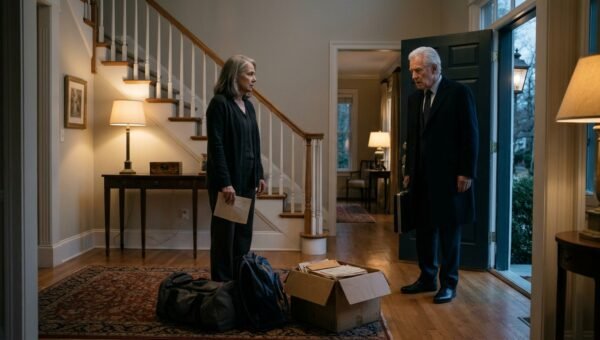
I had just lowered the morning paper when Henry asked me for a raise. His hands were folded in front of him, but his right thumb kept rubbing the side of his left one. I’d seen that little movement before, usually when he was waiting for me to criticize something. I expected a list of complaints about the roofers or the new cook. I didn’t expect him to look so nervous.
“Lady Eleanor, may I ask for a raise?”
I folded the newspaper. “A raise? And what possible reason could you have?”
“Well, ma’am, I have three very good reasons.”
I made him wait a moment. That was my first bad choice, though at the time I thought I was just being myself. I’d spent most of my life treating a pause as a way to remind people who was in charge. Henry didn’t fidget, didn’t look away. He’d been in my service nearly 37 years. I was 89, rich enough not to know the price of eggs, and still surprised when someone asked me to change.
“Fine,” I said. “Let’s hear them.”
Henry had never asked for a raise. He had never taken a vacation, either, not once in all those years. I knew that because I kept the household books, and I knew he was proud of doing things properly.
I also knew he’d once told me he had no need for time off. I had accepted that answer because it let me keep the house running just the way I liked it.
His first reason was his eyesight.
“I’ve been having trouble reading the small print,” he said. “It’s worse in the evenings.”
I looked at him. “You’ve been reading the household accounts for me.”
“Yes, ma’am.”
“And you didn’t think to mention it?”
“I thought I could manage.”
“That isn’t the same thing.”
“No, ma’am.”
He said it gently, which annoyed me more than a sharp answer would have. The morning light was coming through the tall window, and I could see a faint crease between his brows. I’d noticed him holding papers closer lately. I had told myself it was his way of checking the figures. I had not asked.
“Have you seen a doctor?” I said.
“Not yet. It seemed a foolish expense before I knew what was wrong.”
“Your eyes are not a foolish expense.”
He lowered his chin. “I didn’t want to trouble you.”
There it was. That phrase. I’d heard it so often from Henry that it had become part of the house, like the clock in the hall. I had let him smooth away every rough edge before it reached me, then congratulated myself on how calm my life was. I suppose I called that independence.
I told him to make an appointment. He said he would. I knew the difference between a promise and a polite way to end a conversation, so I asked him to tell me the date when he had it. He agreed.
Then he gave me his second reason.
“My sister’s widowed,” he said. “She’s been living out past the village for years. The bus doesn’t come often, and she’s not as steady as she was.”
I had met his sister once, a long time ago. Her name was Agnes.
She’d brought Henry a tin of shortbread at Christmas, and he’d put it in the pantry with a note that said it was for the staff. I remembered because I’d eaten one before lunch and it tasted faintly of orange peel. I never asked what happened to the rest of the tin.
“What does your sister need from you?” I asked.
“I told her years ago I’d help her move closer to town, if she ever wanted to. She wants to now. She can manage the rent, but she needs help with the move and a bit of money to get settled.”
“And you’ve waited all these years to keep that promise?”
“I thought I’d do it when I had more saved.”
“That’s a very useful phrase, Henry. ‘When I have more saved.’ It can keep a person waiting until he’s dead.”
His mouth moved as if he might smile, but he didn’t. “I know.”
I heard my own voice and disliked it. I had been trying to make him feel small enough to stop asking. That was my old trick. Say something clever, then make the other person do the work of pretending it didn’t hurt.
I reached for the tea he’d placed beside the paper. Henry always turned the spoon handle toward my right hand, even though my right hand had started to stiffen. He’d done it for years. I’d never thanked him for that, either. I took a sip and found the tea was already too cool.
“Your third reason,” I said.
Henry took a breath. He looked toward the door, then back at me. I thought he might say he was leaving. The idea irritated me before I could stop it. There are things one can be ashamed of and still feel.
“I want somewhere of my own,” he said. “A small place. A cottage, if I can manage it.”
“You don’t have a place of your own?”
He didn’t answer right away. I could hear the clock in the hall ticking through the open door.
“My room is here,” he said finally. “But it belongs to the house.”
I knew that. Of course I knew that. His room had been assigned to him when he started working for me. It was neat, comfortable, and close to the back stairs. I had never thought of it as anything but his room. I had not thought about what it meant that it was not his.
“I’ve put away what I could,” he said. “But I can’t keep working forever. I’d like a little place before I’m too old to do anything about it.”
“How old are you?”
“Sixty-eight.”
I felt foolish. I had never needed his age before. He was simply Henry, always where he was needed, always able to lift the tray and remember which visitor couldn’t eat butter. The day had carried on around him as if his body were part of the household machinery.
He looked at my folded paper. Then he said, “I have nowhere to go when I put the tray down.”
That was the line that stayed with me. He didn’t make it a speech. He said it as plainly as if he were telling me the pantry had run low on flour.
I had plenty of money. I had more than I could spend if I lived another hundred years. Henry had given me nearly 37 years of his own life, and I had somehow made his silence sound like proof that he needed nothing.
I asked him to leave the newspaper with me and return after lunch. He looked uncertain.
“Am I in trouble?” he asked.
“No.”
“Are you angry?”
“I’m considering how much trouble I’m in.”
That got a small, real smile from him. “I see.”
“No, you don’t. Go on, Henry.”
He went. I sat with the newspaper folded in front of me and did not read another word.
I went to the estate office and asked for the latest accounts. I knew where they were kept. I had checked the household figures every month for decades, partly because I liked knowing what things cost and partly because it gave me something to do that had an answer at the end. Henry’s wages had gone up over the years, but only when I’d adjusted the whole staff’s pay. I’d never sat down and asked what his work was worth to him.
I found the old entries. One year after another. His name, his wages, the occasional note for a repaired coat or a pair of shoes. No holiday pay. No request for time off. No note about his eyes. There was no line for the promise to Agnes. No line for the years he had spent living in a room that was mine.
I tried to remember the last time I had asked him what he wanted. I couldn’t. I remembered asking whether the house was ready for a visitor, whether the cook had ordered enough, whether the accounts balanced. I remembered his answer to every one of those questions. I didn’t remember asking anything that belonged to him.
My first instinct was to say he should have spoken sooner. I even said it aloud to the empty room.
“He should have spoken sooner.”
Then I saw what an easy answer that was. He had spent years learning that I liked things quiet, neat, and dealt with before they reached my desk. I had praised him for anticipating every need. I had not noticed that he’d learned to hide his own.
Three weeks later, his eye appointment was done. I won’t pretend I was calm while I waited for him to tell me what the doctor said. I sent for him twice and then felt ridiculous, so I went to find him myself. He had a mild condition that needed treatment and regular checks. It wasn’t a crisis, but it was not something to ignore. I arranged the cost through the estate, and he thanked me as if I’d given him a favor instead of paid a bill that should never have been his to carry alone.
Agnes found a place closer to town. Henry helped her move, and I paid the moving costs from the estate account. He tried to object.
“I can cover some of it,” he said.
“You can cover it by not arguing with me.”
“That’s a difficult instruction.”
“I know. I’ve practiced.”
He gave a quiet laugh. That sound made me realize how little I heard him laugh. It wasn’t because he had no sense of humor. I had simply built a house where he was expected to be useful before he was allowed to be comfortable.
The larger matter was the cottage. I had several small cottages on the grounds. One had been empty for years and needed repairs. I’d thought of it as a maintenance problem. Henry thought of it as a place he might someday be permitted to ask for.
When he came back to my study that afternoon, I had the account book open and a fresh sheet of paper beside it. He sat opposite me. I noticed he kept his hands on his knees, as if he didn’t want to touch anything that belonged to me.
“I’ve reviewed the figures,” I said.
“I’m sorry you had to.”
“Don’t apologize for making me read my own books.”
He nodded.
“I’m raising your salary,” I said. “And correcting it for the past ten years.”
He blinked. “That’s not what I asked for.”
“I know. I’m not finished.”
He began to say something, but I held up my hand. “You’ll have a pension written into the estate plan. The cottage will be repaired, and it will be yours to live in when you’re ready. Not a room I’ve assigned you. A home you can stay in.”
His hands came together. He stared at the paper.
“I can’t accept all that.”
“Of course you can.”
“It’s too much.”
“Henry, you’ve spent 37 years taking care of everything I didn’t want to think about. You can stop pretending that a place to live is an unreasonable request.”
“I didn’t want to leave you alone.”
I had no quick answer for that. I could have made a joke. I could have said I had managed alone before him. Both would have been lies.
“I don’t want you to leave,” I said. “But I don’t get to keep you here by making sure you have nowhere else to go.”
He looked down at the ledger. For the first time since I’d known him, he seemed unable to find the right polite response. His mouth tightened. He rubbed his thumb along his other hand again.
“I thought you’d be angry,” he said.
“I was, for about a minute.”
“At me?”
“At myself. It’s much less satisfying.”
He let out a breath. “I’m not asking to stop working.”
“Good. I still need someone to tell me when the cook has over-salted the soup.”
“You tell her yourself.”
“I do. I simply enjoy being right twice.”
That time he laughed. Then he picked up the paper and read the figures. We went through the salary, the pension clause, and the cost of repairing the cottage. I had the estate solicitor put the agreement in writing. Henry read every line before he signed. I respected him for that. He had finally asked, and he wasn’t going to let me turn the answer into a vague promise.
Afterward, I poured his tea. I didn’t ask him to carry the tray. I slid the newly revised ledger across the mahogany table between us, and for once I let him decide where to put his hands.
I smiled, actually smiled, as I poured Henry’s tea. The spoon handle pointed toward my right hand, and the ledger lay open between us.