I thought my daughter’s birthday dinner meant I still had a place in her life.
I turned 68 last October. My daughter, Nina, picked an expensive restaurant near the river in our little Hudson Valley city and said she wanted to make a night of it. Her husband, Paul, called to ask if I had a dress I liked. I took that as sweet. Maybe it was. At the time, I was glad they had made the effort.
I spent 31 years doing payroll for the county, so I notice bills and numbers whether I mean to or not. That restaurant’s menu had a glass of wine priced higher than my first car payment. Nina laughed when I checked. “Mom, it’s your birthday.”
Paul ordered a bottle of red. He said it was a good year, though I can’t tell one year from another when it comes to wine. Nina kept asking if I was comfortable, if I wanted more bread, if I was having a nice time. She was being attentive in a way that made me feel a little awkward, but I didn’t want to be ungrateful.
My late husband, Ed, used to say I could turn a nice evening into a bookkeeping exercise. He wasn’t wrong. Still, I let Nina fuss over me. I remember the tiny crack in the bread plate because I turned it around so the crack faced the wall. That’s the sort of thing my mind saves.
I had been a widow for six years. Nina was my only child, and for a while after Ed died she came by every Sunday with groceries. She’d bring me a coffee from the corner place, always too much milk, and sit at my kitchen table while I told her the same stories about work. We got less close over time. Jobs, a house, the ordinary pull of life. I told myself that was fine.
Paul and Nina had been in a tight spot for a while. They never said how tight. I knew their mortgage had gone up, and Paul had lost a big account at his small contracting business. Nina asked me for $8,200 in May, supposedly to cover a tax bill. I gave it to her. She said she would pay me back, and I didn’t ask when. I wanted to be the kind of mother who helped without keeping score.
That night, once the wine came, Nina lifted her glass. “To Mom,” she said. Paul smiled at me. We touched glasses. Mine made a thin little sound against his.
Then Nina looked at her phone and said she had to make a call. Paul stood up too. “We’ll be right back,” he said.
I was alone at the table for a minute or two. I looked at the candle and thought about how lucky I was to have them there. I know how that sounds now. I wasn’t thinking about anything darker than whether I’d remembered to put the garage light on at home.
A waiter came toward me carrying my crystal glass.
His name tag said Leo. He couldn’t have been more than 22. His hand shook enough that the wine moved against the side of the glass. He set it down, then leaned in without looking me in the eye.
“Ma’am, please don’t drink what’s in that glass.”
My brain didn’t catch up at first. I looked at the wine. Then at him.
“What do you mean?”
“I switched it. This one’s clean.” He spoke very quietly. “Please trust me. Don’t touch the other one.”
He had left the original glass in the manager’s office. I didn’t know that yet. I only knew his hand was still shaking and I could hear Nina laughing somewhere behind me.
I didn’t call out. I didn’t stand up. I thought if I made one sudden move, my daughter might see something in my face. So I asked Leo for water like nothing had happened, and I sat there with my hand folded in my lap.
When Nina and Paul came back, their smiles were different. They were still smiling, technically. But both of them looked at my glass before they looked at me. Nina sat down quickly. Paul asked if I’d tried the wine.
I lifted the replacement glass. My fingers felt clumsy around the stem. I took the smallest sip I could manage. It tasted like wine. I put it down.
“Good?” Nina asked.
“Very good,” I said.
She looked at Paul. It was quick, but I saw it. He nodded once. Then Nina picked up her own glass and drank.
I kept thinking that maybe Leo had misunderstood something. Maybe I’d misheard him. I wanted that to be true so badly that I started making excuses for everybody, which is embarrassing to admit. I kept my voice level and asked Nina about work. She answered too fast. Paul barely ate.
At one point Nina reached across the table and touched my hand. Her nails were painted a soft pink. I had taken her to get her first manicure when she was 15, and she’d spent the whole ride home holding her fingers up so she wouldn’t smudge them. I looked down at that hand on mine and felt sick, though I couldn’t have said why yet.
I finished the dinner without touching the original glass. I told them I was tired and wanted to go home. Nina offered to drive me. I said I’d already called a car. That was a lie. I needed a reason to leave alone.
Leo found me near the front desk. The manager, a broad man named Frank, stood beside him. Frank told me the original glass was secured in his office and that Leo had told him what he saw. I asked if there were cameras. He said there were cameras over the dining room.
“Don’t let anyone move that glass,” I said.
“We won’t,” Frank told me.
I wrote down his number with a pen that kept skipping. Leo gave me his own number too. He looked scared, and I hated that I was putting him in the middle of my family. I thanked him. That was all I could get out.
I got home and locked both doors. I didn’t sleep. At 2:14 in the morning, I called the non-emergency police number, then called it again because I hadn’t explained the first time well. An officer came by before 4. I told him the whole thing, including the money I had given Nina, and he wrote it all down.
The next day, the restaurant manager handed the glass over to the police. I didn’t touch it. The police got the video and spoke with Leo. I was told to stay away from Nina and Paul while they checked what happened. They also asked me not to warn them.
That part was hard. Nina called at lunchtime. I watched her name light up my phone and let it ring out. Then she texted, “You okay, Mom? You seemed tired.” I sat at my kitchen table with that message in front of me for so long the screen went dark.
I didn’t answer.
Over the next few days, I had a medical test and met with a lawyer. I had no idea what to do about my will or my insurance policy, so I brought every folder I had to her office. The policy had a death benefit of $410,000. Nina and Paul were listed as the main beneficiaries. My estate was set to go to Nina, too.
I didn’t know they knew those numbers. The police found out they did.
A week after the dinner, the detective told me Leo had heard them talking in a hallway near the restrooms before the dinner. He’d heard my name and enough about the plan to know someone was in danger. He’d recognized me when I arrived with Nina and Paul. I asked why he hadn’t gone straight to the police.
“He said he was afraid they’d do it before anyone could stop them,” the detective told me.
There was more. The security footage showed Paul and Nina at the table while I was in the restroom. The video was grainy, but the detective said it showed one of them slipping a small vial into my glass while the other watched the room. They were passing it off as a toast.
I asked which one.
The detective said he couldn’t tell me yet.
That night, I sat at my kitchen table and tried to remember every time Nina had asked me about my health. I remembered her telling me I looked tired. I remembered Paul suggesting I get a checkup because I was “getting older.” I remembered the extra calls, the offers to drive me places. Maybe some of that had been real. Maybe that’s why this still hurts in a way I can’t sort out. The good memories didn’t disappear just because I learned what they were capable of.
The lab report came back ten days later. The glass held a sedative and a toxic compound that could cause a fatal heart event and look like a medical emergency. The substance was tasteless. The detective told me the plan seemed to be to make my death look like my health had failed. I had no heart condition, but they were counting on people not asking too many questions.
The detective also told me why. The house was close to foreclosure. Paul had overdue loans, and Nina had told someone they needed money before the end of the year. They had found out they were the main beneficiaries of my policy and my estate.
I didn’t cry when he told me. I sat there, in my own kitchen, and asked him to repeat the amount on the policy. He did. I wrote it down, though it was already on the page in front of me.
Then I said, “They could’ve asked me.”
The detective didn’t try to explain my daughter to me. There wasn’t anything to say.
The police investigation moved forward. Frank gave a statement. Leo gave his. The video and lab results backed them up. Nina and Paul were arrested and charged. I signed papers for the prosecution and gave another statement. I spent a lot of time in rooms with people asking me to remember what I had seen, what I had heard, what I had done with my hands. I answered the best I could.
The hardest part was deciding what to do about the estate. My lawyer said I didn’t have to make that decision in a hurry. I told her I did. I revoked the policy beneficiaries and changed my will. Nina would not inherit from me. I also asked my lawyer to file for protective orders. The temporary orders were granted while the criminal case went forward.
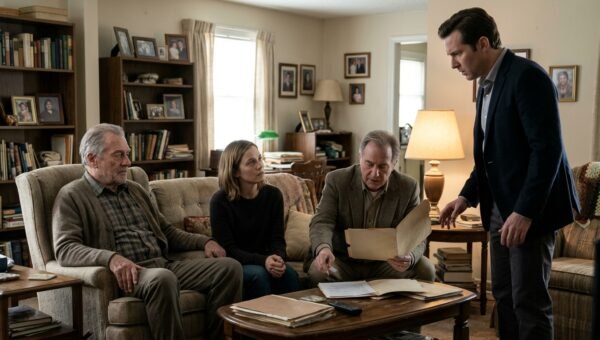
I knew there was one conversation I couldn’t avoid. My lawyer wanted me to let the police handle all contact, but I asked if I could invite Nina and Paul to my house with the detective nearby. I wanted them to see my face when I told them I knew. Maybe that was selfish. I wasn’t doing it for closure. I wanted to stop hearing their voices in my head telling me I’d misunderstood.
I called Nina and said I needed to talk about my estate planning. She agreed to come. Paul came with her.
I put the lab report and the restaurant evidence on the table before they sat down. The police had approved the meeting and stayed close by, outside the house. My lawyer had told me not to argue about anything. I was supposed to say what I needed to say and end it.
Nina looked at the papers. For a second, she seemed confused. Then she saw the report.
“Mom, what is this?”
“It’s from the glass at my birthday dinner.”
Paul moved to take the report. I put my hand on it.
“Don’t.”
He pulled his hand back. Nina’s smile appeared, thin and familiar. She used to smile like that when she was trying to get out of being grounded.
“You can’t believe that,” she said.
“I know what’s in the glass.”
“We didn’t put anything in your drink.”
“The video shows you.”
“It doesn’t show what you think it shows,” Paul said.
I looked at him. “Leo heard you talking about me before dinner.”
Nina pressed her lips together. Paul looked at the front window. They knew the police were there. For once, there was nowhere to redirect the conversation.
Nina started crying. She said they were desperate. She said they’d been scared about losing the house. She said they hadn’t thought it would go this far.
I remember thinking, you don’t accidentally put poison in your mother’s wine. I didn’t say it. I didn’t need to.
“You wanted my money,” I said.
“We needed help,” she answered.
“You had my number.”
“We thought you’d say no.”
That was the thing she said that I keep hearing. Not because it explained anything. Because it didn’t.
“I would’ve helped you,” I said. “But I won’t help you now.”
Paul asked if I was going to make sure they lost everything. I told him the police and the bank could work that out. My money and my will were no longer theirs to count on. I told them not to contact me except through their lawyers.
Nina said, “I’m still your daughter.”
I looked at her for a long time. “You were my daughter before you put something in my glass.”
I got up and opened the front door. They walked out. I didn’t follow them. The detective came in after they were gone and asked if I was all right. I said I was fine, because that was the word I had left.
The case is still moving through court. I don’t know what the final sentence will be. I do know I changed the locks, changed the beneficiaries, and gave my lawyer instructions that can’t be undone with a tearful phone call.
I still miss the Sunday coffees sometimes. I miss the daughter I thought I had. Those can both be true.
This morning I sat on my porch with a plain ceramic mug of tea and watched the light move across my garden. No crystal. No toast. Just my tea cooling between my hands, and nobody asking me to take a sip.