At 10:14 on the morning of Grandpa Mateo’s ninetieth birthday, my phone lit up with a message from my cousin Leo. “Bring your phrasebook, professor. Maybe the cake needs translating.” I was standing in Grandpa’s yard with a paper plate in my hand, and I had to read that twice before I decided not to answer.
I’d been teaching myself Spanish for three years. Not because I thought I’d become fluent, and not because Grandpa asked me to.
He never asked. I started because I wanted to make him laugh, and because his jokes came so fast in the language he grew up speaking that I was tired of catching the laugh from everyone else a second late.
At first I knew maybe twelve words. I kept a little notebook in my purse, and Grandpa would glance at it, say a sentence too quickly, then grin while I tried to work out what he’d said. He spoke English at home, but every phone call was in Spanish. He’d go into the kitchen, lift the old rotary phone from the sideboard, and talk in that quick, familiar rush while I pretended not to listen.
He wouldn’t slow down for me. “You want to learn, listen,” he’d say. I thought he was being difficult. Later I figured that was partly true, but he also liked having one thing nobody could do for him.
That morning, when I managed a little joke about his birthday cake being old enough to remember him as a teenager, he laughed hard enough to cough.
My cousins heard the Spanish and started in again. “You’re still doing that?” my cousin Nico said. “It’s not like Grandpa’s going to give you a medal.” Aunt Elena was fixing the paper tablecloth near the food, and she gave me a quick smile like I should let it go. I did. Mostly.
Elena had been making calls about Grandpa’s next step for months. She said his house was too much for him, even though he still took care of it himself, and she wanted him in a suburban retirement place with a dining room and staff. She also talked about what the house might sell for. I heard her say “good value” more than I heard her ask Grandpa what he wanted.
I wasn’t blameless. I’d snapped at her once and told her she talked about the house like it was already empty. She told me she was trying to be practical, and I said practical was a handy word when the decision belonged to somebody else. I knew she was worried about him. I also knew I was angry she kept talking over him.
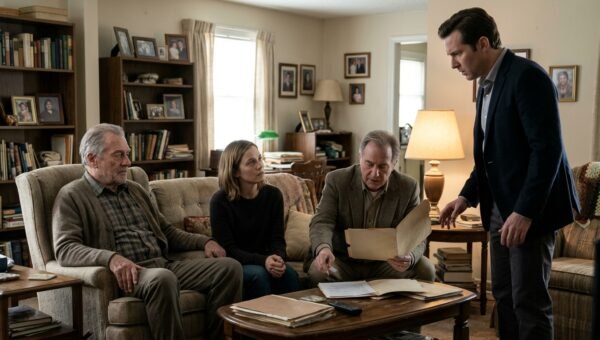
Then a county car pulled up by the gate. A woman got out carrying a thick folder and introduced herself as Ms. Alvarez from the county records office. She explained that Mateo had arranged for her to bring the final deed papers and bilingual verification to his birthday. Nobody reached for the cake after that.
Grandpa wiped his fingers on a napkin and stood up. “Let her read it,” he said. He looked right at me. My cousins had stopped smiling, but I could feel them watching me all the same.
Ms. Alvarez handed me the folder. There was an official seal on the first page, plus a registry number printed near the bottom. This wasn’t a tax notice or some form Grandpa needed help filling out. I turned the page and saw my name at the top.
For a second I couldn’t take in the words below it. I knew how to say them out loud, but this was legal language, and there were people at my shoulder waiting to see whether I’d mess it up. I could have passed the papers to Ms. Alvarez and stepped away. Instead, I held them tighter.
“Can you translate the instructions?” Ms. Alvarez asked. I nodded. My mouth felt dry, so I took a drink of water and started with the first page. It described the house, the lot, and the transfer of title from Mateo to me. The second page explained that Grandpa would keep the right to live in his home for the rest of his life.
“The first page is the house,” I said. “The second page has my name.” My voice came out steadier than I felt. Elena leaned toward the papers, and I saw her eyes stop on the line where the transfer was described.
“Why did you wait until today?” she asked Grandpa. She wasn’t shouting. That almost made it worse. “You could’ve told me. We’ve been talking about the house for months.”
“Talking about it with me?” he asked.
Elena opened her mouth, then closed it. Ms. Alvarez explained that Mateo had made the arrangements six months earlier. The documents showed he’d received independent legal guidance and had gone through the terms in both languages. There was a bilingual affidavit attached. The county had already recorded the transfer, pending the final in-person signing and verification.
Elena reached for the packet. “This is too much to do at a birthday party. He’s ninety. Maybe he doesn’t understand what he signed.”
My hand moved before I thought it through. I pulled the papers back. “He understands. Let him answer.” I wasn’t proud of how sharp I sounded, but I didn’t take it back.
Ms. Alvarez asked Grandpa in Spanish if he understood the deed, the life estate, and the preservation rules. I knew enough by then to follow every word. He answered her clearly, then looked at me and told me to translate it exactly. I did. His voice didn’t shake once.
The preservation covenants took longer. The house couldn’t be torn down or sold to a developer. It had to stay protected, and the family had to be allowed to use it as a family home under the terms he’d set. I read each part slowly. This time no one interrupted.
My cousin Nico shifted his weight. “So nobody can sell it?” he asked.
“Not for a quick payout,” Ms. Alvarez said. She explained that the recorded restrictions would follow the property. The rules weren’t a promise we could ignore when Mateo died. They were part of the deed.
Elena turned to him. “You’ve known we were looking at places. I was trying to make sure you were safe.”
“I know,” he said. “You wanted the house settled.”
“I wanted a plan.”
“You had a plan for the house.” He paused. “You didn’t ask what I planned.”
His words weren’t loud, and he didn’t make a speech. That was Mateo. He could make a sentence last longer by not adding another one. Elena looked down at the grass. I remembered the way she used to bring him soup when he was sick, and how he’d complain that she’d put too much pepper in it. She loved him. She also wanted his choices to fit inside the plan she’d already made.
Ms. Alvarez pointed to the final verification section. Grandpa had to confirm his intent in front of the witnesses, and I had to translate his answer. He looked at all of us, then spoke first in English.
“I picked my birthday because everyone came,” he said. Then he repeated it in Spanish, looking straight at Elena. I translated both sentences. “I wanted witnesses. I wanted nobody saying later I was confused, or that I didn’t know what I was doing.”
Elena’s chin trembled once. “You could’ve told me.”
“I did tell you what I wanted. You heard what you wanted.”
That was the point where I saw what the whole morning had been set up to do. He wasn’t trying to embarrass his daughter. He’d made the decision months ago, with legal help, while he was clear about every part of it. But he’d waited until his ninetieth birthday because he wanted the family to hear him for once. Not through Elena. Not through me. Him.
Ms. Alvarez checked each signature and asked him to confirm the transfer one more time. Grandpa did. I translated. The county representative signed the verification, stamped the final copy, and explained that the recorded deed made me the legal owner, with Mateo holding his life estate. The covenants were attached. There was no quiet meeting later where somebody could say he’d been tricked.
Then came the harder part. I had to say whether I accepted the responsibility under the terms. I looked at my name on the page. I thought of my cramped apartment, the bills I worried about, and the money the house might bring if it were sold. I won’t pretend the thought of owning property didn’t get to me. It did.
But this wasn’t a free house. Grandpa would live there. The rules were clear. The place had to remain a home, not a payout. I’d spent three years trying to hear him. It would have been a strange time to decide the words didn’t matter.
“I accept,” I said. Then I translated the same answer into Spanish. Grandpa nodded once.
Elena didn’t argue again. She asked Ms. Alvarez for a copy, and the county representative gave her one. My cousins didn’t make another joke about my phrasebook. Nico stared at the grass for a while, and Leo quietly helped carry the plates inside.
The party kept going, though it changed shape. Grandpa sat in his usual chair while Elena put his birthday cake on a plate. She didn’t say she agreed with him, and he didn’t ask her to. They were both still there. For that day, it was enough.
Later, after people had started leaving, I found Grandpa by the sideboard. The county folder rested beside his old rotary phone. I touched the edge of the folder and told him I’d keep the house open for the family, as long as everyone treated it like a home and not a prize.
He answered in Spanish. I understood him without reaching for my notebook. “That’s all I wanted,” he said. I poured two small drinks, and we took them out to the porch. He lifted his glass to mine.
The folder stayed beside the phone. Grandpa stayed in his house. And on the porch, he spoke to me in the language I’d learned to make him laugh.