At 11:57 p.m., one of the nurses asked if I wanted the last half cup of coffee. I said no, because I could taste the burnt pot from three feet away. Three minutes later, Emma called me from the curb outside my house.
I’d just finished a long ER shift at the hospital in our county seat. My feet hurt, and my scrub top had a small spot of iodine near the pocket.
I almost let the call go to voicemail because I thought Emma might be asking for a ride from a friend’s house. Then I heard her trying to breathe without crying.
“Mom, Grandpa put my stuff outside.”
I was in the staff lot with my keys in my hand. “Where are you?”
“On the curb. It’s raining. Dad’s here.”
I asked if Curtis had said anything. Emma went quiet for a second.
“He just stood there.”
I drove home without stopping for coffee or changing out of my scrubs. It was a little under twenty minutes, depending on the lights. I kept asking Emma to stay on the phone with me, mostly so I could hear she was still there. She kept saying she was fine, which is what she says when she wants to make something easier for me.
The rain was steady, not heavy. The kind that makes the road shine and gets into the cuffs of your pants when you step out.
I remember thinking I needed to wash my hair before bed. I don’t know why that’s what my mind grabbed. Maybe I was trying to keep the night ordinary for one more minute.
When I turned onto our road, I saw a pile of clothes near the porch steps. Emma’s backpack was on its side. Her math book lay open on the wet boards, pages curling at the corners.
I pulled up and left the engine running. Emma was sitting on the curb in her sweatshirt, arms crossed tight over her chest. I opened the passenger door and she got in without saying anything. Her hands were cold. I rubbed them between mine, then noticed the porch light and the people inside.
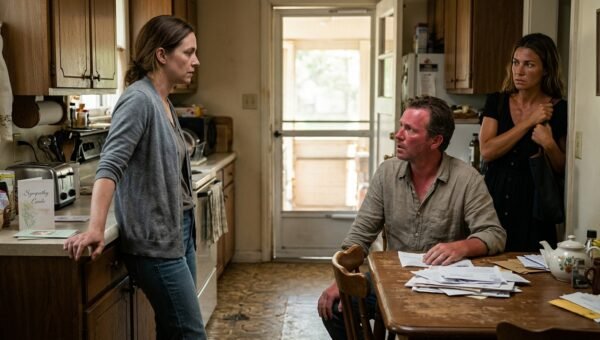
My father-in-law, Gerald, stood under the porch roof with his arms folded. Curtis was a few feet behind him, looking at the ground. Through the front window, I could see Gerald’s granddaughter Brynn and two other relatives still gathered around the living room.
One of them laughed at something. That sound carried right through the glass.
I helped Emma into the car and told her to stay there. She grabbed my sleeve.
“Don’t leave me out here.”
“I won’t,” I said. “I’m right there.”
I walked up the steps. Gerald didn’t move to let me pass.
“We make the rules in this house,” he said.
I looked past him at Curtis. He rubbed his palm on his jeans and still didn’t meet my eyes.
“What happened?”
Gerald answered before Curtis could. “Emma was rude to Brynn. She needs to learn she can’t take over a room just because she thinks she deserves it.”
Emma had been in that room since she was eleven. It was the smallest bedroom, with a slanted closet door that stuck in damp weather. She did her homework at a little desk I’d bought secondhand and fixed with a screwdriver.
None of that had seemed to matter to Gerald once Brynn arrived.
“She’s sixteen,” I said.
“She can sleep at a friend’s house,” Gerald said. “Brynn needs the room.”
I looked at Curtis again. I was giving him a chance. I knew it while I was doing it. He could have said, “Dad, stop.” He could have brought Emma inside. He could have said anything.
Instead, he said, “Let’s not do this right now.”
That was the whole thing. My daughter outside in the rain, and he wanted me not to do it right now.
I went back to the car and opened the passenger door. Emma’s backpack had soaked through on one side. I moved it to the back seat and wrapped my coat around her shoulders. She stared down at her wet sleeves.
“Did Grandpa say I had to leave?”
“He said you needed to go,” I said. “That’s not the same thing.”
“I was doing homework. Brynn said she wanted my room, and Grandpa told me I was selfish.”
Emma had been working hard at school. She had a B in algebra after pulling it up from a C, and she was proud of that. She had also spent the last month helping me with laundry because I’d picked up extra shifts. I didn’t tell Gerald any of that. I was done trying to prove my kid deserved a bedroom.
The house had been mine before Curtis and I got married. I bought it with the money I inherited from my parents, and I kept the deed in my name. I had made that choice because I’d watched money become a sore spot in my parents’ marriage, and I wanted one thing settled and clear. Curtis knew. Gerald knew I’d bought it, though I don’t think he’d ever bothered to ask how.
Over the years, that fact got treated like a piece of old paperwork. Curtis paid some bills, and I paid more. Gerald moved in after a rough patch and said it would be for a few months. Brynn came to stay with him later, after her mother needed time to get back on her feet. I didn’t mind helping at first. I’m not proud of how long I let “temporary” stretch.
But the little things kept adding up. Gerald started telling Emma to keep the kitchen quiet when Brynn was sleeping, even when Emma had homework to do. Curtis stopped correcting him because it was easier to say, “You know how Dad is.” Brynn got the bigger room when she came to stay, and Emma moved her things into the smaller one without making a fuss.
I told myself we were keeping the peace. Mostly, I didn’t want another fight after work. That sounds small, but it’s true.
That night, I walked past Gerald and went inside. I didn’t shout. I didn’t want Emma hearing me trade insults with her grandfather through an open door. I went straight to the kitchen, set my work bag on a chair, and pulled out the folder where I kept the house papers.
I had brought the folder home from the bank that week because I was sorting through some old documents. The deed was inside, along with the purchase papers. I hadn’t planned to use them. I’d never thought I would need to prove I owned my own house to people living in it.
Gerald followed me into the kitchen. Curtis came in behind him. Brynn stayed near the living room doorway, arms folded, watching. The other relatives went quiet.
“What are you doing?” Gerald asked.
I laid the deed on the table. “Read the first line.”
He gave a short laugh, like I’d brought him a bill he didn’t plan to pay. Then he leaned over the paper. I watched his eyes move from the county heading to the owner’s name. His mouth tightened.
“This doesn’t mean anything,” he said.
“It means the house is mine.”
Curtis finally looked at me. His face had that pinched look he got when he was trying to decide which person to agree with.
“Why are you doing this in front of everybody?” he said.
I looked at the wet mark from Emma’s sleeve on my coat. “Because everybody was here when you put her outside.”
Gerald tapped the paper with one finger. “You’re married to Curtis.”
“I know.”
“This is his home too.”
“It’s my house,” I said. “The deed is in my name. I bought it with my inheritance.”
There was a quiet moment. I could hear water dripping from Emma’s clothes onto the floor by the back door. Nobody moved to clean it up.
Gerald tried to take the paper. I put my hand on it.
“Don’t,” I said.
He stopped. He looked less angry than confused, like the rules he’d been using had suddenly quit working.
I told him everyone had ten minutes to get what they needed and leave. I said it plainly, not because I thought I could erase people’s legal rights with a sentence, but because I wasn’t going to let them stay in the house and keep treating Emma like she could be tossed out whenever Gerald wanted. I was ready to call a lawyer and the sheriff if they refused to go. They had somewhere else to sleep that night, and I wanted them gone.
“Everyone has exactly ten minutes to leave.”
Gerald’s mouth opened, but Curtis started screaming first.
“You can’t throw me out! I live here!”
His voice was so loud that Brynn stepped back from the doorway. Curtis pointed at the deed, then at me, like I’d switched the rules on him.
“You said we were a family,” he yelled.
“I did. I thought that meant you’d protect Emma.”
He kept shouting. He said I was making a scene, that his father hadn’t meant it, that I was tired and wasn’t thinking straight. It was a lot of words that all came down to the same thing: he wanted me to let this pass so he could go back to the way things had been.
I had worked too many night shifts to mistake a person’s panic for an apology. Curtis wasn’t asking if Emma was okay. He was asking if he was going to lose his home.
“I can’t believe you’d do this to me,” he said.
I looked at the man who had watched our daughter sit outside in the rain and let his father tell her she had to go. “You did it to her first.”
Gerald tried a different tack. “You’re going to break up this family over a bedroom?”
“No,” I said. “You did that when you put a child outside.”
He said it had only been a few minutes. Curtis said Emma could come back in now. Brynn said she never asked for this. Maybe she hadn’t. I didn’t know what Gerald had told her, and I wasn’t going to make her the main problem. She was a kid too. But she was dry inside while Emma’s schoolbook sat in the rain.
I went to the front door and opened it. “The ten minutes started when I said it.”
That got them moving.
Gerald went upstairs to get his overnight bag. Brynn gathered a jacket and a phone charger. The relatives started asking who was driving and whether they could come back for the rest in the morning. I said they could contact me about a time to pick up their things. Nobody argued about the deed again.
Curtis stayed in the kitchen. His voice dropped, which was almost worse.
“Where am I supposed to go?”
I could have said I didn’t know. Instead I said, “Your brother’s, or wherever you decide.”
“After all these years?”
I thought of Emma’s wet backpack and the way she’d asked me not to leave her alone in the car. “You stood there.”
He sat down and covered his face with both hands. I didn’t comfort him. I’m not saying that to make myself sound strong. I just didn’t have it in me to comfort him after he’d let our daughter think nobody in that house was on her side.
At the nine-minute mark, Gerald came back downstairs carrying a bag. He didn’t look at me. He did stop in front of Emma’s math book, which I had brought inside. He picked it up by the dry edge and set it on the counter.
Curtis packed a duffel and left with his father. He said he’d call in the morning. I said he could contact me through a lawyer. I had no interest in sorting out our marriage at one in the morning, and I wasn’t going to pretend it was fine just because he’d gone quiet again.
The front door shut behind them. I locked it and checked the latch. My hands were shaking enough that I had to try twice.
I knew the deed gave me ownership. It didn’t make every next step simple, and it didn’t settle the divorce. I spoke to a lawyer the next morning about the house and the people who had been staying there. I started the formal separation process that week. Gerald and Brynn collected the rest of their things by arrangement. Curtis stayed with his brother.
The house was quiet after they left, but I didn’t feel peaceful right away. I kept listening for the door. Emma sat on the living room couch in my spare sweatshirt, holding a mug of tea with both hands. I wrapped a blanket around her shoulders and tucked it under her feet.
She leaned against me. I could feel the damp ends of her hair against my arm.
“I thought Dad would say something,” she said.
“I know.”
“I thought he’d come outside.”
I didn’t have a good answer. I still don’t. I could tell her I was sorry, and I did. I could tell her she had a place in that house, and she did. But I couldn’t make Curtis have been the father she needed that night.
I pulled the blanket closer around her and listened to the deadbolt click from the inside.