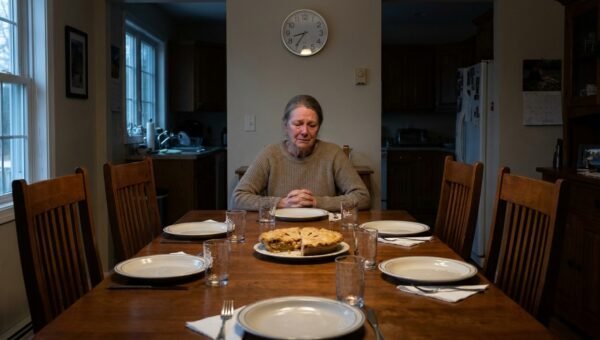
The blue suitcase was wedged behind Mom’s furnace, where you had to crouch to reach it. At four in the morning, I’d been trying to get comfortable on her living-room couch when she tapped my shoulder and asked if I’d seen it. It was my second overnight stay that week, and she looked more upset than sleepy.
“I put it by my closet,” she said. “David keeps saying I’m confused.”
I didn’t know what to say. My brother had been telling me for two months that Mom needed memory care before she became a danger to herself.
I thought he was pushing too fast, so I’d started staying over twice a week to see how she was doing when nobody was asking her questions or watching her eat.
The next morning, I found the suitcase behind the furnace. It had a few clothes, Mom’s passport, and a photograph of a small house near a lake. I was still holding that picture when David came in through the back door and asked why I’d gone into the basement.
He was already looking past me at the suitcase.
I said I’d heard Mom asking for it and wanted to check whether she’d left it downstairs. That was true, but it wasn’t the whole truth. I slid the photograph into my cardigan pocket before he could get a good look at it.
David rubbed his forehead. He’d been doing that whenever Mom brought up something he didn’t want to discuss. “She’s been wandering,” he said. “This is exactly why I’m worried.”
That word bothered me. Wandering. Mom had asked for a suitcase she knew she’d packed. She’d asked where it was because it was missing. I still didn’t know what the house in the photograph had to do with anything, but I knew David wanted the subject changed.
“I’ll talk to her,” I said.
“You can’t keep treating this like it’s a bad week.”
He wasn’t wrong about everything. Mom had forgotten a grocery list and once left a pot of oatmeal on the stove until it stuck. She’d also forgotten my dentist appointment, which she’d written on the calendar herself. I didn’t like admitting that. I was afraid of missing a real warning sign because I wanted her to be fine.
But David had started using every small mistake as proof. I’d ask Mom whether she’d eaten lunch, and he’d tell me she’d asked the same thing three times. I wasn’t there to know if he was right. That was why I’d begun sleeping over.
I asked him to leave the suitcase where it was. He said he had to take a call and went upstairs. I carried it to the kitchen instead, because I didn’t want him alone with it. The handle made a small click against the basement door, the same sound it made when Mom used to pack for a weekend at Aunt Clara’s.
I could see the blue fabric from the kitchen table. Mom sat down across from me and asked if I’d found it. I said yes, then asked why she’d packed her passport.
She looked at the pocket of my cardigan. I hadn’t realized she’d seen me put the photo there.
“Because I was going to the lake,” she said.
She told me the house in the picture was a cottage she’d bought about forty years ago, before she married Dad. She’d bought it under her maiden name and kept it separate.
She’d never sold it. The house wasn’t a family secret in the exciting sense. It was a place she’d kept for herself, a place she could go when she wanted quiet.
I asked why I’d never heard about it.
“You did,” she said. “When you were little, I took you there once.”
I couldn’t remember that. I remembered the blue suitcase. I remembered Mom setting it on the bed and making me help fold my pajamas. I’d thought she packed that way because she liked being ready.
She told me David had found the suitcase by her closet three days earlier. He’d asked where she was going, and she’d told him. He’d said she was getting mixed up, then moved the case. Each time she asked after it, he said she’d already asked and that she was wandering again.
“I didn’t want to fight with him,” she said. “I wanted to get out of the house.”
I wanted to be angry at David right then. I was. But I also knew Mom could get stubborn, and I’d seen her tell us she was fine when she wasn’t. So I asked if she’d packed because she planned to leave that morning without telling anyone.
She looked down at her hands. “I thought I might.”
That answer made it harder. I didn’t want her driving off alone if she was confused. I also didn’t want to help David turn her fear into a reason to take away her choices.
I took the envelope from the suitcase’s inside zipper pocket. It held an original deed and a tax assessment in Mom’s maiden name. I hadn’t even known she had a maiden name on legal papers. The cottage belonged to her alone, and the assessment showed it had no mortgage.
Mom said she’d been thinking about giving it to a family trust or selling it, but she wanted to decide herself. She’d talked to a lawyer once, years ago. David had heard her mention the place recently and started pressing her to sign over more control of her money.
I asked if she had proof he was trying to take control.
She said he’d brought her papers for power of attorney and told her it was just a formality. She’d refused to sign. She thought the memory-care plan came after that.
I felt foolish for not asking sooner. I’d let David set the terms of the conversation. I’d asked whether Mom needed help, but not whether she felt safe with him making the decisions.
“Don’t give him the deed,” she said.
“I won’t.”
David came back into the kitchen while I was holding the envelope. He saw it and stopped. I asked him why he’d hidden the suitcase.
“I didn’t hide it,” he said. “I moved it so she wouldn’t leave in the middle of the night.”
Mom leaned forward. “You told me I was confused when I asked for it.”
He looked at her, then at me. “You have been confused.”
“I can be forgetful and still know where I’m going,” Mom said.
He didn’t answer that. Instead he said the cottage was a long drive, the house needed upkeep, and Mom had no business being alone there. Some of that was fair. It wasn’t right to pretend the whole thing was about her safety when he’d also kept the suitcase from her.
He said the memory-care place had a room ready and we had to act before Mom hurt herself. He’d told me the facility would cost $8,400 a month. He’d also said the doctor agreed she needed it. I asked him which doctor.
He named Mom’s longtime primary care doctor, Dr. Patel. I knew Dr. Patel had not recommended locked memory care. David said she’d only seen Mom briefly and didn’t understand how bad things had become.
So I called the office myself. I didn’t want to go behind David’s back, but I needed more than his version. Dr. Patel set up a full assessment for the following week. I took Mom. David wanted to come, but Mom asked me to go alone with her, so I did.
The appointment took longer than I expected. Dr. Patel asked Mom about her health, her daily routine, and the things she’d forgotten. She gave her a series of questions and tasks. Mom got one date wrong and couldn’t name a word Dr. Patel had just used, then got through the rest without trouble.
Dr. Patel told us the results were normal for Mom’s age. She had some ordinary forgetfulness, but there was no sign she needed locked memory care. She needed help with a few tasks and someone to check in. Dr. Patel said that stress and isolation could make her seem more mixed up than she was.
I asked whether Mom was safe at home.
“With support, yes,” Dr. Patel said.
I wrote that down. I took notes because I know how easy it is for family members to hear what they expect. I wanted the facts on paper.
When we got home, David’s car was in the driveway. He had left a folder on the passenger seat, and I saw his conservatorship papers when he opened the door. I didn’t take them. I asked him to bring the folder inside and put it on the kitchen table.
He said it was a draft. It gave him the right to make decisions and manage Mom’s assets if she couldn’t. The papers included authority to sell property. He said he was trying to protect her, and I believed he might have believed that at first. He was scared she’d fall, and scared of being blamed if she did.
But a draft asking for control over all her assets was not just a plan for safety.
I put the doctor’s assessment beside the cottage deed. David kept one hand on the back of his chair. Mom sat with her fingers folded on the table, watching him. I could hear the refrigerator kick on.
“You told me the doctor recommended memory care,” I said.
“She said Mom needs more help.”
“She said home care.”
“She didn’t see what I see.”
I understood the fear underneath that. David lived closer than I did. He’d been handling Mom’s bills and appointments. Maybe he thought if he could get everything organized, he could stop the next bad thing from happening. But he’d crossed a line, and he’d used Mom’s small mistakes to make her doubt herself.
Mom looked right at him. “I’m not going to memory care.”
He started to speak. She raised a hand.
“No. I’m staying here, and I’m going to the cottage this summer.”
David said the cottage was too much for her. I said Dr. Patel had cleared Mom for home with help, and we’d arrange a visiting nurse twice a week. I told him I wasn’t agreeing to a facility transfer or letting him make those choices alone.
He said I was turning this into a fight.
“I’m not signing those papers,” I said. “And you can’t sign for her.”
The application for memory care was cancelled. David withdrew his placement petition after I sent him Dr. Patel’s assessment and a copy of the deed. We put a written plan in place for the home-care visits, bills, and appointments. I would help Mom with the practical things, but she would make her own decisions. David didn’t get sole oversight.
The change between us wasn’t loud. He stopped calling me every day. I stopped trusting his summaries. We could still sit at the same table, but it was formal now, like we were both checking the words before saying them.
The visiting nurse came twice a week. Mom kept her doctor’s appointments and her keys. She planned a summer trip to the cottage, and I told her I’d go with her. She said she didn’t need me hovering the whole time. I said I knew that, and I’d try not to.
A few days later, I put the blue suitcase back on her bed. It was open in the sunlight. Mom packed two dresses, her passport, and a paperback with a cracked spine. She set the cottage photograph on top.
This time, nobody hid it.